Category Archives: creativity

He makes us stitch and sing.

I have an assortment of things to share, which I beliP1100820 Ps 23 hanging by Geve all flow from people’s creative impulses. So I’ll make that my theme.

When I was sorting and sifting with Kate I found some crafty things I did when money was tight. If you make presents for your parents you might inherit those same things after a while.

This was the case with wall-hangings I made 40 years ago, which came back a few years ago, but then got buried again until last month. This one speaks to me now, so I hung it over a knob near where I am typing at the moment. The scraps of fabric I used remind me of dresses I made for myself in high school and college.


P1100628

Another sort of scrap art is this large design in cloth that I found last month on the wall of a hospital corridor, when I was walking up and down with a post-surgical patient. That hospital has really nice art on the walls, and I kept thinking I should go on a picture-taking tour, but I didn’t. A close-up of this one shows the close quilting.

P1100629

I have to cregum art pastoraledit Chel at Sweetbriar Dreams for introducing me to Ben Wilson via her blog. This man paints miniature works of art on chewing gum that has been rudely and antisocially discarded on the streets of London. Igum art isle of wight liked this BBC video about him.

The art at right includes mention of the Isle of Wight, which reminds me that I didn’t tell you about the birthday party we had for Mr. Glad last month.

gum art bbc w hand

Our small group of friends and family sat around singing to guitars songs such as Dylan’s “Forever Young” and the Beatles’ “When I’m 64,” which gives you a clue as to which birthday my husband celebrated. Ever since then I can’t get that song out of my mind, including the stanza that goes:

Every summer we can rent a cottage in the Isle of Wight
If it’s not too dear.
We shall scrimp and save.
Grandchildren on your knee:
Vera, Chuck & Dave.

P1100900

P1100897crp At least I got a break during church this morning when other music pushed the torture aside. I went with Mr. Glad to his church which was meeting for the first time in a new place, and I took a few pictures of the window shades which I thought much better than a lot of modern church art I’ve seen. I of course prefer icons, but these images feel light and joyful, and are reminiscent of stained glass.

The last one shows the Alpha and Omega, the first and last letters of the Greek alphabet, a reference to Christ from the book of Revelation. He is “The Alpha and the Omega, the beginning and the end.” As all our arts begin with gifts God has given us, may their ends also be for His glory and in His praise.

Every branch He prunes.

I traveled over the hill to the nearby monastery one morning last week and pruned roses for three hours. The sisters who came to this place inherited a big garden next to the river, with many plantings they are learning to manage. Sister Xenia is the chief gardener, and she spends a lot of time on the job, but it’s not the only task she’s assigned, and she appreciates any help outsiders can give.

Frost had to be scraped off my car before I left home. It was still below freezing at that time, and I wore my denim skirt, leggings, work boots and a thick flannel shirt over one of my old turtlenecks. But after I’d arrived and started in with my clippers, it wasn’t long before a springtime breeze began to blow.

So many roses! And most of them are not in a location that is good for roses; they are in the shade too much. Each bush was a big challenge to my skill and art, presenting one or more problems including:

1) Too tall and leggy, with no buds down low that my pruning might channel the lifeblood to.

2) Too many large canes and branches crowding each other, so that I had to thin drastically, after deciding based on uncertain parameters which ones to remove.

3) Bushes growing too close to another type of shrub or tree, as in the case of the one pictured, where a Pittosporum has surrounded one tall rosebush.

4) Growing close to the path or over the sidewalk, catching on the sisters’ habits or poking passersby.

5) Dead wood

It really was a joy to have quiet time to focus completely on a project like this, and I needed every bit of my mental resources and powers of concentration to do the work. Also my imagination, as I tried to envision what effect my cuts would have on each bush in the next months and even years.

Afterward when I was driving home, I began to ask myself why I hadn’t prayed while working, and quickly realized that it had taken all of my attention and creativity to do the task set before me. Is it perhaps a little like restoring a painting that has been severely damaged… a little like designing a building that must be raised on top of living ruins?  I wonder that, having no real knowledge of those types of art.

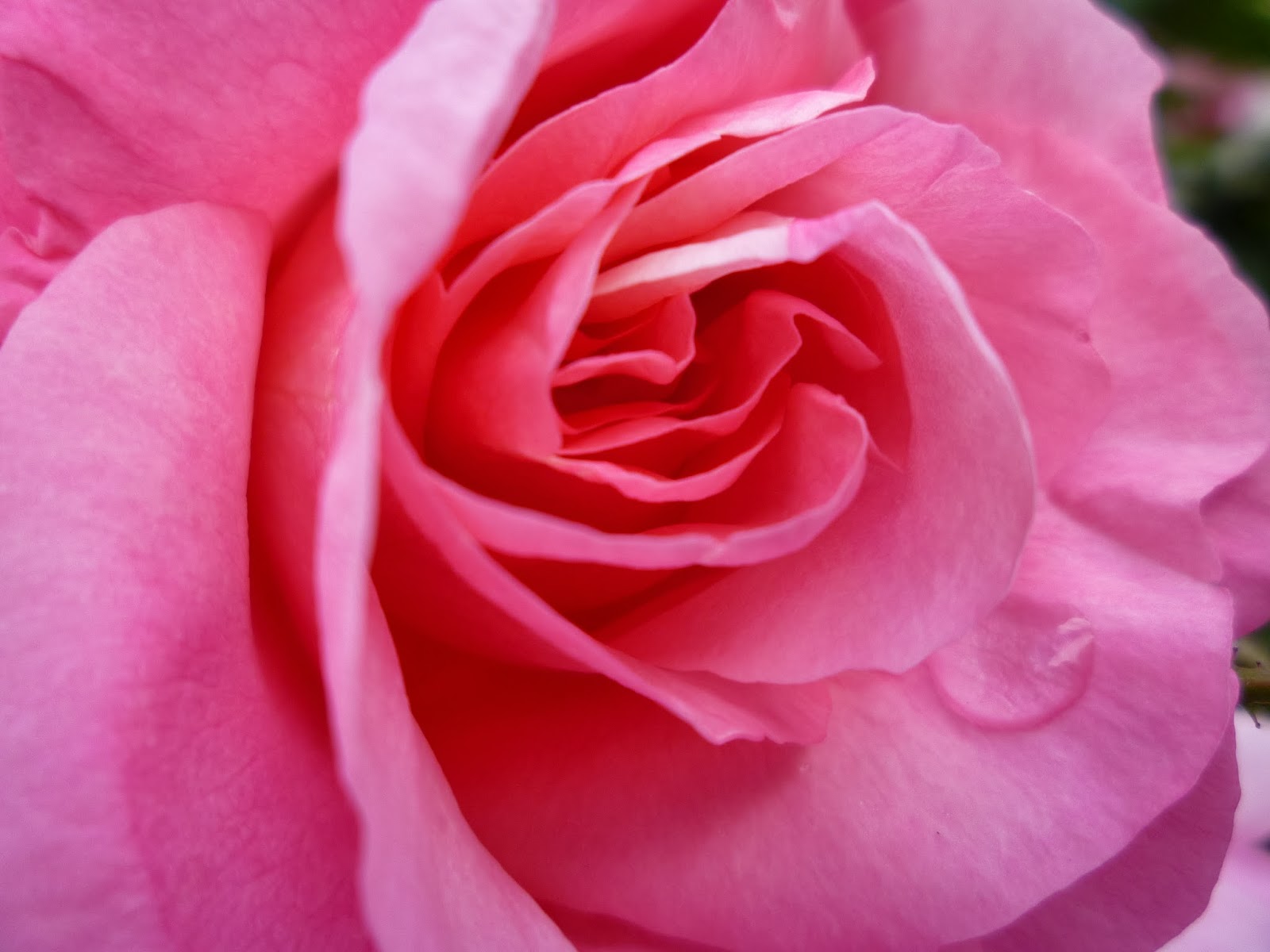
One thing for certain, the glory of this art won’t show until after many weeks the plants produce the actual rose flowers. I have just decided that a visit to the monastery is necessary when that brilliance begins, because I’ve never even seen these bushes in bloom. In the meantime I’m posting some old rose photos from my own parish church grounds, to keep me happily anticipating warmer weather.

At about noon the nuns gather for the 6th Hour prayers, and when the bell rang the announcement I laid down my tools and joined them. There was my chance to pray and soak up the Spirit, and the spirit of the place, and to stand up straight for a while and breathe the incense.

I hadn’t pruned all the roses, but I ate lunch with the sisters and went home anyway, meditating on what made the experience so fatiguing. Does it cause God this much trouble to prune us, as the Bible says he does: “Every branch that bears fruit He prunes, that it may bear more fruit. John 15:2” Does He say to Himself, “I did the best I could, under the circumstances.”? Maybe we grow all out of shape in odd ways, not getting enough of the Sun of Righteousness.
Speaking of sun, it had brought the temperature up to 79 degrees that afternoon. We are all aching for rain here in the West, as we suffer a terrible drought that makes it hard to enjoy those lovely warm rays. The drought is like a dark un-cloud looming behind the sun. Now that I am invested in a few dozen rosebushes, I am a little concerned that some of them might not make it through a water-rationed cycle of seasons to next January when I will try to get back and minister to them.

As we anticipate a possibly very long dry season, my motherly/sisterly feelings are reaching out to the plants and animals, and I’m praying more intently in Divine Liturgy along with the deacon, “For favorable weather, an abundance of the fruits of the earth, and temperate seasons, let us pray to the Lord.”

The Music of My Life

The third chapter of The Hidden Art of Homemaking is the impetus for this post. It is titled simply “Music,” and continues the theme of how Christians might express their creativity in their varied and unique circumstances. I am participating in the discussion of the book on Cindy’s blog, Ordo Amoris. This is a long post and I apologize — you would be smart to skip it and go do something creative!

It might have been 30 years ago that I first read Hidden Art, and I wrote on the day of the author’s death how important it was in developing a vision for my life. At the time of its publication in 1971 I don’t think there was anything else like it, but feminists were writing plenty about the stifling life of the typical housewife. It was lovely to have laid out before me many concrete examples of interesting people and their home-enriching activities.

Just a couple of years later, Karen Mains wrote Open Heart, Open Home, which also contributed to my Christian vision, on the theme of hospitality. And I was married in the early 70’s, and enjoying keeping house and garden even before the children started arriving. When the house began to fill with kids, I never lacked for creative projects and plans.

But I hadn’t even read Schaeffer’s book yet. My young-married-childbearing years were overflowing with culture and creativity, and I could not relate to the reader Edith seemed to be writing for, someone who is frustrated, locked up, or unfulfilled (her words).

Only recently have I been able to look back over my life and see with more understanding (I hope) why the story reads the way it does. I needed time to think, and I needed to see more of the plot toward the end, before I could notice how the first chapters fit with middle parts of my saga.

Part I contained an excess of family drama, as we call it these days, emotional and psychological stress that I didn’t get any help dealing with. If you have a splitting headache it is hard to tap into your creativity. It’s the same with emotional pain, maybe more so when it isn’t diagnosed or even acknowledged, but stays like an always-freshening wound that makes you want to move as little as possible.

Me in Part II

What brought me into Part II was getting married to a good man and empowered to create my own story, free of distracting pain. The setting was calm and clear and full of the hope of the gospel. It was somewhat the opposite of what Schaeffer talks about, because being home was my obvious opportunity to do just about anything. I had had no lack of examples and ideas; actually, the hippie era for me segued into a homesteading spirit a la The Mother Earth News. And there were all the creative people I’d known growing up (just about everyone), while I was storing up tinder for my creative fires.

I see that I have mixed a few metaphors here trying to tell my story — or am I writing the score for the symphony that has been playing out? Though this chapter is about music, it seems as good a place as any to bring up what seem to me to be realities on which our artistic life is built. They apply to music, too.

I received little musical training as a child, and I had no career that I had to put on the back burner. But growing up in church was good ear-training, and even in the Girl Scouts and in public school we sang a lot. I was lucky to marry a musician, and by means of his guitar and my singing we filled the house and our children’s ears with music.

We sang in the car, using songbooks I wrote out by hand. We sang around the campfire. We parents sat on the bedroom floor and crooned lullabies to our children every night. And in church I helped the young readers to develop fluency while hymn-singing, running my finger along the page under the words while they looked on. But I don’t know how to read music.

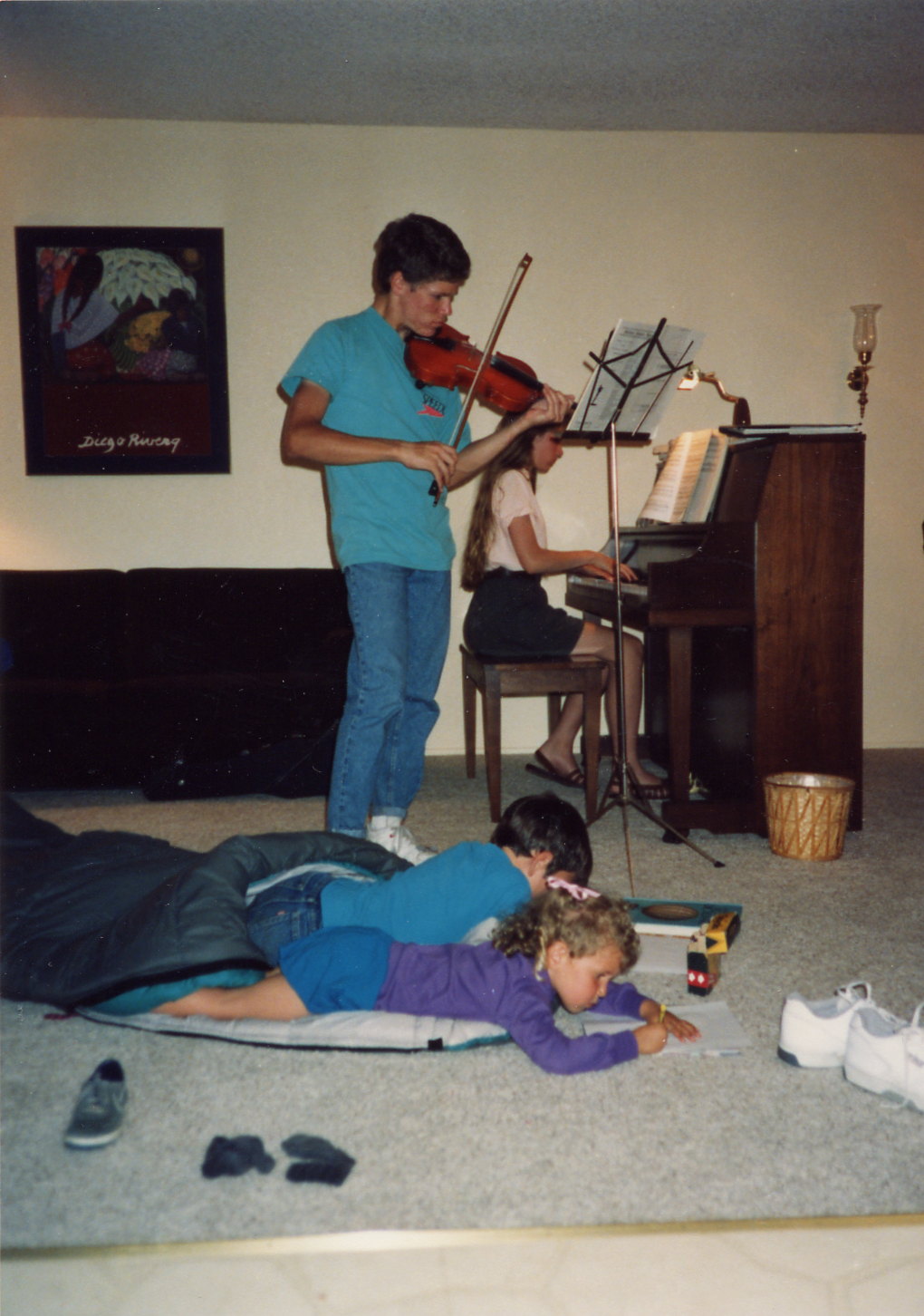
At first there wasn’t money for music lessons, and I wept over the injustice of a world in which my firstborn had no opportunity for a more structured musical education. Then grandparents and great-grandparents stepped in and God provided a generous piano teacher two blocks from our house. From that time forth the provisions continued in various ways, so that eventually all of our five children learned to play at least one instrument. The photos are of them and a grandson enjoying their music. Two of our daughters became piano teachers in their teens.

But for many families, music is not something they can really accomplish. My parents could not provide it for me, but it all worked out o.k. Some women find that their distracting drama only starts when they marry, or when a child falls ill. There are women for whom getting through the day is like climbing a steep mountain, and while they might be relieved to stop and smell the flowers, it’s asking a lot to tell them they ought to get out the seed catalog and develop a plan for further landscaping. But I suppose they aren’t the ones reading Hidden Art.

When Schaeffer says things like, “Christian homes should…be places where there is the greatest variety of good music,” I balk at the word should. I don’t know how she might otherwise have presented a picture of what she considers the ideal home, but every time she says we should do this or that to develop our creative side — and in the short Chapter 2 she used the word nine times — I get annoyed that she is telling me what my Christian duty is.

To me that’s backwards, because I can’t recall ever doing one creative homemaking thing out of a sense of duty, though I firmly believe we are all obligated to do our duty. To fear God and keep His commandments is the whole duty of man, according to Ecclesiastes (Not that we can even accomplish those basics on our own). It seems to me that the rest, the art and music and beauty, flow naturally from a human soul that is nurtured by God’s love — just as sap running up a tree trunk results in bright leaves and colorful fruit. The main thing is not to tell the tree to make fruit, but to keep the connection to the life-giving Fountain — Who is also the One who heals all those diseases of the heart that might hinder us.

What do you know — beauty in our life is one of the healing potions God provides. So if we start with small things that brighten our homes, say, singing a few lines from a hymn over the kitchen sink, or teaching a nursery rhyme to a toddler, just in response to the impulse, we are creating culture and feeding our own souls. It keeps the sap running, and the more the tree grows, the more sap and delicious fruit there will be.

Since Edith Schaeffer wrote this book and What is a Family, the only two of hers that I have read, thousands of families have discovered that homeschooling provides the opportunities to build the kind of family life and culture that the author presents a vision for. Just give us enough time with our children and all these good things are more likely to happen. The vision she sets forth was an ingredient in the soil that nourished my own heart and gave me the courage I needed. All the rest is in Part II, Part III, and still writing… Oh, and still singing new songs!


See and be His art.

The second chapter of The Hidden Art of Homemaking is short, and titled “What is Hidden Art?” I love reading all the many women’s thoughts on this topic, which [used to be found, but not these several years later] on Ordo Armoris where the discussion [was] taking place.

It’s a huge topic! Each human is a living and complex demonstration of creative powers, as is revealed by the uniqueness of each woman’s life as expressed in her contributions to these discussions. The stories, the photos on the Hidden Art Pinterest page, the glimpses into the families whose wives and mothers are taking time to share their creativity online in addition to the never-ending work they do in their homes….it’s all a glory to the Creator.

Obviously, art is hidden as long as you don’t see it. That seems a basic point of this discussion. For me, having children opened my eyes to the world in a new way, because I often thought of my babies as tiny foreigners who were themselves seeing things in this new “country” for the first time. It was fun being the tour guide, and it challenged me to look afresh at my environment.

Sometimes just pointing a camera at some everyday scene helps to reveal a pattern of beauty – or to preserve the art when there isn’t time for a quick sketch. My picture that I titled “Butter Art” so many years ago still makes me happy with its hominess, and it calls to mind the intangible kinds of creativity that I also brought to bear on the task of mothering my children, small “art” projects that took place in the kitchen, or the garden, or — the heart.

I’m still pondering the thoughts of my previous post on this inward kind of creativity, which the author I quoted says “begins with the ability to change — to change intentionally. Creativeness begins with the ability a being has…to become what he is not yet, to start at the point at which he was created and then grow into a fullness that he did not possess before…”

Might this not include the developing in us of the fruits of the Spirit, the love, joy, peace, kindness, longsuffering, etc. that are so essential to making a home? I know that Edith Schaeffer in the book under discussion is primarily dealing with outward, visual or sensory beauty. But what if we could “create” peace by our very presence, or transfer some of our own joy into our children’s hearts?

Mothers naturally do those kinds of things, and often it’s by the attitude they have while they are accomplishing practical works such as laundering the socks, changing them from stiff and smelly to soft and fresh. It all starts with something we are. The artistry of our God is not just something to imitate, but is His active work in us, with which we participate, and by which we become ourselves lights in the world.