Truly, it seemed that I had posted more than enough pictures of mountains and children and drying-up flowers seen on my travels with family. But when the Professor shared one of his own captures of a moment in a place, I said, “Now I will have to write at least one more post about this trip.” You can skip to the end to see it if you are in a hurry.
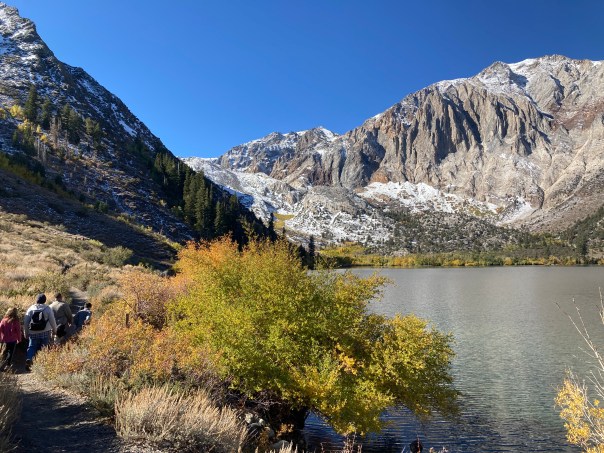
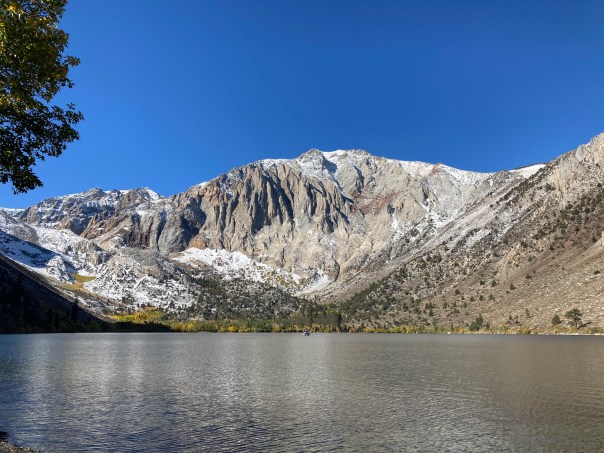
The day after my last post, we went to Convict Lake in the morning:
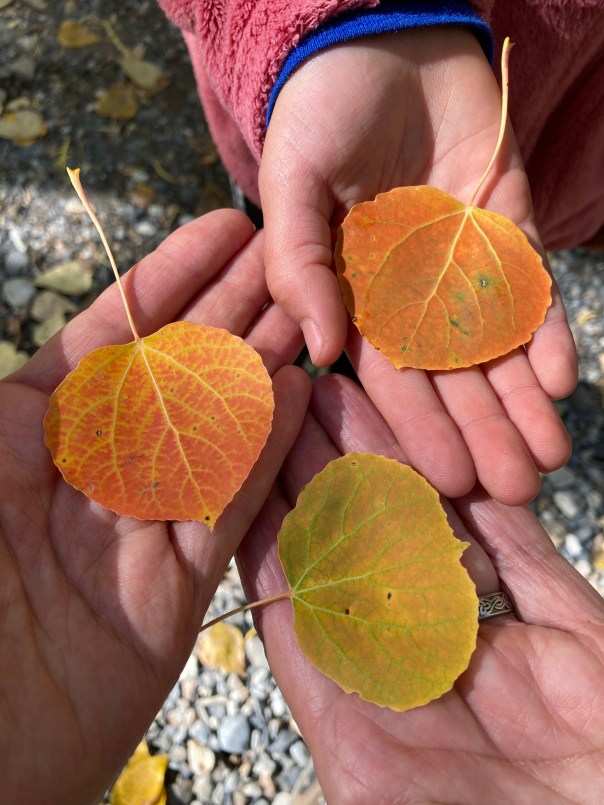
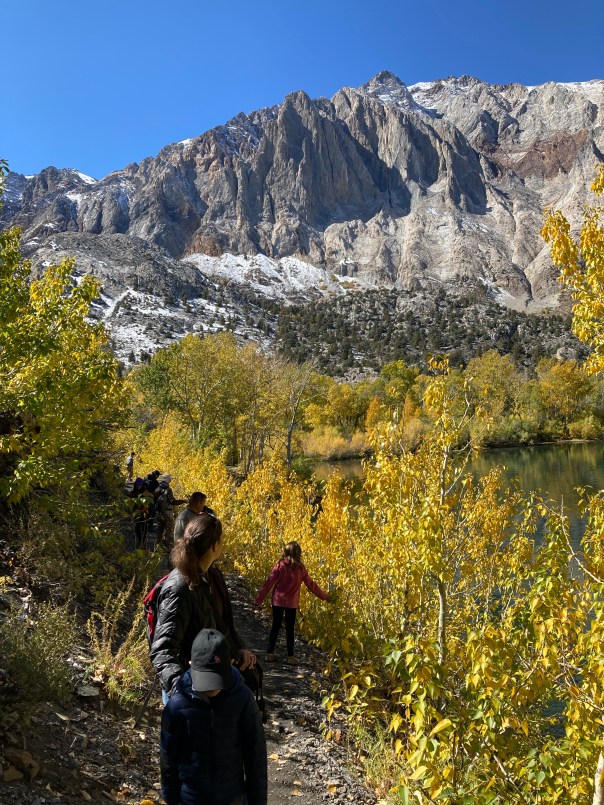
At the end of the lake where Convict Creek comes in, there is The Enchanted Forest, of aspens and cottonwoods.
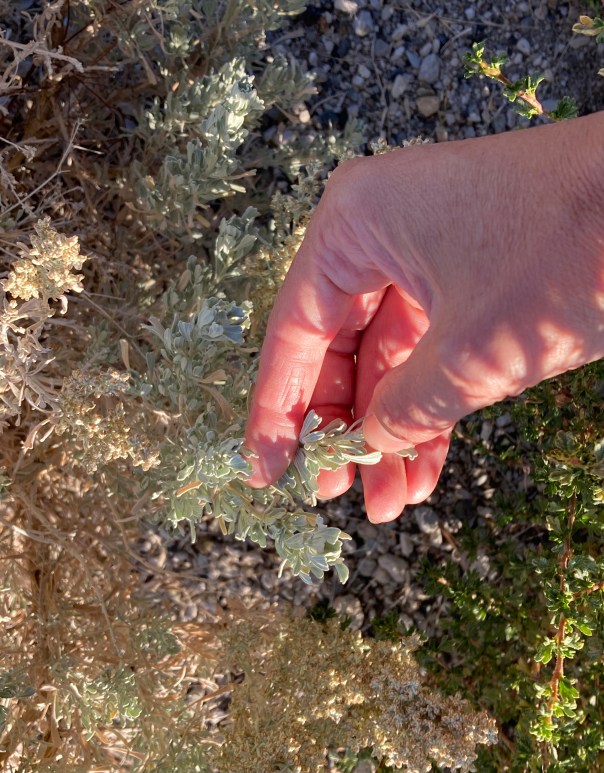
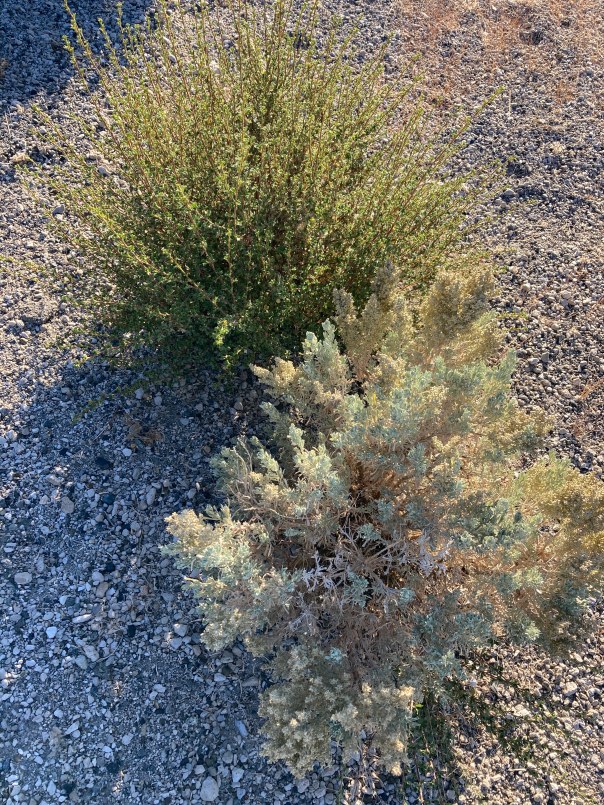
In the afternoon we drove north to Mono Lake, with a brief detour to get closer to the Mono Craters, where some red form of “wild buckwheat” was adding splashes of color to that area. (I don’t have a picture of the craters.) Pippin and I compared Antelope Brush and Common Sagebrush, and found the two growing close together, which was helpful. Sage has softer leaves.
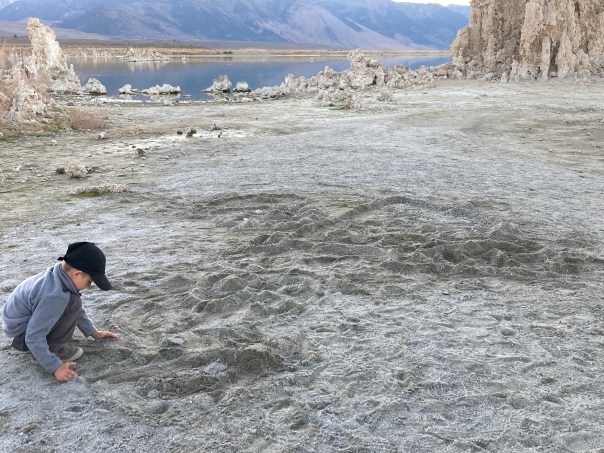
Ivy persuaded me to collect sand out there for my collection, which I will label “Mono Crater Vista.”
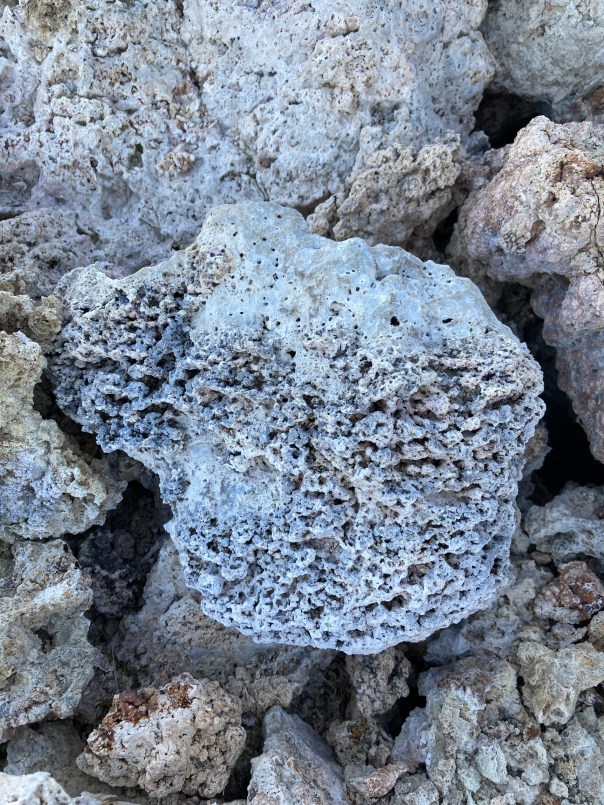
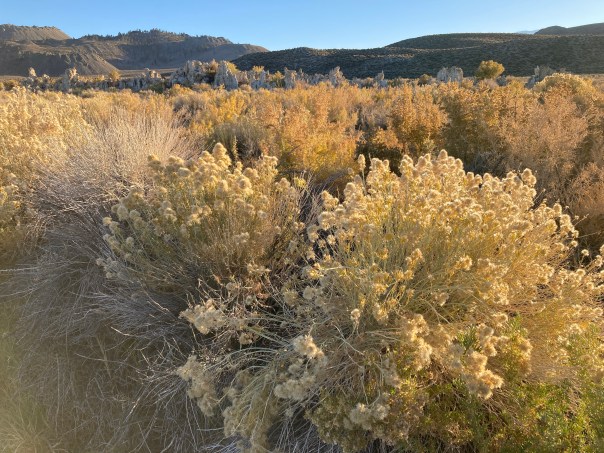
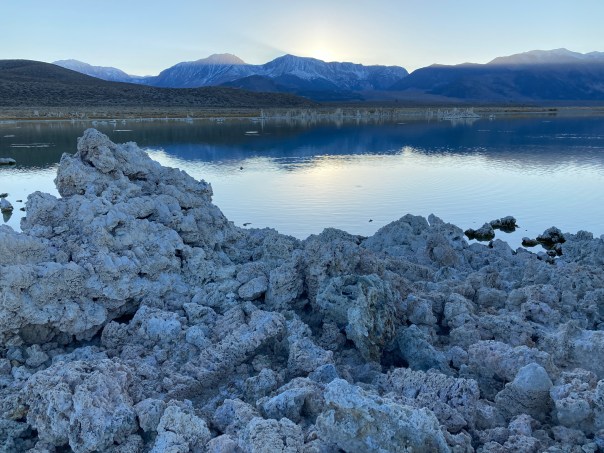
At the lake, we saw the tufa and the beautiful rabbitbrush and sage at dusk:
I’m in a bit of a rush to finish this wrap-up post, before I get home and too busy. It turns out it will not be the last post about my trip after all; I had a great adventure at the end, after I parted ways with the family.
But to return to the Enchanted Forest, the Professor took this picture of my daughter and me, which shows the mood and the glory and the specialness of our time together. To God be the glory and the thanks and the praise for all these people and experiences and beauty. Thank you, Lord.
We arrived in California and settled in our lodging (together) in Mammoth Lakes, on the east side of the Sierra Nevada. The next morning was pretty cold, requiring several layers of clothing as we set off for a hike in the Little Lakes Basin, along Rock Creek and to Marsh Lake. The trailhead was already over 10,000 ft in elevation, which meant that we were enjoying a very high mountain experience with minimal effort.
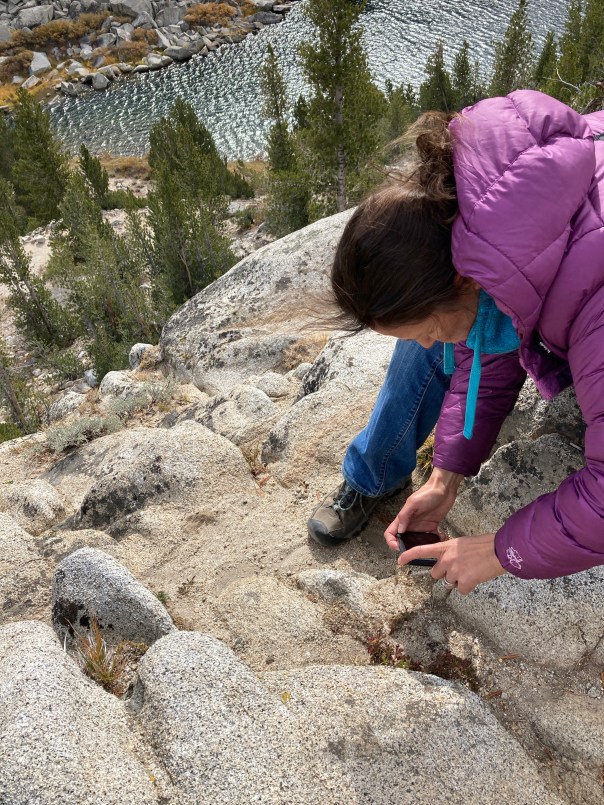
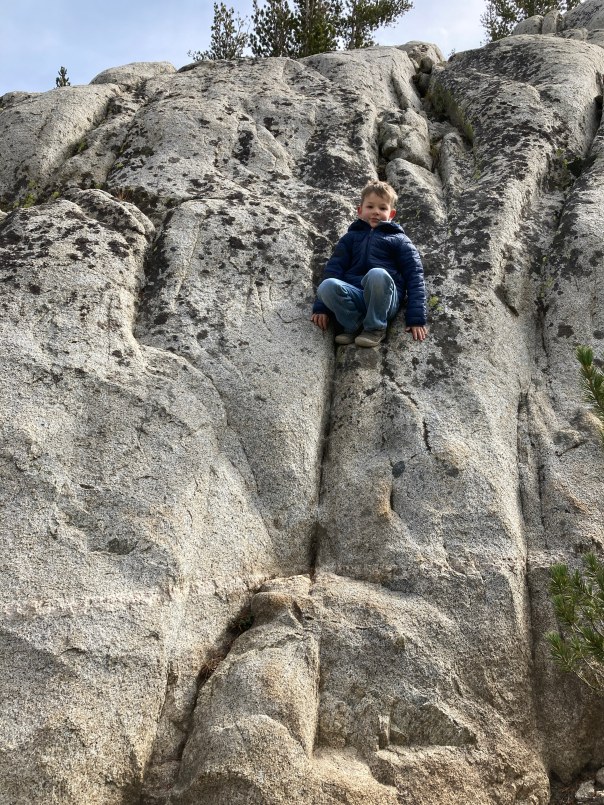
There was ice in several places along Rock Creek, which just made for more fun for Jamie. Three of us reveled in expansive or micro views in our camera viewfinders, and the youngest ones scampered like goats up and down boulders and cliffs.
Purple Mountain Heath
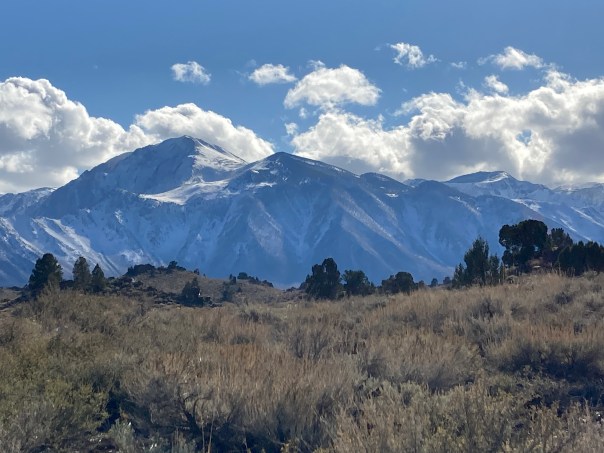
On the western side of the Sierras, you start from the Central Valley, nearly at sea level, and have to climb through foothills and lower ranges before you get to the high elevations. But on the east side, the valley is already at 4,000 feet elevation, and from there the mountains rise up immediately, and startle you.
Me
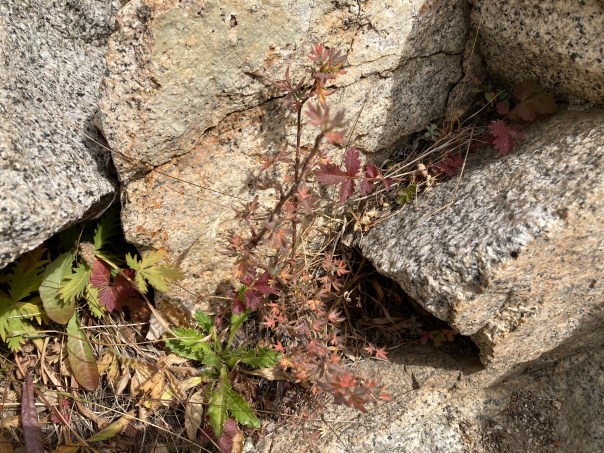
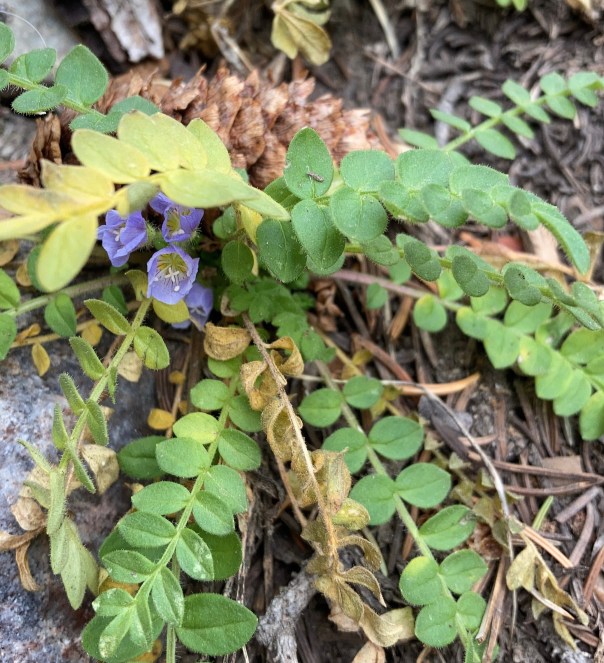
Above, you can see three species of cinquefoil that Pippin and I encountered all along the trail. In this spot they were all in close proximity to one another, though one is ihard to see back there n the shade. They are Slender Cinquefoil, Sticky Cinquefoil, and Shrubby Cinquefoil, not necessarily in that order. I actually gave up on keeping them straight.
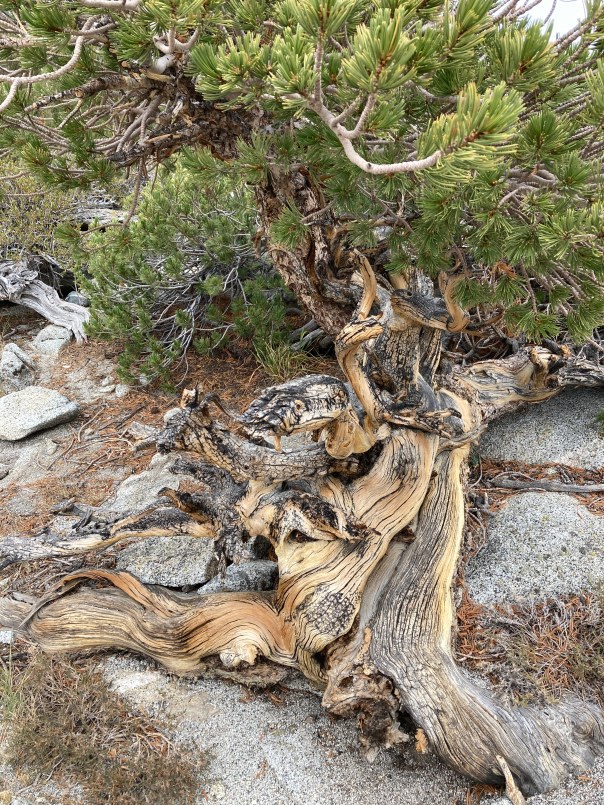
This weathered Whitebark Pine got my attention; the Professor identified it for me:
We had arrived in town just before a snowstorm, we could see it coming on our phones’ weather app, and anticipated having to stay mostly indoors the next morning at least, because we have no snow gear with us.
And that’s how it turned out. While the snow was falling thickly for a few hours, we ate rice pudding for breakfast, built a fire in the woodstove (fires hadn’t been allowed in the campgrounds) and read or did creative projects. I tried sketching one of the images from the day before, in a tiny notebook I had brought, using Jamie’s and Ivy’s colored pencils. Both Jamie and Ivy got into writing stories, picking out the words on my laptop, their first time at a keyboard.
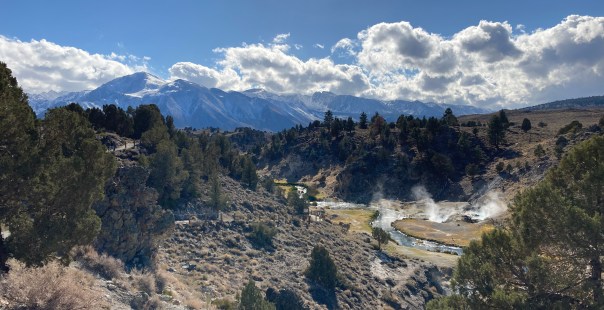
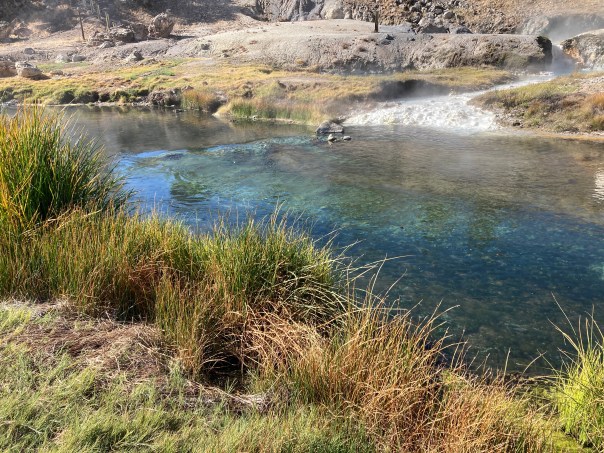
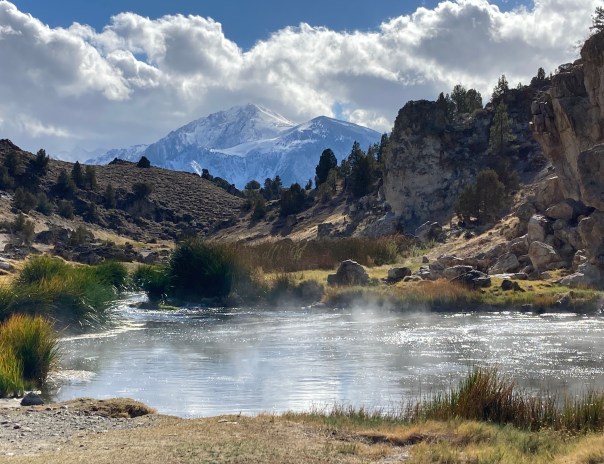
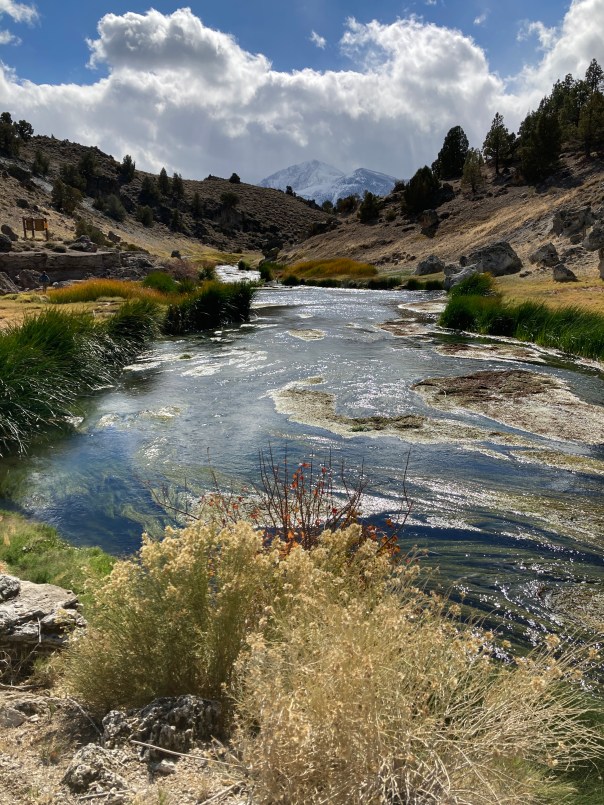
Then the snow stopped, and after lunch we drove to Hot Creek to ramble and explore. This is a place in the lower part of Mammoth Creek where the water spurts from hot springs under the surface of the creek, and its name is changed. We all found so much to look at, and Scout fished.
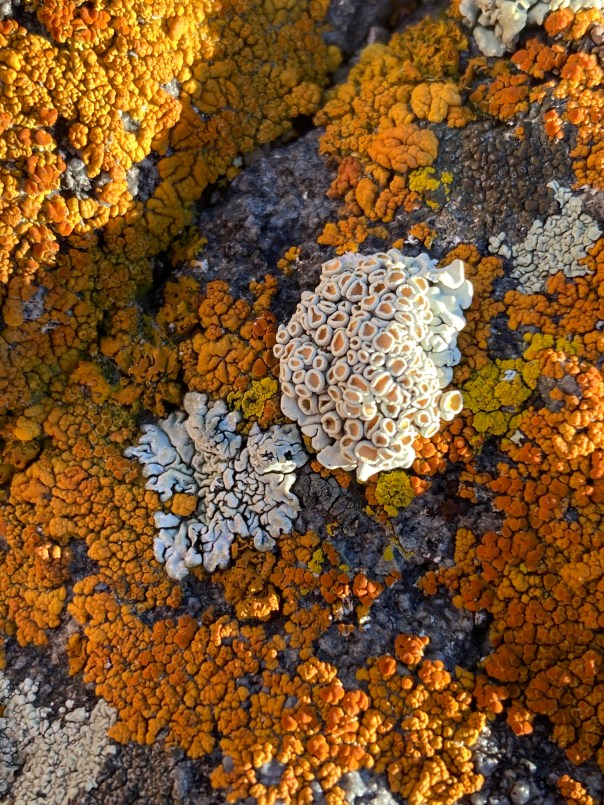
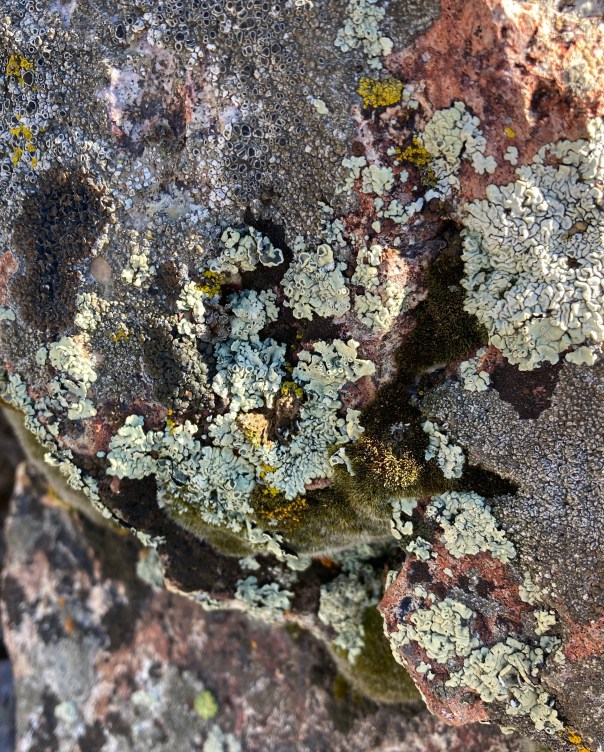
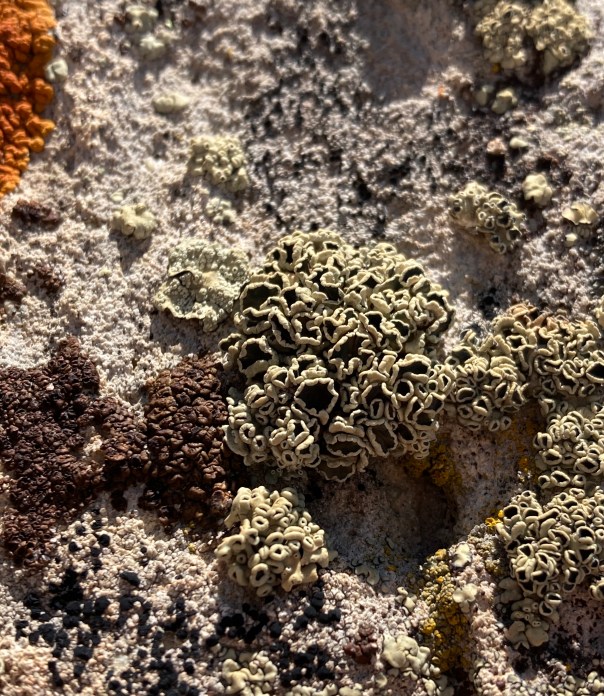
Lots of types of lichens grow on the “moonscape” rocks. Two of my favorites were growing together in this group captured by Pippin:
Elegant Sunburst Lichen with a mound of Orange Rock Posy Lichen
And more:
I was pleased to discover many bushes of ephedra or Mormon Tea growing near the creek.
The green bush is ephedra.
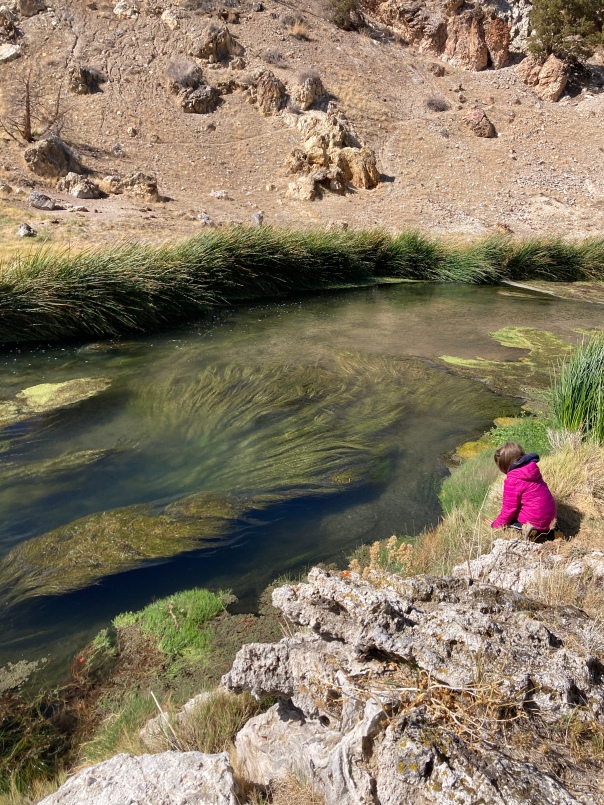
We dipped our fingers in the water in several places, and were surprised that tiny fish were swimming in it, it was so like bath water. In many places along the bank just above you could put your hand in a hole or crack and feel the warm and humid air. The smell of sulfur was strong in places, too.
Ivy had an encounter with nettles. She said with great feeling, “I thought it was lemon balm but it was a baby nettle!” Her mother managed to find some purslane leaves which she reluctantly chewed, and put the poultice on her skin. Either the poultice worked, or the taste of it distracted her; in any case, she was not frowning for long.
When we walked back up out of the creek channel, there the mountains stood, like gods.
Considering these mountains, and all the wonders that have surrounded me in the last week, Isabella Bird well expresses my feeling:
“I have found a dream of beauty at which one might look all one’s life and sigh.”
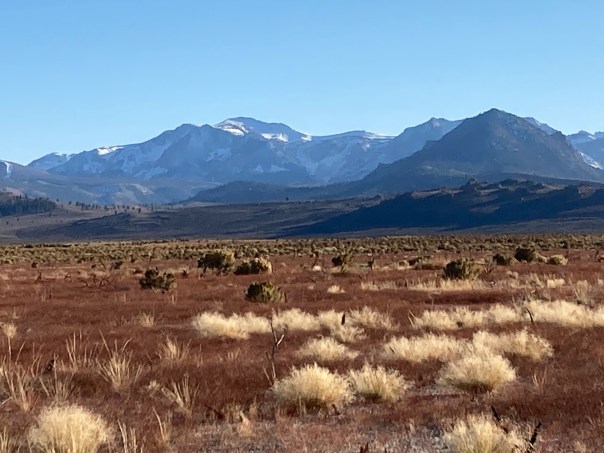
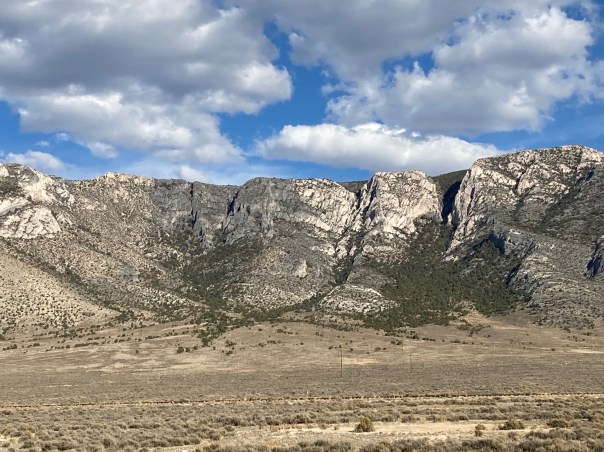
Driving from Baker, Nevada to Mammoth Lakes, California took most of the day, and filled our vision with wide views. Pippin took the picture above showing one fine example.
We stopped within a few minutes to take pictures of clouds. Scout rode with me for a while, long enough to tell me stories of third-century Rome, especially of the tetrarchy of the emperor Diocletian. When we pulled over for car and human fuel Ivy took his place, and for about an hour we didn’t have enough of a mobile signal to listen to a book together, so I asked her to tell me about The Black Stallion, which she read very recently. She is a good storyteller; I think she remembered more details from her first reading than I even noticed the last time I read it.
As soon as possible, we started listening to The Call of the Wild, which she chose from my Audible library. I hadn’t read it since I was just a little older than she is now. We finished the whole book during our drive, and Ivy paid close attention. The next day on the trail, she was composing poems as we hiked, one of them about a husky dog in the northern wilds.
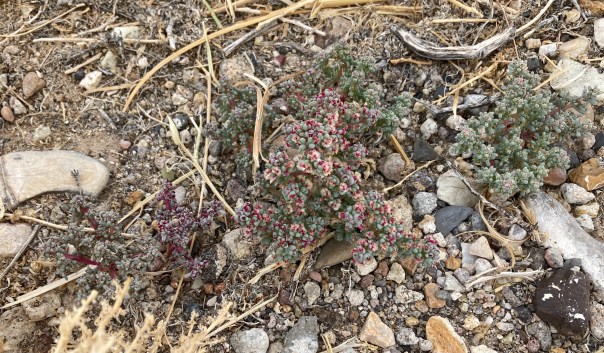
We saw plenty of mountains in the distance as we pushed on toward California, but the plant life seemed thin. Only when we parked our cars along a wide spot in the road in the Stone Cabin Valley did Pippin and I see the truth. Darling and diminutive flowers in a rainbow of pastel colors were scattered all over the gravelly sand.
The Professor was amused at the sight of our happiness in what many would call a “godforsaken place,” as we scanned the ground for just one more version of what the Seek app told us was “Saltlover.” Here is the picture he took of us:
What we learned later when we were able to research it online was surprising and a little sad. This plant Halogeton glomeratus is not a native plant but was introduced from Russia and China; it is a noxious weed of the amaranth family in rangelands of the American West, because of what it does to livestock and to the soil. Grazing sheep are especially vulnerable and can be killed by the high levels of oxalates it contains, and the mineral salts it excretes into the soil make it hard for other plants to survive. Two different species of plants have been introduced that tolerate the salts and might compete under the harsh conditions of that territory. The seeds of Saltlover “have the ability to germinate within one hour after being exposed to water.” That is vigor!
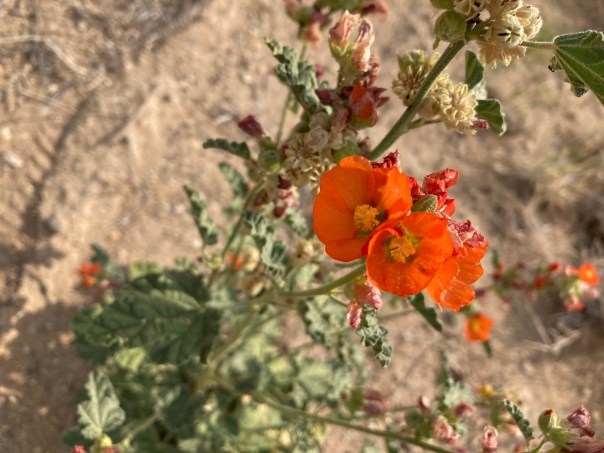
A bright orange flower stood up above these little spires in a few places, the Desert Globe Mallow:
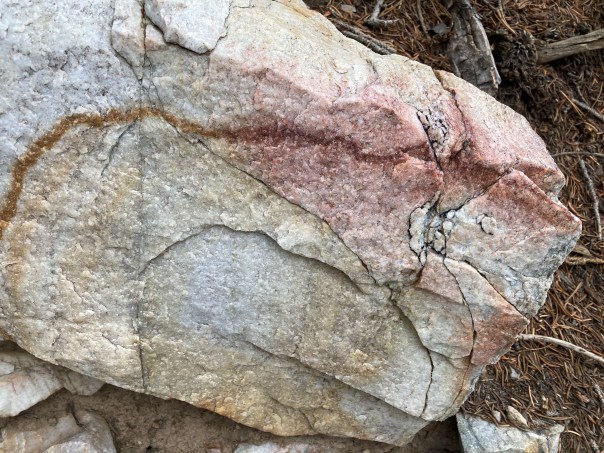
And colorful rocks also caught our eye. I wanted to take this big one home, but after I dislodged it I could see it was too large and heavy:
Not to worry, several other smaller ones were just as brilliant, and before we piled in our cars again and continued on our journey, I had squeezed a few in the back of my Subaru. I told the children that when I die, they should be sure to take these rocks out of my garden and keep them as their own continuing memorials to the time Grandma came along on their mountain and desert explorations.
I took this one last picture from the campground, and shortly afterward we left Lamoille and drove north and east and then south for several hours. The first hour and more were on gravel roads with miles of washboard bumps and billows of dust, but they all passed through spectacular expanses of wild country that shared some qualities of other arid lands, but were different in the shapes and colors of the mountains, and in the varieties of plants. Soon enough these lonely roads took us over the Secret Pass to the eastern side of the Ruby Mountains.
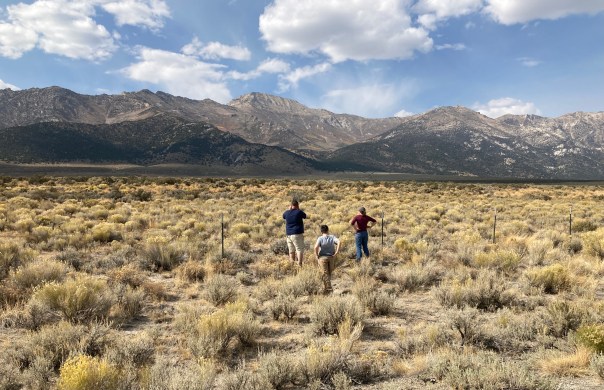
Ivy looked over the barbed wire fence at the view above and said, “It looks like wild horses should be running out there.” We had stopped our cars on the shoulder of the highway, and all six emerged to stretch our legs and look, and take pictures. But immediately Pippin said, “Oooh, the smell of the sagebrush….”
Broom Snakeweed
She had been riding with me, and I’d had the windows closed so we could hear each other talk; the sudden breaking into our senses of the warm and sweet aroma of the deserty plants, with the pungent dominance of Common Sagebrush… that was what I wanted more than any photograph, to put in a bottle and take home with me.
As we were standing there breathing and trying to take in everything, a big pickup appeared and stopped in the middle of the road, and a gray-haired man spoke to us through the window, with his engine running. “Welcome to the Ruby Valley,” he said. He told us that the little valley we were looking up at higher in the mountains, with splashes of yellow aspen, and some other plants turning red and orange, was named Joe Billy Basin, and his brother runs cattle up there.
He himself has a hay and grain business in the valley, and he hospitably invited us to “come back anytime.” We were still talking the next day about the unusual meeting and human warmth we had experienced in those few minutes — a person who loves his place and feels such ownership of it that he can spot a few souls who are kindred enough to be obviously appreciating what he also doesn’t take for granted.
This trip across Nevada might be called a Great Basin journey. The Great Basin is an area of the western United States most often defined hydrologically as in the map below, an area where the waterways do not flow to the ocean. We had now arrived on the other side, the east side of the Ruby Mountains, which, to answer Martha’s question from my last post, are said to be named after the garnets that early explorers found.
The family are camping in Great Basin National Park, and I have been staying 2,000 feet down the mountain in Baker, Nevada. My husband and I came to this place with our children when they were small, and I am thrilled to explore again with one of those children now that she is grown up and camping herself. The campground by Baker Creek has forests of wild roses, now covered with hips, and their leaves turning yellow and orange.
Jamie drew in his nature journal a picture of the rose hips, and a dragon making a meal of them. Ivy and I explored the creek, which runs right by the campsite. I collected sand for my collection in a snack bag, and while I was taking pictures of thistles she spotted a coyote by the creek.
Our day was mostly consumed by an experience I didn’t get in this park on our last visit, a hike to the Bristlecone Pines that have grown here for millennia, and to see a glacier! Other joys of the hike were various species of conifers that we adults are always trying to learn better and distinguish from one another, the local ones in this case being Limber Pines, Bristlecone Pines, Piñon Pines and Engelmann Spruce.
By the way, the Seek app we have found of no help, unless you are someone who is happy enough to be informed that the tree you are looking at is a Conifer. Here Pippin is holding a Piñon pine nut cone, in which all the nuts seem to have either not developed, or been eaten by some insect. She foraged through many cones and nuts under these trees but never found a good nut.
The talus below the active glacier, along the three mile trail that climbs up to the glacier, is the most colorful and lovely you could ever see. I may have to do a post of only rocks, to show you what variety there is. Pippin and I could not stop taking pictures of the marble-like slabs and blocks that came in blues, purples, orange and pink, often striped and patched with contrasting colors composing the most sublime abstract designs, not modern but as ancient as the mountains.
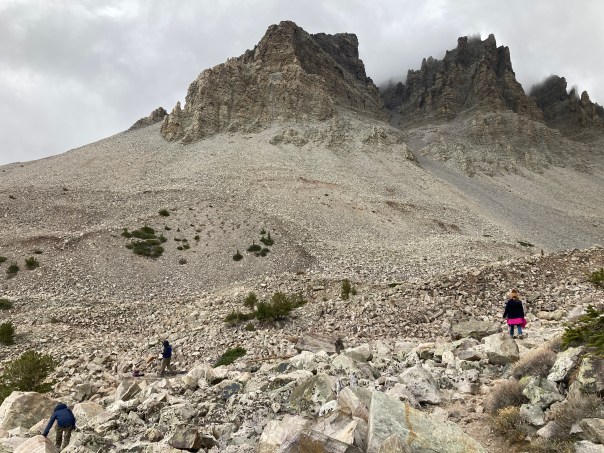
As we climbed up the rocky trail to over 10,000 feet elevation, we were surprised to see flowers still in bloom. Occasionally drops of rain began to fall on us but we didn’t actually get wet; some of the pretty rocks got prettier by the moisture. Below, the active glacier at the top of the moraine can be seen by the lines of white to the middle right of the picture.
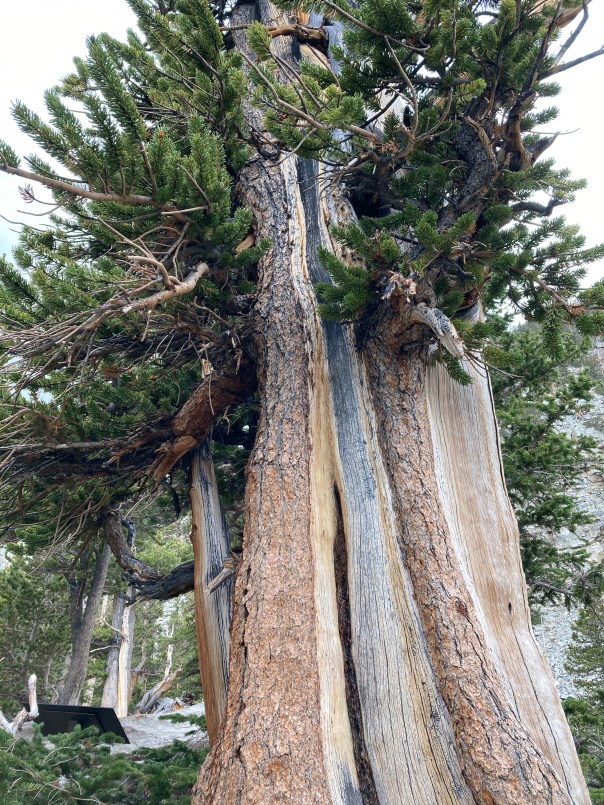
Above, one of the weathered Bristlecones that are thousands of years old. I wrote about my visit with my late husband to see these trees in the White Mountains ten years ago; here in the national park is the only other place in the Great Basin where trails have made viewing of them possible.
My back and knees are a bit strained from the various exertions of the last few days, but I’m eager for the mountain adventures yet to come, and grateful also for my readers’ vicarious enjoyment with me. I hope to be back soon with more!


























 By the way, the Seek app we have found of no help, unless you are someone who is happy enough to be informed that the tree you are looking at is a Conifer. Here Pippin is holding a Piñon pine nut cone, in which all the nuts seem to have either not developed, or been eaten by some insect. She foraged through many cones and nuts under these trees but never found a good nut.





 Gladsome Lights