Category Archives: family

What Happened at the Symphony

I was moved to tears by the experience of attending the symphony yesterday. As I have little musical training beyond being challenged by the Tonette in third grade, I’m not the one to give a knowledgeable critic’s review. Other than one music appreciation course in college, most of my music listening has been with three-quarters of my brain elsewhere.

Our son’s Japanese violin teacher assured us that even if we dozed during concerts we all would benefit by hearing the music played well, so I have comforted myself with the image of beautiful sounds soaking irresistibly into the consciousness. After my marriage, our house was often full of live music, what with five children and a husband playing guitars, flute, violin and piano. But I was normally in another room stirring the soup or folding laundry.

And concerts were typically not in the budget, though I have to admit that many of the children’s recitals filled me with joy at the expertise of the students, especially toward the end of the lineup when those most advanced at their instruments showed us their stuff. The boys were also able to play in beginning or amateur orchestras. It makes me very happy these days even to hear over the radio one of those pieces from the Suzuki violin repertoire, or a Nocturne that a daughter played. I can’t seem to enjoy classical music the first time I hear a piece, but after it has become familiar I love it dearly.

That’s why I cared so much about going to the symphony last weekend, to hear Brahms; in college when I owned only a few LP’s, a thrift-store album of Brahms symphonies was one of them. We’ve never acquired an updated recording, but I was eager to hear a live rendition of his music.

I also wanted to sit there in the concert hall and listen to whatever was on the program, familiar or not, for the greater chance for participation that it affords. Even when the compositions being performed are not to my liking, the visual component helps to keep me on the edge of my seat. Because I’m not much of an auditory learner, if the sensory input is limited to hearing, as in a recording, it’s really hard for me to assess or even pay close attention to the music, and the fact that I’ve never learned to play an instrument is another hole in my readiness.

But with the orchestra arrayed before me I’m greatly helped to appreciate the amazing work that’s being done. It’s all to the glory of God at the very outset, Who formed each individual in the womb with incredible gifts of intelligence and physical coordination. From there every artist has a unique story about how he struggled to bring his fingers and/or lips into submission to the requirements of the instrument and to the demands of  the musical score.

Speaking of fingers, the conductor had the longest fingers I’ve ever seen. His whole body was long and thin and so flexibly energetic, he threatened to bounce into the floodlights or melt into the sound waves. The timpanist looked like my high school chemistry teacher — well, who knows, perhaps he is a high school teacher. One balding cellist with a bushy ponytail stood out because he jerked his head so emphatically with his bowing, and the flutist who played a solo part exquisitely — thank God for her!

The two Brahms pieces were the 4th Symphony, and the Violin Concerto Opus 77. Though she is famous in the classical music world, Mr. Glad and I hadn’t heard of the violin soloist Elina Vähälä, so we read a little about her online beforehand and even listened to a clip of her playing. Of course, the live performance was thrilling. Certainly I’ve never heard anything more sublime than the sounds from that “Antonio Stradivari violin, built in 1678 and generously loaned by the Finnish Cultural Foundation,” which she played lovingly. She’s a beautiful woman and we were privileged to be there with her in her radiance.

After her performance, Ms. Vähälä came up into the balcony not far from where we sat, to join the audience in enjoyment of the 4th Symphony. I so admire all those regular members of the orchestra and the way they submit their art and skill to the group, and to the composer. They gather in ranks and in humble monochrome to work their magic, making the music emerge and shine in all its brightness, lifting our spirits. Even Brahms and his talent, the story of his life and how God worked in it to bless the world, are in the background.

It all makes me think of lying dreamily in a meadow in springtime. Your mind is filled with contentment and excitement all at once, for the multitude of pleasant sounds and feelings all mixed up and coming in. Gradually and intermittently, you notice individual players, like a particular bird’s song or the scent of the grasses. The sky is blue overhead; clouds with interesting shapes pass by. And yes, you might even sleep. But in the end, you are a richer person for having been there. And you don’t even know how it happened.

Pacific in Pacific Grove

Seaside paintbrush

Counting my dear sons’ wives, which I very thankfully do, I now have five daughters. It’s sad to think how I spent several years complaining that I didn’t birth more children; during that time I never anticipated the familial wealth that in-laws can bring.

Point Lobos

In an effort to enjoy our family friendships we women spent a few months planning our first mother-daughter holiday. When continents stretch between, the grandchildren have pressing needs, and the young women pressing schedules, so it’s a tribute to our devotion that we even tried. In the end, only half of us, two daughters and I, were able to get together recently, on California’s Central Coast.

Seaside daisy

Pacific Grove was our home base. Every morning I woke with the feel of long-ago visits to my Aunt Margaret, whom I knew mostly in my teens. She lived in Carmel in a cream-colored house with white carpets, under a sky that was often white with fog or overcast, and the mood was so quiet. The sort of quiet that is filled with the sound of surf and the cry of sea gulls.

Our gathering of last week was a quiet group, too, in spite of our much talking, which I imagine was still on the low end of charts that might be made of all-women excursions, as we often stood in silent wonderment over our surroundings.

In our Keen boots — really, no one one had coordinated our foot attire, contrary to all appearances — we walked a lot, up and down the hills of Pacific Grove and Monterey and Carmel-by-the-Sea. And we looked at flowers and trees and birds and tried to identify them all.

Flower is California hedge nettle
ceanothus in Pacific Grove

On Point Lobos especially the sweet smell of ceanothus blooms was filling the air, along with the buzzing of bees who were crazy over it. We liked the challenge of photographing busy bees. They liked how the pollen was offering itself to them on vast fields of stamens.

Carrying great loads of pollen
Protea behind Cannery Row
Lucky for us that Mrs. Bread showed us a Protea in her garden our first afternoon, so that we could guess their identities when we kept seeing them everywhere from then on. The genus includes a huge variety of forms that are really striking. I came home to find that our bottlebrush tree is not a Protea, however. Proteas seem to have come originally from the southern hemisphere, but they definitely like growing on this patch of the globe.

Behind Cannery Row murals have been painted along the bike path, evoking the culture and history that John Steinbeck depicted in his books. I liked browsing this lane better than the touristy shops which carry, as Joy pointed out, all the same stuff from China that touristy shops all over the nation carry.

Oh, except maybe the otter dolls. I was expending so much mental energy drumming up buyer’s resistance that I didn’t even think about how I could have taken a picture of one. There were three stuffed toy versions of the captivating creatures that we watched lolling and playing in Monterey Bay, and I can’t find one online that is as cute, to post here.

fava plant in bloom
While in Monterey it was quite fun to revisit the Cooper-Molera House so soon after our last visit, but long enough that the plants were further along in spring, as this fava bean plant with its black-and-white blossoms. There were even little bean pods forming lower on the plant.
Another Protea
cistus
Pacific Grove is called Butterfly Town, because of the Monarch butterflies that migrate there every year. I’ve long had a vicarious and romantic attachment to the place thanks to the book by Leo Politi, and now it has become a direct relationship with the same feelings.
Updated adobe cottage in Pacific Grove

The weather we experienced was surprisingly mild in spite of frequent short showers of drizzle or light rain — but I might find it difficult to stay long where the sun doesn’t show itself often enough to keep the spirits up.

Flowers seem to glow more vividly under grey skies, though, and that makes up for the drear a little bit. People paint their houses in cheerful colors. And peace and quiet count for a lot.

The Pacific Ocean is not always peaceful, but it was fairly calm this week. The tsunami from Japan didn’t make a big wave here. You can’t see them, but two otters are playing in this picture. And peace and serenity and love were all playing some quiet music in our hearts.

Scouting Around

It was great fun to follow little Scout around the yard for an hour while he explored his world. I took a slew of pictures trying to catch something of the Serious Scientist and Joyful Naturalist I was observing.

He is so good at walking on icy snow…I wonder how it feels to be so close to the surface and have a short toddly stride. Evidently pretty secure. Walking on snow was part of the adventure he was enjoying, and he never once slipped.


Scout is also an expert at recognizing a crabapple, even if it has lain under the snow for a few months and doesn’t look like its former self. He can get one into his mouth, avoiding the large piece of gravel that is also in his fist, and calmly remove the pit, enjoying what little “fruit” was left. I was a bit concerned when he picked up a specimen that had decomposed to an ugly state, but after squeezing it through his fingers for half a minute he rejected that one.

The main project of the hour was picking up stones, acorns, pine cones and sticks. He’s not yet at the age when sticks are preeminent, but he did carry a few for a while, which meant that his capacity for rocks was less.


But when he found the field of acorns, the sticks were dropped.The question is, how many acorns can fit in one little fist?

In spite of the sun, I’m sure his hands felt pretty cold after splashing in little puddles and patting ice, but he was oblivious to anything that would distract him from his Purpose.

However, Grandma did feel the chill, so we went inside and took a few acorns with us.


My Valley Oak

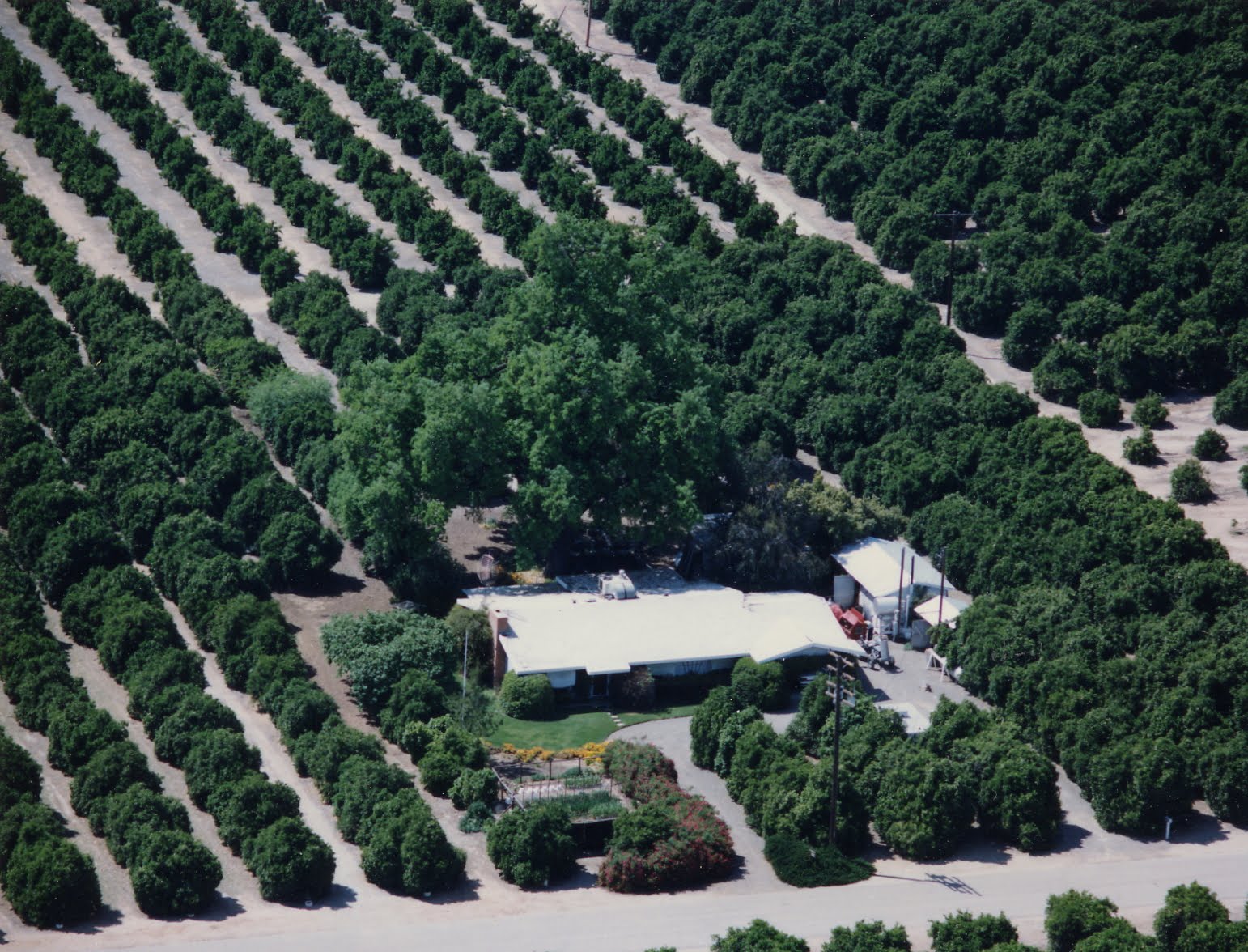
My father bought 30 acres of land with oranges and lemons growing on it, and no house. There was a large oak tree looming above a spot where a house might have stood in the past. And he thought that the tree was pretty much grown up, so he planted a house nearby.

This is the oak under which I lived after we moved in, until I went away to college about twelve years later. Only twelve years? Those formative years have an impact far beyond their numerical value, and that tree has to be my favorite tree, because there hasn’t been a particular beloved tree between then and now that I can bring to mind.  I realized that this week when Elizabeth was telling about her favorite trees and I wondered if I had one.

In these first pictures, taken decades after I had married, the tree had recently been trimmed with great care and patience by a tree man who was in love with it. I was amazed at its beauty and took a lot of pictures.

At that point the oak had grown mightier than my father ever expected, and its limbs were leaning dangerously over the house. My father said that if he had known how big it would get, he wouldn’t have built the house so close to it. At least one large limb had to be cut off to protect the house, and the whole tree was refreshed and lightened by being pruned all over.

When I was growing up I only knew that it was an oak tree. If someone told me it was a Valley Oak I didn’t remember. People in our family rarely talked about the birds and trees in those days. I didn’t know those were mourning doves I used to hear every evening as I was lying in my bunk. But one year a flock of bright orioles lived in our tree for a few weeks and we heard some talk then.
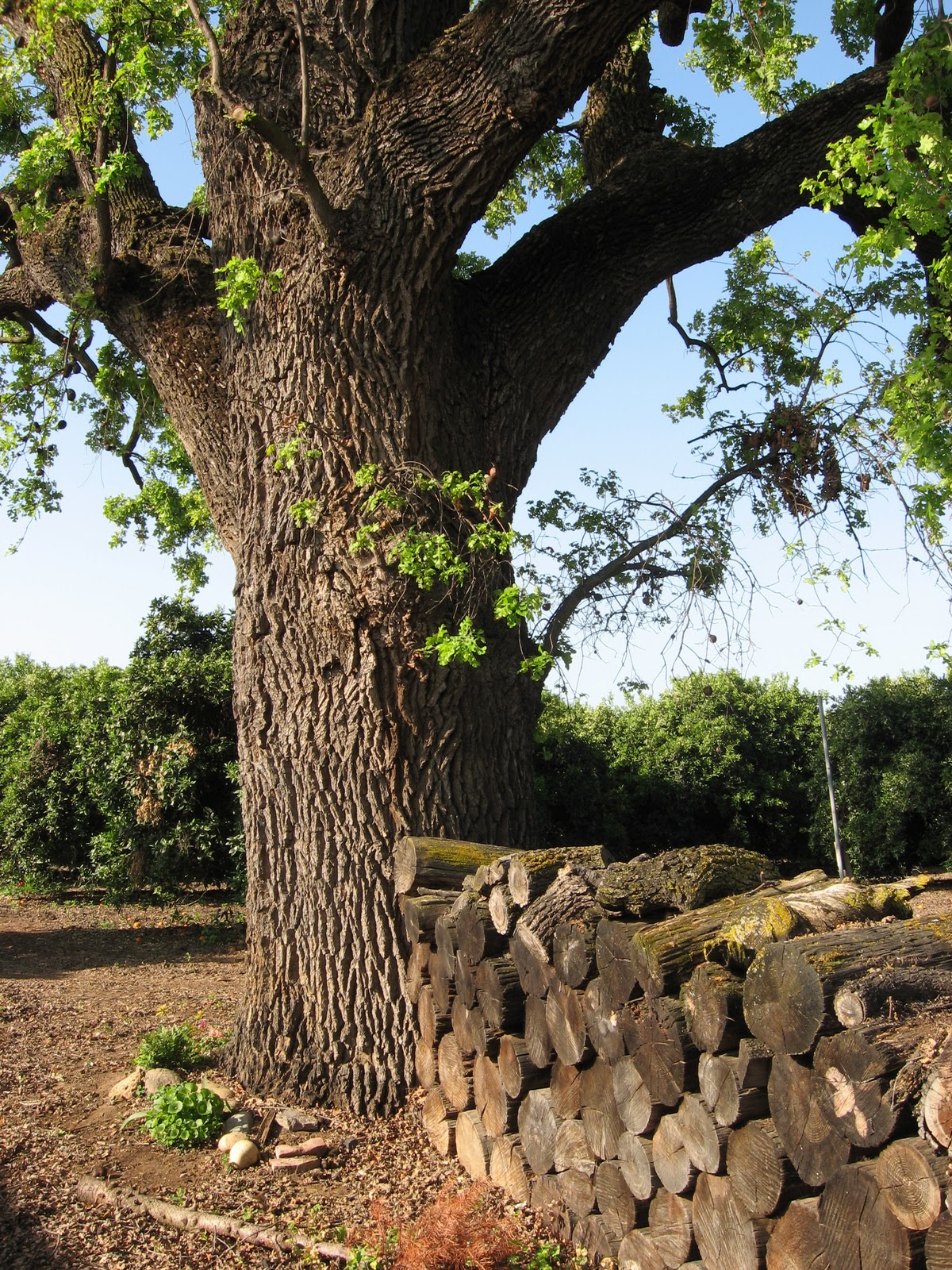
When I used to play under the tree, this is the way I mostly saw it, as a thick trunk. There was no reason to look up into the branches, excepting the times when orioles visited, and it was usually so messy up there that some twigs or dirt or even tree frogs might fall in your face.

oak galls/balls in winter
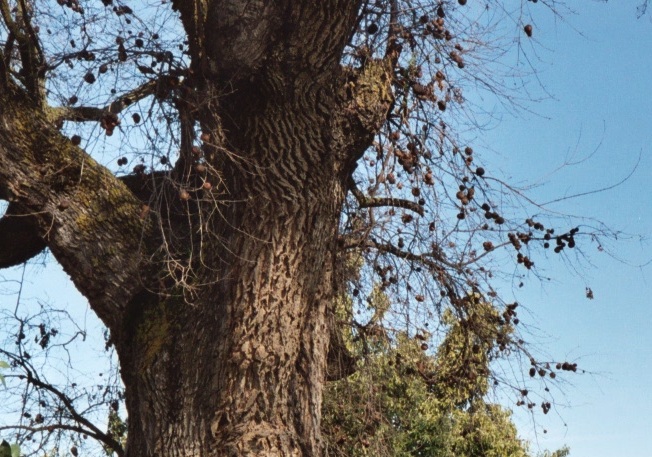
Yes, more than once we had veritable plagues of tiny tree frogs swarming in the branches, on the trunk, hopping all over the ground under the leaves. When we walked under the tree they jumped onto our legs as though they were little trunks.

And our tree suffered many times from all varieties of galls, the most common of which we just called “oak balls.”

Always Daddy had stacks of firewood under the canopy of branches, usually fruit wood that he’d gleaned from neighboring orchards that were being replaced. But here we see it is logs cut from our tree’s own pruned limbs.

One year my grandma gave me a little tent for my birthday and I set it up under the tree to lie in the summer long, reading comics and books and sucking on cubical cinnamon suckers.

Doghouses were common at the base of the trunk, and one year we had a banty chicken coop there. The basketball hoop that my father built for me was shaded by this tree friend. And as I think more about the shade it provided, I wonder how much money was saved on cooling bills because we had a partial shield from the burning Central Valley sun.

In his last years my father would walk out under the tree to the edge of the orange grove and scatter grain for a family of wild pheasants that visited. You can tell that this picture was taken pre-trim. One pheasant can barely be seen between the rows of trees.

One view of our tree that we didn’t have as children was from above. But some time after we were all grown up an aerial photographer took the photo below and came to the door after the fact to present his wares. Of course Daddy couldn’t say no. As he studied the picture he could see his spray rig in the driveway and him bending over it. And soon each of us kids received a gift of a framed picture of our childhood home — and my favorite tree.