Category Archives: feasts

I’m jumping in with joy.

blessing-creek1

It’s the Feast of Theophany! How can I not post something on this day when there is blessing abounding to the degree that people want to jump into icy waters over it? I am caught between the impulse to spread the riches around, and the awareness of the extreme limitations of my mind when the meaning of Christ’s baptism is set before me. There is a lot to take in and try to absorb at Theophany, regarding the Baptism of Our Lord.
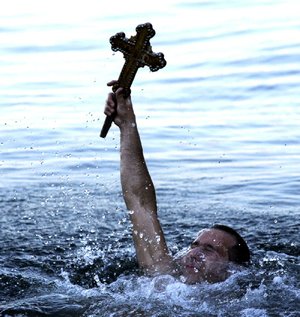
Orthodox Christians celebrate Theophany in various ways around the world. Some release doves as a symbol of the Holy Spirit while others toss crosses into water in remembrance of Christ’s baptism. Young boys or men often dive into the water to retrieve the cross. I know what I’ll do — I’ll post a link to Father Stephen Freeman’s recent blog on the subject. An excerpt:

St. John himself does not seem to understand the purpose of Christ’s Baptism. He is told that “whomever you see the Holy Spirit rest upon and remain” is the Messiah – but he is given little information beyond that. Witnessing Christ’s Baptism and the Spirit resting upon Him, he hears the voice, “This is my beloved Son in whom I am well pleased” (Matthew, Mark and Luke all bear witness to the voice).  The Church later celebrates this manifestation of the Trinity (Christ in the water, the Spirit descending, the Voice of the Father – hence the title “Theophany”).

But with the text alone, on its literal level, we are left with a mystery, without context or meaning. The Tradition of the Church, however, sees the Baptism of Christ in the context of Pascha (Easter) as it sees everything in the context of Christ’s Pascha. Christ’s Baptism is a foreshadowing (and on more than a literary level) of His crucifixion and descent into Hades (just as our own Baptism is seen by St. Paul as a Baptism into Christ’s “death and resurrection”).

When he goes on to explain that in the workings of God in the world, the literal is not all there is, he quotes Fr. Andrew Louth:

Allegory is a way of entering the ‘margin of silence’ that surrounds the articulate message of the Scriptures, it is a way of glimpsing the living depths of tradition from the perspective of the letter of the Scriptures.

There is so much to think about, even if you aren’t part of the Orthodox Tradition in which we will be participating on the praxis level by blessing urns of water, creeks and lakes and oceans of water. In parishes everywhere priests will be blessing houses as my rector described in our newsletter, so as to bring “the joy of the feast of the manifestation of the Holy Trinity to each and every dwelling. Think of the house blessing as a renewal of God’s grace in your home.”

How could we not be welcoming of that? I won’t be jumping into any frozen streams, I hope ever, but I will certainly have the joy of the feast.

O Christ our God,
 Who hast revealed Thyself,
And enlightened the world,
Glory to Thee.

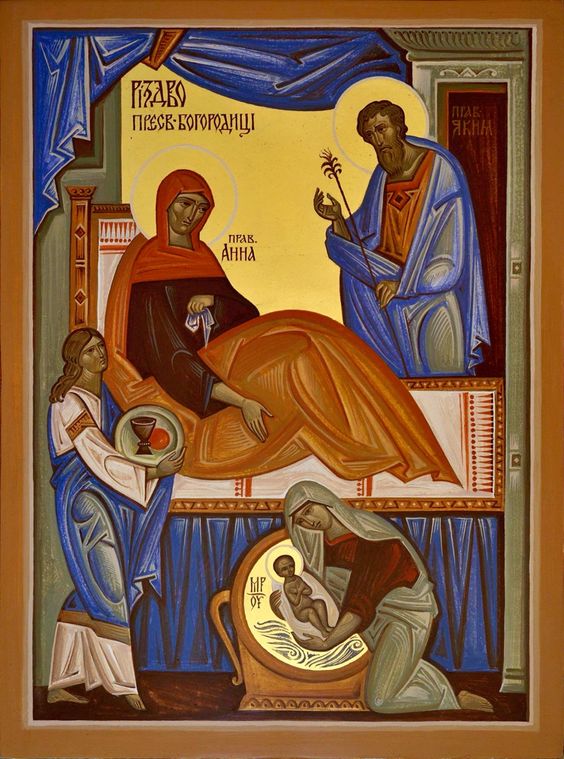
The Celebration of Man in a Little Girl’s Birth


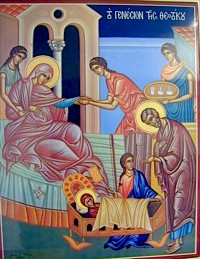
What a joy to be present at the “birthday party” for the beloved mother of our Lord! We began tonight, and will continue tomorrow, to rejoice at this first event of the church liturgical cycle, one of the 12 Great Feasts of the year. In honor and remembrance, I offer this sermon by:

Protopresbyter Alexander Schmemann
Sermon on the Nativity of the Theotokos September 8

The Church’s veneration of Mary has always been rooted in her obedience to God, her willing choice to accept a humanly impossible calling. The Orthodox Church has always emphasized Mary’s connection to humanity and delighted in her as the best, purest, most sublime fruition of human history and of man’s quest for God, for ultimate meaning, for ultimate content of human life.

If in Western Christianity veneration of Mary was centered upon her perpetual virginity, the heart of the Orthodox Christian East’s devotion, contemplation, and joyful delight has always been her Motherhood, her flesh and blood connection to Jesus Christ. The East rejoices that the human role in the divine plan is pivotal. The Son of God comes to earth, appears in order to redeem the world, He becomes human to incorporate man into His divine vocation, but humanity takes part in this. If it is understood that Christ’s “co-nature” with us is as a human being and not some phantom or bodiless apparition, that He is one of us and forever united to us through His humanity, then devotion to Mary also becomes understandable, for she is the one who gave Him His human nature, His flesh and blood. She is the one through whom Christ can always call Himself “The Son of Man.”

Son of God, Son of Man…God descending and becoming man so that man could become divine, could become partaker of the divine nature (2 Peter 1:4), or as the teachers of Church expressed it, “deified.” Precisely here, in this extraordinary revelation of man’s authentic nature and calling, is the source of that gratitude and tenderness which cherishes Mary as our link to Christ and, in Him, to God. And nowhere is this reflected more clearly that in the Nativity of the Mother of God.

Nothing about this event is mentioned anywhere in the Holy Scriptures. But why should it be? Is there anything remarkable, anything especially unique about the normal birth of a child, a birth like any other? The Church began to commemorate the event with a special feast…because, on the contrary, the very fact that it is routine discloses something fresh and radiant about everything we call routine and ordinary, it gives new depth to the unremarkable details of human life…And with each birth the world is itself in some sense created anew and given as a gift to this new human being to be his life, his path, his creation.

This feast therefore is first a general celebration of Man’s birth, and we no longer remember the anguish, as the Gospel says, “for joy that a human being is born into the world” (Jn. 16:21). Secondly, we now know whose particular birth, whose coming we celebrate: Mary’s. We know the uniqueness, the beauty, the grace of precisely this child, her destiny, her meaning for us and for the whole world. And thirdly, we celebrate all who prepared the way for Mary, who contributed to her inheritance of grace and beauty…And therefore the Feast of her Nativity is also a celebration of human history, a celebration of faith in man, a celebration of man.

Sadly, the inheritance of evil is far more visible and better known. There is so much evil around us that this faith in man, in his freedom, in the possibility of handing down a radiant inheritance of goodness has almost evaporated and been replaced by cynicism and suspicion. This hostile cynicism and discouraging suspicion are precisely what seduce us to distance ourselves from the Church when it celebrates with such joy and faith this birth of a little girl in whom are concentrated all the goodness, spiritual beauty, harmony and perfection that are elements of genuine human nature. Thus, in celebrating Mary’s birth we find ourselves already on the road to Bethlehem, moving toward the joyful mystery of Mary as the Mother to God.

Nativity of Theotokos contemporary


Thy nativity, O Virgin,
has proclaimed joy to
the whole universe!
The Sun of Righteousness,
Christ our God,
has shone on thee,
O Theotokos!
By annulling the curse,
He bestowed a blessing.
By destroying death,
He has granted us
Eternal Life.

The Glory of Thy People Israel

This morning I’m putting up my post of two years ago today, 
essentially unchanged but maybe slightly improved. 
A blessed feast to all!
 

My Favorite Neglected Feast

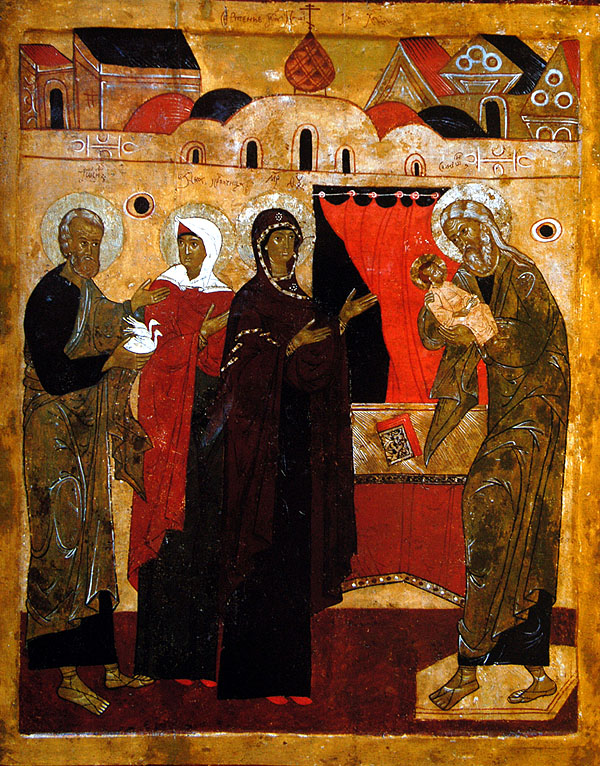
Today is one of the Twelve Great Feasts of the Orthodox calendar, The Presentation of Christ in the Temple; therefore I think it excusable if I postpone tackling many pressing mundane tasks and meditate a little longer on one of my favorite celebrations.

As long as I can remember, the story of Christ being presented in the temple as an infant has brought tears to my eyes, because of the constancy and joy of Simeon, a “just and devout man” who had throughout a long life been waiting and praying for the Messiah. His words express a single-minded heart — his purpose in faithfully waiting had been fulfilled. What a sweet reward, to be the one to receive and hold the Christ!

When Jesus was brought to the temple at 40 days old, according to the law, Simeon (Luke Chapter 2) “… took he him up in his arms, and blessed God, and said, ‘Lord, now lettest Thou thy servant depart in peace, according to Thy word: For mine eyes have seen Thy salvation, which Thou hast prepared before the face of all peoples, a light to enlighten the Gentiles, and the glory of Thy people Israel.’ ”

Thanks to Deb, I found this series of very informative postings that Matt wrote, linking all the events of this day through history, including Groundhog Day, which I will now always remember, in the background. (I did love that movie, whose lesson of humility is applicable throughout the secular or church year.) It is a neglected feast, our priest noted this morning, though our numbers weren’t too small this morning for Divine Liturgy.

The festivities spill over to February 3rd when we give a whole day to commemorating Simeon and the Prophetess Anna. It’s been a happy thing to find that Orthodoxy takes plenty of time for rejoicing in an event that has long been a resting place to me along the path that we call our salvation history.

Candlemas is another name for the holy day, and the church East and West has traditionally blessed candles on this day. I love candles as much as anyone, and I left the church with a handful to burn at home and in that way to stretch out the joy for a good while, brightening and lightening up these winter days.

Theophany Worship and Doctrine

Today the Orthodox Church celebrates Theophany, about which I have posted a time or two in the past. This year I found a blog by a young woman in Greece who has posted a rich mix of photos, videos and accounts describing the celebration of this feast around the world, and its meaning for us.

It all well illustrates the message of this short quote from the newsletter of my parish:

WORSHIP AND DOCTRINE:

“In the Tradition of the Eastern Orthodox Church, doctrine and worship are inseparable. Worship is, in a certain sense, doctrinal testimony, reference to the events of Revelation. Thus, ‘dogmas are not abstract ideas in and for themselves but revealed and saving truths and realities intended to bring mankind into communion with God.’ One could say without hesitation that, according to Orthodox understanding, the fullness of theological thought is found in the worship of the Church.

This is why the term Orthodoxy is understood by many not as ‘right opinion,’ but as ‘right doxology,’ [that is,] ‘right worship.’”

—Archimandrite Zacharias, Ecclesial Being, pg. 88.

Those movies of people diving into icy waters make me consider in a more bracing way the scriptural exhortation to “present your bodies a living sacrifice….”

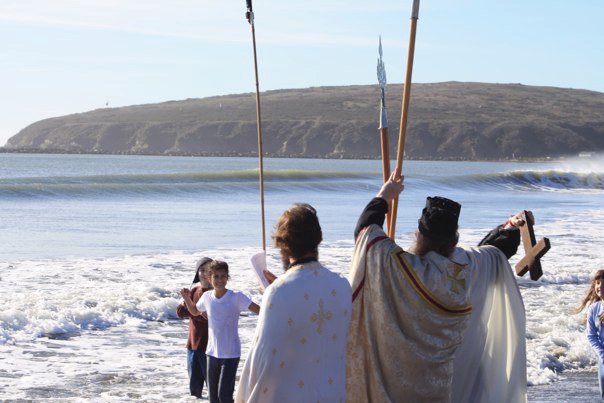
Some friends of ours celebrated Theophany at our Northern California beach last year, where the current brings chilly water from Alaska, giving the children who dove for that cross a bit of the experience of their fellow Orthodox in colder climates.

To all who celebrate in worship and truth, a most blessed feast!

Mosaic from Ss. Constantine and Helen Orthodox Church
Colorado Springs, Colorado