Category Archives: food and cooking

Snowmen and Jello – Christmas

Two Glad Grandboys

While we are waiting for Christmas and preparing our gifts, and thinking about what Santa and our parents are preparing for us, children are lucky if we have some snow around with which to build a snowman or snowlady.

My own grandchildren sometimes have that. But when I was a child, I only had the beloved “Frosty the Snowman” 45 to play on my little record player.

It’s the only record I remember from my youth until I bought such ones as “Like a Rolling Stone,” and I listened to the Frosty tale over and over so that I can still hear the voice — maybe it was Red Foley — in my head. On the other side he sang “Rudolph the Red-Nosed Reindeer.” The image below is not quite like what I owned, but it evokes the memory well enough.

I remain snowless, and don’t mind a bit. Besides, I can watch “The Snowman” on video. Those who lack the technology for watching movies (and I know there must be some of those people still, though they are probably not the ones reading this) could read the wordless book The Snowman.

But the video is so enchanting, with its haunting tune. The first time I borrowed the movie from the library, it was a version with the song, but since then I have only found it with a purely instrumental score. We are all fortunate now, and I am more than pleased to tell you that YouTube has a clip that includes sung lyrics of “Walking in the Air.”

When I turned fifty a friend took me browsing in a quilt shop to pick out a few pieces of fabric as a birthday present from her. Several prints called to mind images from the adventures of the snowman and his little boy, and I took rectangles of them home with a theme brewing.

I sewed by hand several potholders that I call my Snowman Potholders. Of course, they have nothing to do with Christmas, except for their frequent role in pulling pies out of the oven for Christmas dinner.

Waiting….We Orthodox are still waiting until December 25 (or January 7) for the feast and waiting to feast, because we are preparing our hearts, which are tightly bound to our bodies. But in preparing for culinary aspects of the feast I’m considering this festive rainbow jello I made for one Christmas Day:

RAINBOW RIBBON DESSERT


1 (3 oz.) package (each flavor) raspberry, lime, orange, lemon, and strawberry Jell-O

6-1/4 cups water
1-1/4 cups evaporated milk

Dissolve raspberry Jell-O in 1 cup boiling water. Remove 1/2 of Jell-O to a bowl and add 1/4 cup cold water. Place into a 9-inch square pan. Place in refrigerator until slightly firm. To the remaining half of Jell-O, add 1/4 cup evaporated milk. Cool and place over slightly firm layer in pan. Continue procedure with remaining flavors of Jell-O in this order: lime, orange, lemon, and strawberry. Cool each mixture before layering. Chill completely. Cut into squares to serve. Yield: serves 8 to 12. 

I’m trying to figure out how to tweak this colorful recipe into a frozen dessert. It already has the brightness of Tolkien’s wintery image, and I think I might attract my snowmen friends to my holiday table if I just advertise that for dessert we are serving a treat called “Northern Lights.”

(This is the third in my contributions to Pom Pom‘s Childlike Christmas Party.)

Limón in the Cazuela

The Cazuela That the Farm Maiden Stirred by Samantha R. Vamos is a delightful Hispanic incarnation of The House that Jack Built. It tells the story of a rice pudding from the farm to the table. The reader is introduced to two new words, first in English, every time he turns the page. From then on, those key words are only written in Spanish.

Before I opened the book, Mr. Glad was enjoying it and noticed that the word for lime was much like our lemon. That made me wonder what the word for lemon is.

New World Spanish-English Dictionary sits on the reference shelf here as a leftover from the days when four of our children in turn studied Spanish. Even though their father and I never did study that language that is so useful, almost essential, in California, we’ve lived here our whole lives and have picked up some vocabulary, sometimes by consulting this word book, as I did on this occasion.

The hen helps by grating the limón

I don’t know why, but my dictionary is wrong about limón. It says that it means lemon, and that if you want to talk about a lime you say lima. I found it hard to believe that this book written by a woman with a Hispanic name, illustrated by a man with a Hispanic name, with the intent of teaching 21 words, would get any wrong.

But I have a friend who is married to a Mexican man and teaches at a bilingual school, and I couldn’t pass up the opportunity to ask my local expert. She wrote, “Okay babe. Limón means lime and limón agria or limón Amarillo can mean lemon. There is a lemon-like fruit called Lima limón. There are not lemons like we have here in the U.S. in Mexico.” That seemed a pretty authoritative word on the subject.

This is a picture book, an Easy Reader, so I must not forget to mention the illustrations, which as you can see from these sample pages I photographed are party-bright, full of the joy and fun of cooking together.

At the back you will find a glossary with pronunciations, in case your Spanish is rusty, and best of all, a recipe for rice pudding. What I would love to do with a young child is read the book, make the pudding together while using the English and Spanish words to talk about the ingredients, and then read the book again while the cazuela simmers.

I would rather one of my grandchildren helped me in the kitchen, while we keep the animals outdoors or in the pages of the book. But an arroz con leche pudding with plenty of crema and some zest of limón would suit me just fine.

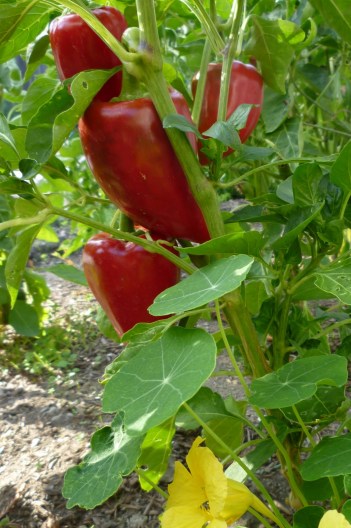
Pimientos from the October garden.

Have you ever seen a fresh pimiento pepper for sale in the grocery store? No? That’s why, if you have a garden, you should consider growing them yourself. The little jars of diced pimientos that are the only experience most people have of them — sorry, but they are not to be compared to the fruits you can expect to harvest from your back yard.


I went around the garden this afternoon snapping pictures of the prettiest things, including the peppers.

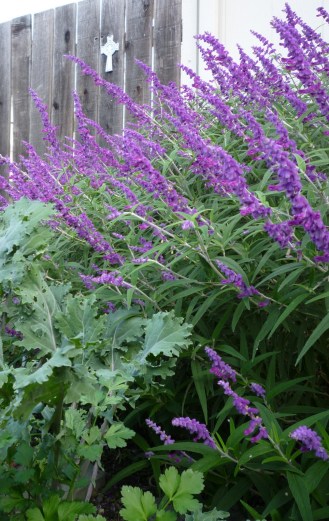
What first caught my eye was the way the color of the Mexican Sage coordinated so nicely with the Red Russian Kale. Some parsley is peeking up at the bottom.

Arugula (with the white flower) is a real self-starter and has come back up through the basil, and the nasturtiums are still going strong.

But about those pimientos: It was about 30 years ago I encountered a fellow gardener’s planting of them, on a sunny hillside growing alongside beans and tomatoes and other more common things. Ellie said, “Pimientos are marvelous; they are good with everything. We just love them!” It was at a time in my life when I was very suggestible regarding any homemaking idea, and the garden was a big part of my homemaking.

Since then, I don’t think a year has gone by that we didn’t grown some pimientos, though one time we ended up with plants that had an odd shape and slightly different flavor. That’s when we learned that there are different varieties called pimiento. But the shape of the fruits in my photos here is what we think of as standard.

Pimientos have a richer taste than the standard sweet red bell pepper that the supermarkets carry, and the wall of the fruit is probably twice as thick. For 20+ years I would mostly serve them sautéed with mushrooms and/or onions and garlic as a vegetable dish. The skins would often slide off before I got the skillet to the table, in which case sometimes I’d sometimes manage to remove some of them. Mostly the skins got eaten.


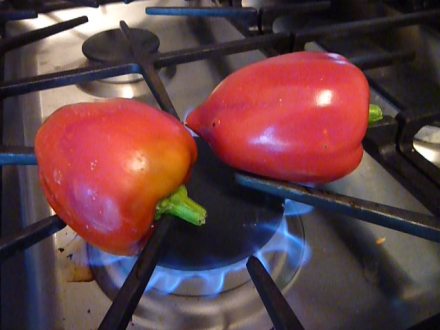
But now that I have a gas range I can easily turn them around on the stove with tongs while they hiss and sputter, and have fire-roasted peppers. (I also did this with poblano peppers this summer.) After they are blackened all over, you stick them in a bowl or something with a lid — I tried a plastic bag but the peppers were so hot they melted holes in the bag — and let them sweat a few minutes until the skins rub off easily under water.

Meanwhile, the house starts to smell like a Mexican restaurant!

Once they are bare and thick slabs of sweet flesh, it is so easy to chop some up into soups or stews or salads. Lay a pepper on top of bread and cheese, or just bread…or feel really indulgent eating one all by itself. I freeze some flattened between waxed paper to use all year long.

Candy: Fake, Fruity, or Drunken?

Fruit snacks are yummy treats. The Candy Professor thinks so, too, but she writes in The Atlantic about how the idea that they may legitimately be touted as something other than candy is under question in court. In her blog this week the professor, Samira Kawash, also treats the semiotics of candy:

“Candy as simulacrum cuts loose from the chain of origins and descent. It’s fake, and unashamed of its fakeness and therefore not in need of connecting itself to some legitimating narrative of ancestry and origin.

“So candy as fake food is more true than food that disguises its fakery. Candy, perfect post-modern food.”

And she does her own experiment to find out if gummy bears can really soak up vodka without dissolving in it.

I’ve always enjoyed this woman’s blog, but never more than this week, because I love science experiments using food, even junk food. I do like many forms of candy, but I mostly try to feed myself and my family truly nutritious food, which doesn’t include sweets. I haven’t indulged in any fruit snacks lately, but I wonder if the food police will require their being shelved with the jelly beans in the future?

By the way, candy is a topic of conversation I sometimes fall back on when talking with my grandchildren, most of whom will become engaged on some level at the mention of it. Now I have even more threads of talk with which to lead them on.

At the same time, these latest discussions are getting tangled in my mind. Are fruit snacks real? Are drunken gummies liquor or fusion cuisine? I hope I am right in this at least, that the philosophers are telling me that my sweet tooth is merely a healthy preference for honest food.