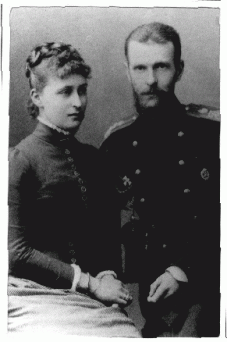
 When my Kate was in high school, she and I studied as a part of our history course the children of Queen Victoria, and their marriages and children. You take in a lot of general European and even world history through their stories. Since my conversion to the Orthodox Church, I’ve come gradually to know a little more about some members of the extended family, and one of the most interesting to me is the Grand Duchess Elizabeth.
She was a granddaughter of Queen Victoria through Princess Alice, her father being Ludwig IV, Grand Duke of Hesse and by Rhine; her younger sister married Czar Nicholas II. (That couple are more famous generally, and many books have been written about their family. The only one I have read so far is a photo album sort of book, Tsar: The Lost World of Nicholas and Alexandra, which I loved.)
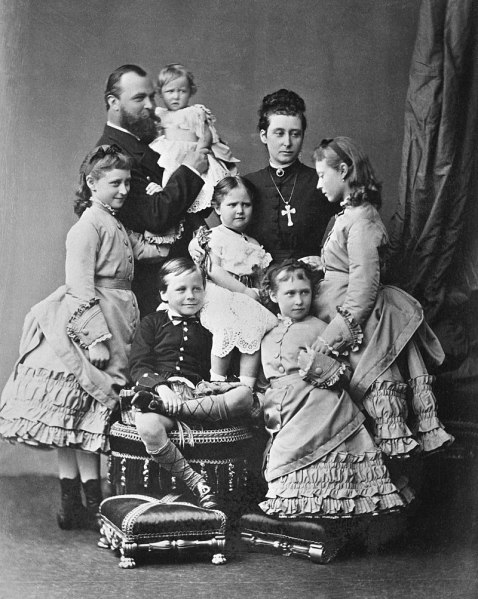

Elizabeth’s mother, who had modeled for her a devotion to helping the poor and living a modest lifestyle, died of diphtheria when Elizabeth was fourteen, along with her youngest sister.
Elizabeth had many suitors and admirers, and was considered by women as well to be exquisitely beautiful in body and soul. She rejected several suitors before she fell in love with Grand Duke Sergei Alexandrovich, son of Tsar Alexander II, who used to visit her family with his mother. It is interesting to me that her grandmother was very unhappy about this, and tried to discourage Elizabeth from accepting Sergei’s proposal. I think she was still trying to arrange marriages, and she had someone else in mind for her granddaughter. But the couple were married in 1884, when she was nineteen. Sergei was appointed Governor-General of Moscow.
Elizabeth and Sergei never had children of their own, but they became foster parents to Sergei’s niece and nephew, and Elizabeth would give parties for children at their summer estate. She converted from the Lutheran faith to Orthodoxy in 1891, against the wishes of her family. The following is from OrthodoxWiki:
- “Once the decision was reached, it proved a difficult task to make it known to her relatives. She writes to them at this time that she is ‘intensely happy,’ but that it pains her to cause grief to her beloved family. And yet her determination was firm, ‘I am sure God’s blessing will accompany my act which I do with such fervent belief, with the feeling that I may become a better Christian and be one step nearer to God.’ Explaining the reasons for her decision, she writes in a letter: ‘Above all one’s conscience must be pure and true… many will — I know — scream about (it), yet I feel it brings me nearer to God… You tell me that the outer brilliance of the church charmed me… in that you are mistaken — nothing in the outer signs attracted me — no — the service, the service, the outer signs are only to remind us of the inner things.’
“The Kaiser is thought to have been behind the claim that her husband had forced her to convert, but Elizabeth explained that it would be ‘lying before God’ to ‘remain outwardly a Protestant.’ Of all her family, Queen Victoria showed the most understanding, and provided her with moral support for her decision.”
Wikipedia tells us:
“Elisabeth was instrumental in the marriage of her nephew-by-marriage, Tsar Nicholas II, to her youngest sister Alix. Much to the dismay of Queen Victoria, Elisabeth had been encouraging Nicholas, then tsarevich, in his pursuit of Alix. When Nicholas did propose to Alix in 1894, and Alix rejected him on the basis of her refusal to convert to Orthodoxy, it was Elisabeth who spoke with Alix and encouraged her to convert. When Nicholas proposed to her again, a few days later, Alix then accepted.”
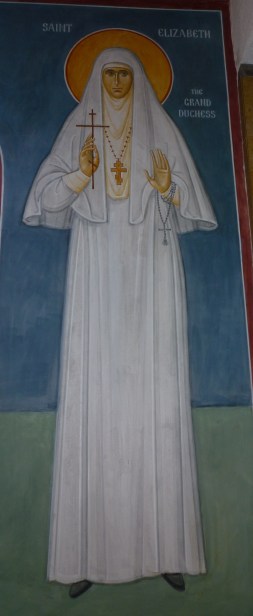 In February of 1905, Sergei was assassinated in the Kremlin by the Socialist Revolutionary Ivan Kalyayev. Elizabeth was, of course, shocked and stricken, but she regained her calm, and according to Edvard Radzinsky,
“Elizabeth spent all the days before the burial in ceaseless prayer. On her husband’s tombstone she wrote: ‘Father, release them, they know not what they do.’ She understood the words of the Gospels heart and soul, and on the eve of the funeral she demanded to be taken to the prison where Kalyayev was being held. Brought into his cell, she asked, ‘Why did you kill my husband?’ ‘I killed Sergei Alexandrovich because he was a weapon of tyranny. I was taking revenge for the people.’ ‘Do not listen to your pride. Repent… and I will beg the Sovereign to give you your life. I will ask him for you. I myself have already forgiven you.’ On the eve of revolution, she had already found a way out; forgiveness! Forgive through the impossible pain and blood — and thereby stop it then, at the beginning, this bloody wheel.”
The widow Elizabeth went into seclusion, and eventually sold her jewels and possessions, using the proceeds to establish a convent of which she became the abbess. She and her monastic sisters opened a hospital and accomplished many and various deeds of mercy.
“This creature, so unlike the others, so towering above all, of such captivating beauty and loveliness, of such irresistible kindness; she had the gift of effortlessly attracting people who felt that she stood above them and gently helped them to rise to her…. She was made of the same material as the early Christian martyrs who died in the arenas of Rome” -Countess A. A. Olsufieva
In 1918 the Communist government exiled Elizabeth to Yekaterinburg and then to Alapaevsk, where with several others she was killed by the local Bolsheviks on July 18.
“They were herded into the forest, pushed into an abandoned mineshaft, into which grenades were then hurled. An observer heard them singing Church hymns as they were pushed into the mineshaft. After the Bolsheviks left, he could still hear singing for some time…. Later the White Army briefly recaptured this area, and her relics were recovered and the account of the person who witnessed it recorded. Her relics were first taken by the White Army to Beijing and placed in the Church of St. Seraphim of Sarov, and then they were taken to Jerusalem and placed in the Church of St. Mary Magdalene, which she and her husband had helped to build.”
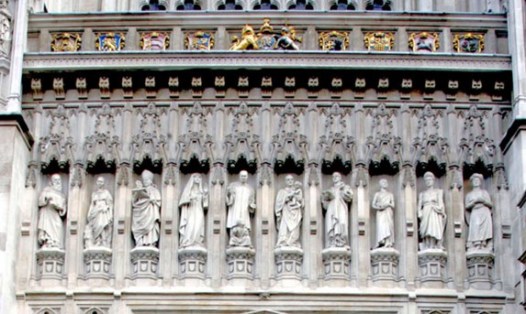
I have had to leave out many details about this saint’s life, but want to share a couple of memorials before I end this particular remembrance. Elizabeth was commemorated by Westminster Abbey as one of ten Modern Martyrs whose statues above the Great West Door were unveiled in 1998.
 And the sand artist Kseniya Simonova has told the story of Elizabeth’s life in a surprisingly moving way here: “White Angel.”
” … if we believe in the sublime sacrifice of God the Father in sending His Son to die and rise again for us, we shall feel the Holy Spirit lighting our way, and our joy will become eternal, even if our poor human hearts and earthly minds pass through moments which seem terrible.”
– Grand Duchess Elizabeth Feodorovna of Russia
May her life and prayers encourage and inspire us to receive with her,
even in our terrible moments, that eternal joy.


 This is the oak under which I lived after we moved in, until I went away to college about twelve years later. Only twelve years? Those formative years have an impact far beyond their numerical value, and that tree has to be my favorite tree, because there hasn’t been a particular beloved tree between then and now that I can bring to mind. I realized that this week when
 And our tree suffered many times from all varieties of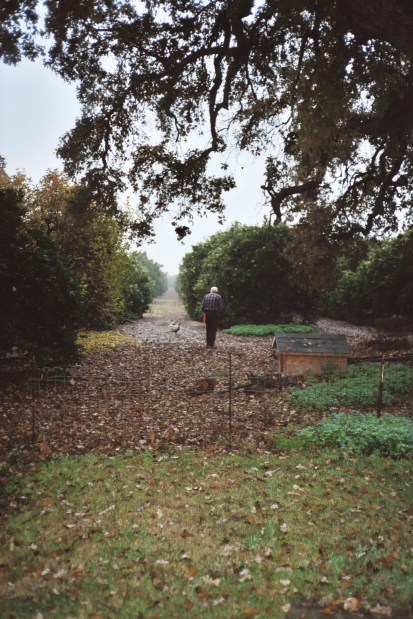

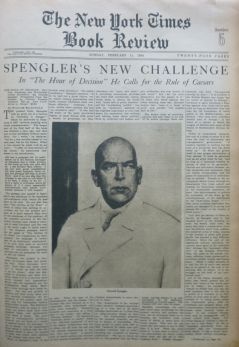 column in 2017. Of course, it being the birthday of G.K. Chesterton, I wanted to read what Keillor might say about that favorite writer of mine. But Bob Hope and Oswald Spengler were also born on the 29th of May. Spengler studied the history of civilizations, and published the book The Decline of the West in 1918.
