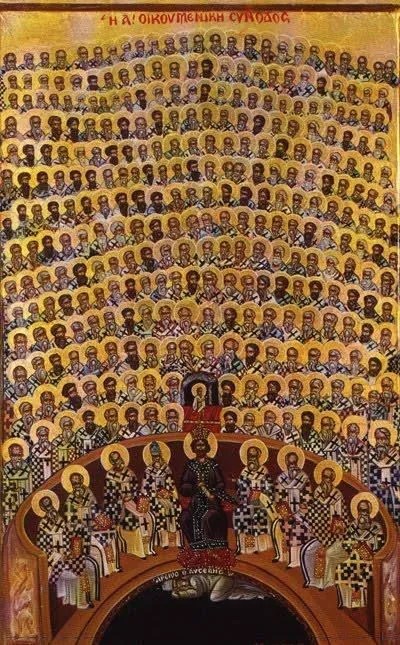
The Apostles’ preaching and the Fathers’ doctrines
have established one faith for the Church.
Adorned with the robe of truth, woven from heavenly theology,
it defines and glorifies the great mystery of Orthodoxy!
-Hymn for the feast
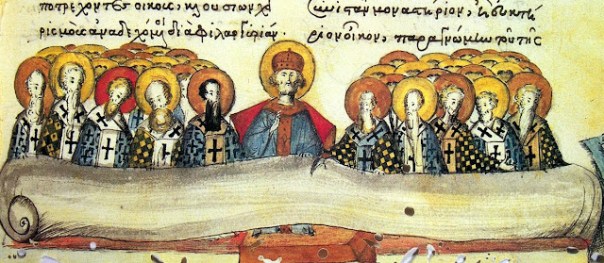
On the seventh Sunday of Pascha we Orthodox commemorate the Fathers of the First Ecumenical Council. This gathering was organized by the Emperor Constantine in 325. St. Nicholas of Myra and many others whom we now know as saints were present.
Arianism (not Aryanism) had been a recurring source of controversy in the early Church, and when Constantine called for a council, it was primarily out of a desire to settle the underlying theological questions. This was the Council at Nicea in Asia Minor, held in 325, where the major part of the Nicene Creed was formulated. Many of the hymns and readings for this feast are very theological, too.
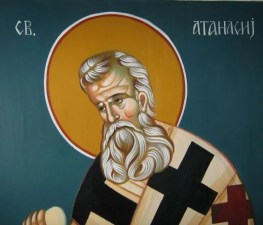
On the site linked above, we read, “A list of bishops at the council exists, including about 230 names, though there are indications that the signature lists are defective. St. Athanasius of Alexandria (Athanasius the Great) puts the number at 318, which is regarded as a mystically significant number, as in Genesis 14:14, the number of servants whom Abraham (then still named “Abram”) took with him to rescue his nephew Lot.”
Though we aren’t commemorating the Fathers of the second council today, those who completed the Creed as we know it, I wanted to post the full Symbol of Faith here, as we profess it in our daily prayers and in many services. The majesty and splendor of The Holy Trinity and of His loving plan of salvation captivate me from the first few lines, and by the time we get to “the Life of the age to come,” I am full of joy at being a participant in this Life. Here is some background:
“The Creed as it now stands was formed in two stages, and the one in use today in the Orthodox Church reflects the revisions and additions made at the Second Ecumenical Council. Some centuries later, the Roman Catholic Church attempted a unilateral revision of the Creed by the addition of the Filioque, this being one of the causes of the Great Schism between Rome and the rest of the Church.”
THE CREED
We believe in one God, the Father Almighty, Maker of heaven and earth, and of all things visible and invisible;
And in one Lord Jesus Christ, the Son of God, the Only-begotten, Begotten of the Father before all ages, Light of Light, Very God of Very God, Begotten, not made; of one essence with the Father; by whom all things were made:
Who for us men and for our salvation came down from heaven, and was incarnate of the Holy Spirit and the Virgin Mary, and was made man;
And was crucified also for us under Pontius Pilate, and suffered and was buried;
And the third day He rose again, according to the Scriptures;
And ascended into heaven, and sits at the right hand of the Father;
And He shall come again with glory to judge the living and the dead, Whose kingdom shall have no end.
And we believe in the Holy Spirit, the Lord, and Giver of Life, Who proceeds from the Father, Who with the Father and the Son together is worshipped and glorified, Who spoke by the Prophets;
And we believe in one, holy, catholic, and apostolic Church.
We acknowledge one Baptism for the remission of sins.
We look for the Resurrection of the dead,
And the Life of the age to come. Amen.
You are most glorious, O Christ our God!
You have established the Holy Fathers
as lights on the earth!
Through them you have guided us to the true faith!
O greatly Compassionate One, glory to You!
 “I realized that a crisis of limits is a crisis of culture, and a crisis of culture is a crisis of spirit. Every living culture in history, from the smallest tribe to the largest civilization, has been built around a spiritual core: a central claim about the relationship between human culture, nonhuman nature, and divinity. Every culture that lasts, I suspect, understands that living within limits—limits set by natural law, by cultural tradition, by ecological boundaries—is a cultural necessity and a spiritual imperative. There seems to be only one culture in history that has held none of this to be true, and it happens to be the one we’re living in.”
 Gladsome Lights