Category Archives: history

Peony

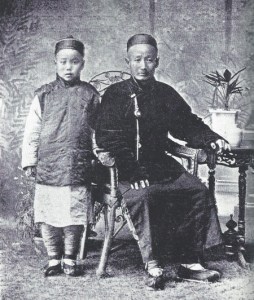
I am so blessed to have met the appealing character of Peony in Pearl S. Buck’s novel about Jews in China. It seems that as early as the 8th century Jewish traders settled in China and their tribe increased through the centuries. Buck thoroughly researched their history and includes many authentic details in this story that tells about their community in the city of K’aifeng in the northern province of Honan. She gives a short intro and timeline of the Jewish presence in China in a preface, and my Kindle edition includes an afterword by Wendy R. Abraham with a thorough history up to about 1990.

The events take place in the middle of the 19th century. At this time the last rabbi died and the Jews were in the final stages of being assimilated into the Chinese culture. One big reason can be summed up in this question that several of the characters ask themselves: “…here [in China], where all are friends to us and receive us eagerly into their blood, what is the reward for remaining apart?”

The story is told from the point of view of the Chinese bondmaid Peony, who belongs to a Jewish household and for her own survival uses all her resources to promote this abandonment of her owners’ practice of their Jewish lifestyle. She and the Young Master of the household grew up as playmates and good friends, and now that they have come of age she works to turn his heart away from the faith that has been passed down from his parents. That may sound bad, but she is honestly playing her part in this drama in which each one tries to follow the most prudent path he can, while at the same time honoring his elders. From the distance of time or in a novel we can see a broad view, but when you are thrust into a role with no script, you can only do your best.

The substance of the Jewish faith portrayed in the novel is somewhat vague. Other than the goals of “remaining separate” and remembering their history, any tenets of faith mentioned were ideas the Chinese neighbors could and did easily agree with. An example of this is in a synagogue mentioned in the story, on whose stones are written “‘The Temple of Purity and Truth,’ and beneath the words are carved the history of the Jews and their Way, and it is there said, ‘The Way has no form or figure, but is made in the image of the Way of Heaven, which is above.'”

The name of the temple is factual, and if the confusing statement about The Way comes from Pearl Buck’s imagination, it is probably based on the truth of what it is like to try to live out a faith tradition that is more history than reality. This experience is certainly not foreign to many moderns.

I don’t know when I last read such a wonderful work of fiction. It was a page-turner because I could not at all imagine how the plot would flow. The setting in China was the primary strange aspect for me; I don’t think I’ve read any of Buck’s other works set in that country and I’ve been fairly incurious about Asia generally. But recent exposure to the writings of Lin Yutang has made the history and culture of China seem much more accessible and intriguing, and prepared me to enter into this tale.

Peony is a young Chinese girl whose depiction I fully trust, because Pearl S. Buck grew up in China as the daughter of Presbyterian missionaries and was immersed in that world. She returned as an adult and wrote many books about China and its people, including the most famous one, The Good Earth. Lin Yutang himself was a friend of hers and they seem to have encouraged each other in their writing.

Peony was sold by her mother to the family whom she serves; she has no one else but them in the world. So she sees that it is in her interest to be the very best servant she can be, and she truly loves not only the Young Master but his parents. About the Young Master she thinks, “His heart was centered in himself, and so must hers be centered in him.”

Her love for the family increases as the years go by, even as they come to depend on her in countless ways. That’s o.k., because she always tries to make things work out for their health and welfare. Her own happiness must be found in the context of disappointment, and in relationship with people who take her for granted.

When she is still fairly young she asks the older servant a philosophical question:

Was life sad or happy? She did not mean her life or any one life, but life itself— was it sad or happy? If she but had the answer to that first question, Peony thought, then she would have her guide. If life could and should be happy, if to be alive itself was good, then why should she not try for everything that could be hers? But if, when all was won, life itself was sad, then she must content herself with what she had.

“You cannot be happy until you understand that life is sad,” Wang Ma declared. “See me, Little Sister! What dreams I made and how I hoped before I knew that life is sad! After I understood this truth I made no more dreams. I hoped no more. Now I am often happy, because some good things come to me. Expecting nothing, I am glad for anything.”

Getting to know Peony and watching how she matures over the years was pure pleasure. She has good sense and character even as a teenager, and as she responds to the sometimes cataclysmic changes in the household her competence and wisdom grow, often through struggling to overcome her own desires and heartache. Through her we get an idea of how the Jewish religious practices might have appeared to the Chinese, and she also epitomizes many of the best qualities of the Chinese and their outlook on life that I was only recently reading about in Lin Yutang’s books.

For me the Jewish characters in the story were also unpredictable, though they are well-drawn and believable. They are people of their particular time and place, most of them already a unique blend of the Chinese and Hebrew. The patriarch of the family is of mixed-blood, having had the “consolation” of “a rosy, warm little Chinese mother.” This image is contrasted with his own wife who is almost single-handedly trying to preserve their religious tradition, and who causes a Jewish friend to muse, “For a woman to love God too much was not well, he now told himself. She must not love God more than man, for then she made herself man’s conscience, and he was the pursued.”

This theme of women and their power is another element of the story that fascinated me, being myself a woman with power. Of the only son David we read,

His mother, Leah, Peony, Kueilan, these four women who had somehow between them shaped his life were shaping him still. He longed to be free of them all, and yet he knew that no man is ever free of the women who have made him what he is. He sighed and tossed and wished for the day when he could return to the shops and the men there who had nothing to do with his heart and his soul.

In the end it is Peony who has the best and sweetest sort of influence. Her conversation with the father when she is giving him a foot-rub:

Peony knew his thoughts. Nevertheless, she asked, “Why do you sigh, Master?” “Because I do not know what is right,” Ezra replied. She laughed softly at this. “You are always talking of right and wrong,” she said. Now she was pressing the soles of his feet. They were hard and broad, but supple. She went on in her cheerful way. “Yet what is right except that which makes happiness and what is wrong except that which makes sorrow?” “You speak so because you are not confused between Heaven and earth,” he said. “I know I belong to earth,” she said simply.

I’ve tried not to spoil the story by telling too much. One review I read ahead of time said something about the ending being sad, but I didn’t find it so. We find Peony considering her life and that of the people she has served, and wondering if she had been wrong to have a part in closing the book on the Jewish tradition in her city. In keeping with her outlook on life and religion, she concludes that it’s all o.k.:

Long she pondered, and as often happened to her in her great age, the answer came to her. She had not done wrong, for nothing was lost. “Nothing is lost,” she repeated. “[The Jew] lives again and again, among our people,” she mused. “Where there is a bolder brow, a brighter eye, there is one like him; where a voice sings most clearly, there is one; where a line is drawn most cleverly to make a picture clear, a carving strong, there is one; where a statesman stands most honorable, a judge most just, there is one; where a scholar is most learned, there is one; where a woman is both beautiful and wise, there is one. Their blood is lively in whatever frame it flows, and when the frame is gone, its very dust enriches the still kindly soil.”

kaifeng-jews-450x532

Refreshed by a thousand things.

P1110460

Rain was forecast for both days that Mr. Glad and I had planned to be on California’s North Coast for immersion in the sights and sounds of the sand and waves. But we were undaunted; we just packed extra clothes in case we got soaked on our beach walks, and noted that our hotel room had a (gas) fireplace we could sit next to and cozy up.

P1110483The drive over was only drizzly, and by the time we arrived and ventured out on the bluffs and the shore, the clouds only threatened and did not drip. All the rain fell when we were eating dinner, and while we slept. Wasn’t that a sweet gift from the Father?

We spent our first day in the town of Fort Bragg. This small town did start out as a military fort in 1857, established for the sole purpose of maintaining order on an Indian reservation.

Lumber milling is part of the town’s history, too, and of its presenP1110486t. The old railroad trestle left from when logs came by train from the north evolved into a road and then into its current use as a pedestrian bridge over Pudding Creek where it empties into the Pacific.

At the southern end of the trestle is Glass Beach, another attraction with interesting history. According to the man who has set up the Sea Glass Museum (and store) in town, it has been common through the ages for seaside communities to have garbage dumps at the beach, and much of the garbage would wash out to sea. At Fort Bragg, he says, the ocean currents were atypical, and kept the garbage close to shore. The broken glass was kept in the swirling seawater-tumbler close at hand.P1110494

We didn’t take the time to visit the beaches with the most abundant fields of sea glass, but even the little cove we did examine was thick with fragments of colored and frosty white, what started out as clear, glass.P1110592

MacKerricher State Park is just north of Fort Bragg, and there we walked on the boardwalks that get you out to the beach with as little damage as possible to the coastal plants. We spent most of our time gazing out at the surf, and walking along the bluffs. We looked into tidepools and watched seals bobbing in the waves. This map of the whale migrations may also help some of you simply to get an idea of where we were.P1110579


I found myself this far behind my husband because I made so many stops to shoot photos of little wild radish flowers that were in the lee of the boardwalk and not blowing too wildly.


P1110577crp

At this time of year the dominant colors are blue and brown and grey, and it’s easy to overlook points of contrasting brightness.

P1110581

Back in our room resting before dinner, we were able to leave the door open to the breeze and the cool, damp air, to listen to the surf and watch the gulls swooping past. Below our balcony was the nearly 10-mile long local section of the California Coastal Trail, this part stretching from Fort Bragg to MacKerricher Park. Under the roar of the surf we could hear voices of people walking or bicycling by.

P1110498crp


Even in the middle of the night Mr. Glad opened that door and the instant refreshment invigorated my dreaming.


P1110554

But I must backtrack and show the one food picture I took. Cheesecake is somewhat conventional and boring as a photographic subject, but we wondered how the stellar rasberry decoration was created – shot from a gun, perhaps?

P1110504

Our breakfast was delicious but even more commonplace. It was the compact little restaurant that was unique and appealing; we had eaten here once years ago and wanted to return. The place is called EP1110518gghead’s, and the theme is The Wizard of Oz. The room is about as wide as Dorothy and her companions standing in a row, and all its decor relates to the story: red shoes, posters of the movie or play, photos of Judy Garland.

Above the kitchen door at the back is a sign: “Nobody Gets in to See the Wizard, Not Nobody Not Nohow.” But actually, to use the restroom one must go through that very kitchen out the back door, where one finds a Yellow Brick Road leading to this shack:

P1110521…where even the comics taped to the wall keep to the theme.
We left Oz fortified for our remaining day of explorations. In addition to more beach time, there were art galleries to peruse, a visit to the Mendocino Headlands and a lunchtime experience that requires a separate posting.

Last, the long drive back through Anderson Valley where we hadn’t been in so long. When we turned away from the coastal bluffs the scent of the air lost the elements of kelp and salt and moisture. Suddenly the smells of the dry conifer forest, with its spicy bay tree accents, filled my senses. We drove along like this for an hour, and I was contented.P1110650crp1

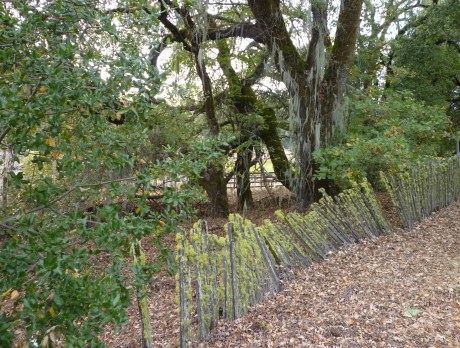
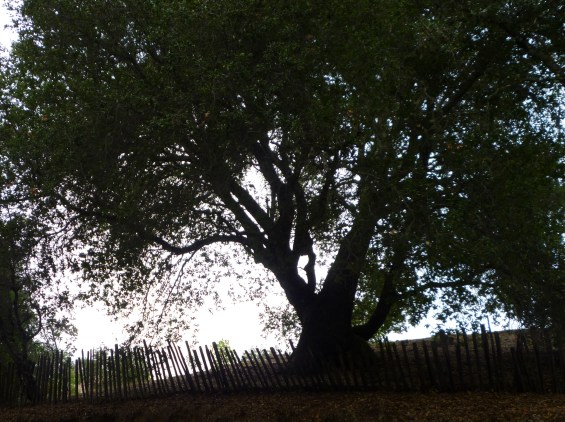
Except for a bit of queasiness from the windy road, which forced us to stop and get out for a few minutes, but it was at a comfortable and lonely place featuring aromatic oaks, a fence overrun with moss and lichen, and the glossy leaves of madrone trees. The leaf mulch under these trees was incredibly thick and spongy. If we’d had a picnic, and preferably a picnic table to go with, it would have been the perfect place to prolong our mini-vacation.

But lacking those amenities, we continued on our way back to civilization, and here we are again. We may look and feel pretty much the same as we did a few days ago, but our quiet adventures have changed us. At the least, we have a thousand more things to thank God for.

P1110654


Nina

When the weather is hot, my friend Nina prefers not to be out pruning roses or picking apples, so yesterday, it being 99 degrees, I kid you not, was a good day to visit and find her in the cool house doing a little embroidery. She set it aside while talking to me, though, and curled her slender legs under her where she sat in an easy chair.

I’ve been getting to know her since last winter, but I don’t recall ever seeing her dressed for cold weather. It’s usually some combination of Bermuda shorts and flip-flops, because she does not like being hot. Once when I came by she was just taking a loaf of bread out of the oven. It was intended primarily for her sandwiches, but we discovered that we are alike in our inability to resist freshly baked bread, so we enjoyed a warm slice together.

Before this year, I had rarely spoken to Nina, but I did study her very intently when I would see her in church, not daring to hope that ever in my life I might look so elegant. Maybe the use of a cane actually helped her to walk with the grace and erect carriage of a dancer. Week by week I would see her go up to the altar to pray, as though she were processing up a great hall to be crowned queen, or like a bride on her way down the aisle to be joined to her husband. She always wore a hat and a smile, never hurried, and looked completely serene and at peace. Yesterday she told me that as a young child she was allowed to walk to church by herself, which she loved to do, because being in church to her meant Peace.Nina bd girls w roses

We organized a surprise recognition of her 100th birthday, which fell on a Sunday. Our sisterhood bought 100 roses and toward the end of the service passed them out to as many parishioners to hold. At the very end Nina was ushered up to sit at the front and we all paraded by and gave her a rose and/or a greeting.

What a lot of stories she has to tell from so many years on this earth! Her family was Russian and her father went to China as part of the large crew on the Trans-Manchurian Railway, around the turn of the 20th century. Nina’s family were among the many workers’ families who became permanent residents of Manchuria, but they also were like many of the Russians in that they eventually immigrated to America. Her brother came first, and then Nina all by herself made the journey as a young woman. The stories of that trip to San Francisco, and how she found her brother and met her husband, are the fascinating topics of our chats together.Nina roses HB

A year or more after her 100th birthday Nina switched to a wheelchair for church attendance, but at home she continues without any assistance. She has lived alone for more than 25 years, having been widowed twice.

The second time she had only been married a year when her husband told her that he had had a dream about his late wife in which she asked him to take a walk with her. “Did you go with her?” was Nina’s immediate question. Because Russians have a superstition (she did not use that word) that if you have this dream about someone who has passed from this life, and you agree to walk with them, you will soon join them “on the other side.”

Nina says that her husband would not answer her question, and it wasn’t very long before they were in a car accident together, in which he was instantly killed. For a short time Nina lost her own will to live, but thanks to the mercy of God she realized that she loved her children and wanted to go on living. But in her own house, mind you, where she can do things the way she likes, including her own yard work, cooking, and housecleaning.??????????????????????

When she was about 50 she had some health problems, likely brought on by the pain of her first widowhood, and two of her doctors advised her about her diet. Between them she got the message not to eat dairy products or white flour, and to drink carrot juice. 50+ years ago how many people were drinking carrot juice? Not enough to cause the stores to carry it, so she bought a juicer and has been making her own ever since.

There doesn’t seem to be a fitting way to end this introduction to my friend who is now 102. She is going forward, and going strong, and shows no sign of slowing down. I want to learn from Nina, I want to be more like her. So far my lessons are: smile, drink your carrot juice, and stand up straight.

Enduring and Truthful Fictions

Today is Book Lovers’ Day, my friend Myriah just informed me, and I’m so glad she did. It’s actually one of two days that are celebrated for and by people like us. To mark the day I am re-posting an old book review I wrote, from 2009. It’s a response to three books, so we could think of it as a triple treat for our readers’ party:

Three Truthful Fictions

In early summer I read three works of fiction in a short space of time:

Ah, But Your Land is Beautiful by Alan Paton
A Thousand Splendid Suns by Khaled Hosseini
The Folding Cliffs by W.S. Merwin

These were all pretty dramatic stories of historical fiction. Paton’s book follows closely the events in South Africa mid-20th century. Hosseini writes about Afghanistan in the last 30 years, and Merwin’s book is an epic poem about Hawaii, mostly in the 19th century.

I was sitting around after surgery with my foot up, and that was what had made it possible for me spend more time reading and thinking. Some things I thought about: How funny that the settings of these thr3 truthful fictions picee books were at three corners of the globe. Obviously they were not part of any theme. So were there some ways they were alike? What made them all worth reading to the end, when so many books I’ve tried lately were not?

Suffering was a large part of all the stories. The Afrikaners in Ah, But Your Land is Beautiful were treating all people of color unjustly and inhumanely. Whites who did otherwise suffered along with the oppressed, and often sacrificed their careers, homes, and reputations.

All the women suffer miserably in A Thousand Splendid Suns. War and famine, selfish and sinful men and women supported by bad cultural traditions, all combine to keep the women trapped in complicated and painful predicaments. Factions of Muslims hate one another.

The Folding Cliffs makes vivid the way conquering peoples oppress the vanquished, all the while thinking it is “for their own good.”

What benefit is there in dwelling on Man’s Inhumanity to Man? Don’t we already know how wretched we are? If that were all one gets from these stories, I don’t think they would be worth reading, but there is another bigger part to all of them, and that is Man’s Love. Just as Christ gave His life in love for us suffering humans, so He gives grace to men to rise above their suffering, show compassion to their fellow man, and do deeds of mercy.

“Courage is not simply one of the virtues but the form of every virtue at the testing point, which means at the point of highest reality,” said C.S. Lewis, and it is this courage that is shown by the young parents in Cliffs who flee to the hills and fight off government agents who are shooting at them, rather than have their family torn apart by the health officials who are shipping lepers off to Molokai like so many unclean animals. Their love is demonstrated in the test of courage.

In Land, the author and his companions find joy and fellowship in realizing the sacrificial, mercy-giving aspect of their humanity as they fight what seems to be a losing battle against political power. Perhaps they were living what Winston Churchill was talking about when he said, “We shall draw from the heart of suffering itself the means of inspiration and survival.”

Alan Paton in his autobiography Towards the Mountain writes of the experience:

“…the inhumanity of man to man could be made endurable for us only when we manifested in our lives the humanity of man to man….there is a wound in the creation and…the greatest use we could make of our lives was to ask to be made a healer of it.”

I haven’t lived with the kinds of suffering I read about, and that is partly why I think these writings are valuable, for as we read we take as our companions in mind and heart characters who are historically real or fictionally true, who can train us in Christian virtue.

Khaled Hosseini has given his countrymen and all of us a wonderful gift in the two books of his I am familiar with. In Kite Runner and in A Thousand Splendid Suns he paints a backdrop of horror, including much personal moral failure. Kite Runner exposed my own innate cowardice as I empathized with the protagonist, and as he was able to find healing and hope after repentance, I was also comforted.

In Suns the author gives a tender role model to women everywhere who are beaten down by life. The character of Miriam is the ultimate in misery, as she has no friends and no family who care about her, and she is barren, so her husband hates her. Then a young woman comes into her life, a woman who could easily slide into being another tormentor. But instead she shows kindness and becomes a true friend, and Miriam finds hope and courage, as well as other parts of her humanity and womanhood that had been obscured. She is transformed from a passive recipient of abuse into a woman who can return love, and she is happy, even in the face of continued abuse.

These stories have the potential to become part of the collective consciousness of a people, and help us to live more humanly, more humanely. I hope that Suns in particular can give vision to the women of Afghanistan, a vision of themselves as able to rise above their circumstances by means of love toward others.

We won’t eliminate the oppressors; our hope does not consist of that, as Father Alexander Schmemann has summarized:

“The fundamental Christian eschatology has been destroyed by either the optimism leading to the Utopia, or by the pessimism leading to the Escape. If there are two heretical words in the Christian vocabulary, they would be ‘optimism’ and ‘pessimism.’ These two things are utterly anti-biblical and anti-Christian…. It is for us, Christians, to reconstruct this unique faith, in which there are no illusions, no illusions at all, about the evil.”

Keeping with the theme of inspiring fiction, I’ll end with a quote by Whittaker Chambers from Witness (which book I love, but it is not fiction) about a novel that was formative for him. I haven’t read Les Miserables, but I noticed a few years ago that at least three important writers I knew of had mentioned they read it more than once as children. Sorry, I can’t remember who the others were. Chambers describes what can happen when a good writer connects with the reader:les miz pic

“I read and reread Les Miserables many times in its entirety. It taught me two seemingly irreconcilable things–Christianity and revolution. It taught me first of all that the basic virtue of life is humility, that before humility, ambition, arrogance, pride and power are seen for what they are, the stigmata of littleness, the betrayal by the mind of the soul, a betrayal which continually fails against a humility that is authentic and consistent. It taught me justice and compassion, not a justice of the law, or as we say, human justice, but a justice that transcends human justice whenever humanity transcends itself to reach that summit where justice and compassion are one….”