Category Archives: homemaking

May the pots never grow cold.

About 30 years ago we owned a modular house whose many large windows were covered by the original fancy draperies, so that when the curtains were closed they covered most of the expanse of three walls with nubby gold curves. The walls were thin particle board painted to look like wood, as you can see in the photo – but I didn’t mind those as much as the drapes. I would have preferred something more rustic and casual and of another color to go with the country setting, but even if we’d had the money we couldn’t have justified spending it to replace Perfectly Good high-quality drapes.

It was a recurring temptation to me, though, to stew over how ugly and Not Me they were. This was tiresome, and eventually my better self convinced my offended self to stop, using this argument:

What is your purpose in life? To love God and be useful to Him.

What is the most important way for you to do that? To love people.

Do you need pretty and tasteful drapes in order to love people? No, I answered. If someone who comes to my house sees my drapes and not me, I can’t help that. If they need my hospitality and friendship they need it from me personally, and God will just have to use me in spite of this ugliness in the room. (Which of course was not a universally recognized ugliness anyway.)

Those of us who have read any of Edith Schaeffer’s other books know that she by her life and words demonstrated the importance of love and hospitality. Her book The Hidden Art of Homemaking, which is the subject of a book club hosted at Ordo Amoris, I do not take as contrary to the rest of her life and work, but complementary to it. Some of you may not have read the other books like What is a Family? Partly from reading it I am pretty sure that if she had to choose, she would herself rather have been a resident or guest in a plain and even ugly house run by a warmhearted woman than in an artistically decorated dwelling with an unkind or angry soul. We’ve all heard of and perhaps had the experience of going into a house where the decor was shabby or messy but you wanted to be there because it felt like home — welcoming and nurturing. Mother Teresa’s saying fits here: “Love begins at home, and it is not how much we do… but how much love we put in that action.”

I think Edith’s own houses were like this, because she was that kind of woman, and likely much more than I myself am. But I have it as a vision to be like that, and am inspired by quotes that speak of a woman being able to make a home wherever she finds herself, of a woman herself being the heart of her home….but I can’t find any of those at the moment. The line that has intrigued me for years now is from the Santana song “You’ve Got to Change Your Evil Ways,” from the perspective of a man who is dismayed by his woman who’s gadding about all the time:

When I come home, Baby,
My house is dark and my pots are cold.

These are just signs to the poet that there is no woman at home to welcome him.  The verse reminds me of advice I read to housewives who haven’t figured out what to make for dinner, but who want to do something to give their husbands a good feeling when they come in the door after work: While you are getting your act together put an onion in the oven to bake so that he will get a hopeful olfactory signal.

A message I get here: A woman conveys her love and hospitality by these simple modifications to the environment: opening the drapes or turning on the lights, cooking something in the kitchen, and in both ways warming up the sensory atmosphere. If she has a kiss and a smile for her family and guests all the better.

The last few years when my husband and I live here alone, I notice that I am the one who thinks about light control. In that photo above you can see all the light that came into the humble house with the gold drapes. It was the best feature of the house, as I was later to discover, when I wanted our new house to have as much light — it was not to be. The photo was likely taken in the winter, when we would open the drapes wide and let in all the warming sun.

In our area we can get along pretty well in summertime without air conditioning, if we manage the windows and window coverings: At night open all the windows to let the cool air in; in the morning close everything up to shut out the sun’s rays, and leave them that way (and the house kind of dark!) until the air inside gets as warm as outdoors — then you may as well get any breeze that might stir, and be ready for the coolness to enter as soon as it arrives.
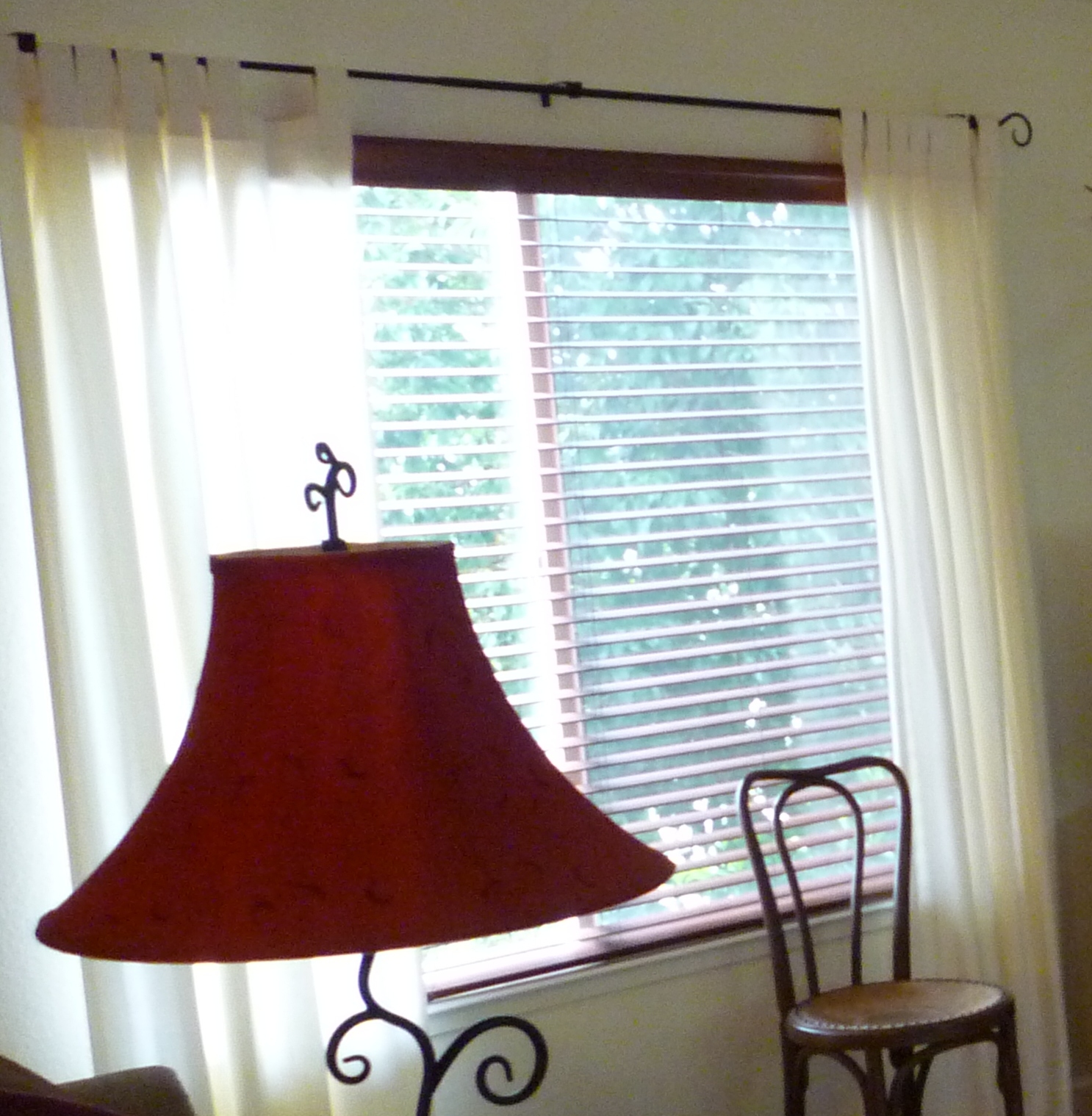
In Spring or Fall our present house doesn’t get very hot, so in the mornings I like to open the blinds and let the sun in as soon as I come downstairs — but my man never thinks of doing this. For my mind, sunlight is the very loveliest decoration. And at night, I like to close the curtains or blinds so as to feel sheltered against the world. This also seems to be, in my experience, a homemaker’s impulse.

I have learned to do many artful things in my houses over the decades; I have arranged and painted furniture, swept the floor, bought bedspreads and embroidered Bible verses to hang on walls that I painted, but those things aren’t more important than the light-monitoring I do. I also tend the fire in the stove, and light candles, and keep the pots warm.

While you’re working on the outward appearance of your home, attend also to your heart and keep it warm with prayer. If the family members are getting snappy or sulky, take a prayer break together and ask God’s help – then sing something to warm up the atmosphere. I like this quote that Debbie posted, by Laura Ingalls Wilder:

Let’s be cheerful! We have no more right to steal the brightness out of the day for our own family than we have to steal the purse of a stranger. Let us be as careful that our homes are furnished with pleasant & happy thoughts as we are that the rugs are the right color and texture and the furniture comfortable and beautiful.

Thank God for making Edith Schaeffer the kind of woman who could pass on to us a bright homemaking heritage.

The Music of My Life

The third chapter of The Hidden Art of Homemaking is the impetus for this post. It is titled simply “Music,” and continues the theme of how Christians might express their creativity in their varied and unique circumstances. I am participating in the discussion of the book on Cindy’s blog, Ordo Amoris. This is a long post and I apologize — you would be smart to skip it and go do something creative!

It might have been 30 years ago that I first read Hidden Art, and I wrote on the day of the author’s death how important it was in developing a vision for my life. At the time of its publication in 1971 I don’t think there was anything else like it, but feminists were writing plenty about the stifling life of the typical housewife. It was lovely to have laid out before me many concrete examples of interesting people and their home-enriching activities.

Just a couple of years later, Karen Mains wrote Open Heart, Open Home, which also contributed to my Christian vision, on the theme of hospitality. And I was married in the early 70’s, and enjoying keeping house and garden even before the children started arriving. When the house began to fill with kids, I never lacked for creative projects and plans.

But I hadn’t even read Schaeffer’s book yet. My young-married-childbearing years were overflowing with culture and creativity, and I could not relate to the reader Edith seemed to be writing for, someone who is frustrated, locked up, or unfulfilled (her words).

Only recently have I been able to look back over my life and see with more understanding (I hope) why the story reads the way it does. I needed time to think, and I needed to see more of the plot toward the end, before I could notice how the first chapters fit with middle parts of my saga.

Part I contained an excess of family drama, as we call it these days, emotional and psychological stress that I didn’t get any help dealing with. If you have a splitting headache it is hard to tap into your creativity. It’s the same with emotional pain, maybe more so when it isn’t diagnosed or even acknowledged, but stays like an always-freshening wound that makes you want to move as little as possible.

Me in Part II

What brought me into Part II was getting married to a good man and empowered to create my own story, free of distracting pain. The setting was calm and clear and full of the hope of the gospel. It was somewhat the opposite of what Schaeffer talks about, because being home was my obvious opportunity to do just about anything. I had had no lack of examples and ideas; actually, the hippie era for me segued into a homesteading spirit a la The Mother Earth News. And there were all the creative people I’d known growing up (just about everyone), while I was storing up tinder for my creative fires.

I see that I have mixed a few metaphors here trying to tell my story — or am I writing the score for the symphony that has been playing out? Though this chapter is about music, it seems as good a place as any to bring up what seem to me to be realities on which our artistic life is built. They apply to music, too.

I received little musical training as a child, and I had no career that I had to put on the back burner. But growing up in church was good ear-training, and even in the Girl Scouts and in public school we sang a lot. I was lucky to marry a musician, and by means of his guitar and my singing we filled the house and our children’s ears with music.

We sang in the car, using songbooks I wrote out by hand. We sang around the campfire. We parents sat on the bedroom floor and crooned lullabies to our children every night. And in church I helped the young readers to develop fluency while hymn-singing, running my finger along the page under the words while they looked on. But I don’t know how to read music.

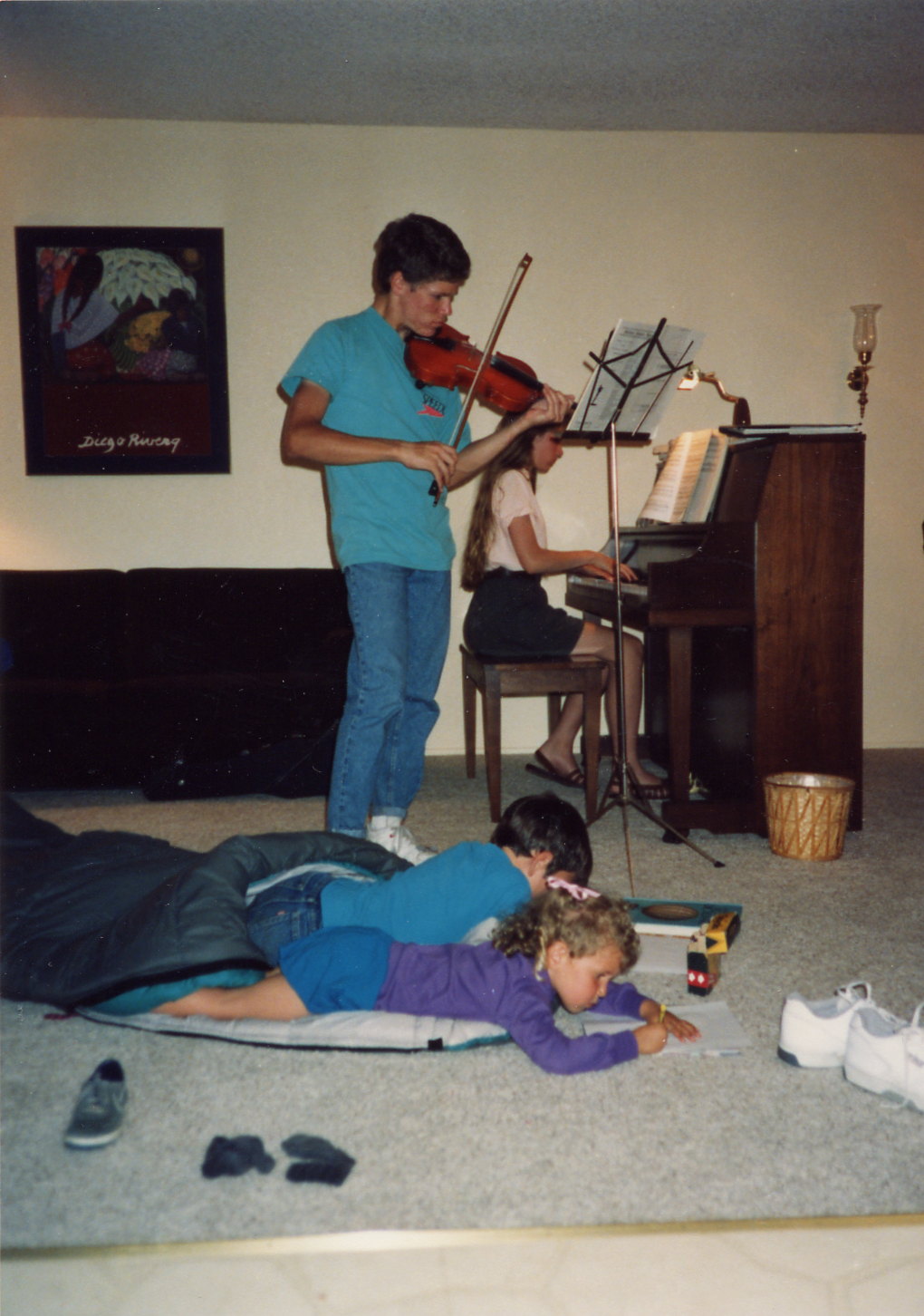
At first there wasn’t money for music lessons, and I wept over the injustice of a world in which my firstborn had no opportunity for a more structured musical education. Then grandparents and great-grandparents stepped in and God provided a generous piano teacher two blocks from our house. From that time forth the provisions continued in various ways, so that eventually all of our five children learned to play at least one instrument. The photos are of them and a grandson enjoying their music. Two of our daughters became piano teachers in their teens.

But for many families, music is not something they can really accomplish. My parents could not provide it for me, but it all worked out o.k. Some women find that their distracting drama only starts when they marry, or when a child falls ill. There are women for whom getting through the day is like climbing a steep mountain, and while they might be relieved to stop and smell the flowers, it’s asking a lot to tell them they ought to get out the seed catalog and develop a plan for further landscaping. But I suppose they aren’t the ones reading Hidden Art.

When Schaeffer says things like, “Christian homes should…be places where there is the greatest variety of good music,” I balk at the word should. I don’t know how she might otherwise have presented a picture of what she considers the ideal home, but every time she says we should do this or that to develop our creative side — and in the short Chapter 2 she used the word nine times — I get annoyed that she is telling me what my Christian duty is.

To me that’s backwards, because I can’t recall ever doing one creative homemaking thing out of a sense of duty, though I firmly believe we are all obligated to do our duty. To fear God and keep His commandments is the whole duty of man, according to Ecclesiastes (Not that we can even accomplish those basics on our own). It seems to me that the rest, the art and music and beauty, flow naturally from a human soul that is nurtured by God’s love — just as sap running up a tree trunk results in bright leaves and colorful fruit. The main thing is not to tell the tree to make fruit, but to keep the connection to the life-giving Fountain — Who is also the One who heals all those diseases of the heart that might hinder us.

What do you know — beauty in our life is one of the healing potions God provides. So if we start with small things that brighten our homes, say, singing a few lines from a hymn over the kitchen sink, or teaching a nursery rhyme to a toddler, just in response to the impulse, we are creating culture and feeding our own souls. It keeps the sap running, and the more the tree grows, the more sap and delicious fruit there will be.

Since Edith Schaeffer wrote this book and What is a Family, the only two of hers that I have read, thousands of families have discovered that homeschooling provides the opportunities to build the kind of family life and culture that the author presents a vision for. Just give us enough time with our children and all these good things are more likely to happen. The vision she sets forth was an ingredient in the soil that nourished my own heart and gave me the courage I needed. All the rest is in Part II, Part III, and still writing… Oh, and still singing new songs!


The beginning of a true newness

I am somewhat apologetically writing already another post on The Hidden Art of Homemaking, because it is the philosophy and theology, the heavenly underpinnings perhaps, that inspire me and give me the energy to carry out the practical details. From looking at the chapter titles it seems that this introductory chapter might be the one about which I have the most musings.

As to the oddness of me taking my inspiration from yet another man, when it is we women who traditionally do the homemaking and who are discussing a woman‘s book, I will just say that, Christ who enables us also was a man, and the Life of The Holy Trinity is something greater than our gender roles. The reality of the Holy Spirit operating in the world through us is our means of living out our humanity. Homemaking is one of the many facets of our calling and our life in God, and this particular pastor always encourages me in the fact of “Christ in you, the hope of glory.”

The passages from Metropolitan Anthony are from a talk on Genesis given in June, 1986, from the book Metropolitan Anthony of Sourozh: Essential Writings by Gillian Crow.

Creativeness, however, is something more complex than the ability to call out new forms, to shape one’s surroundings or even to determine to a certain extent…our destiny. It begins with the ability to change — to change intentionally. Creativeness begins with the ability a being has…to become what he is not yet, to start at the point at which he was created and then grow into a fullness that he did not possess before: from image to likeness, if you will — having begun to be, as it were, a reflection, to become the reality itself; having begun to be in the image of the invisible Creator, to become the image of God incarnate.

…And this process is a creative process. It is not an organic one; it is not something that must develop inevitably; it is something that we must choose and that we must achieve with the grace of God.

Amy mentioned the possibility that we might, contrary to our calling, create ugly or bad things, and even sometimes express not craftsmanship but craftiness. Other and various sinful impulses can also rob us of our creative strength. On the other hand, many times just creating something can give us a boost in the right direction. For example, I am learning not to be discouraged by the disorder of my messy house. Instead I can take joy from the chance to create order and space to replace — or at least reduce! — the chaos that so easily develops. But creating order out of chaos is huge. That seems like a good description of one aspect of the creative work God is always doing in our lives.

Met. Anthony says that the creative work he is primarily talking about is not the art and music and literature that we tend to think of right away,

…both of heart and intelligence, of skill and of hand, but is much more essential and also much more important because all the rest can flow from this basic source of creativeness but cannot derive from anything else.

So that here we are confronted with man, whom God has called and loved into existence, endowed with His image, launched into life, and when on the seventh day the Lord rested from his works, the seventh day will be seen as all the span of time that extends from the last act of creation on the part of God to the last day, the eighth day, the coming of the Lord, when all things will be fulfilled, all things will come to an end, reach their goal, and blossom out in glory. It is within this seventh day, which is the whole span of history, that the creativeness of man is to find its scope and its place.

And this is a wonderful call to us because each of us can be a creator within his own realm, within his mind and his soul, by making them pure and transparent to God, within his actions and life, and become what Christ said we are called to be: a light to the world, a light that dispels darkness, a light that, as in the beginning of creation is the beginning of a new day — that is, the beginning of a true newness and a new unfolding of the potentialities that are within us and around us.

(Cindy was hosting a discussion of Edith Schaeffer’s The Hidden Art of Homemaking, and this post was written as a contribution.)