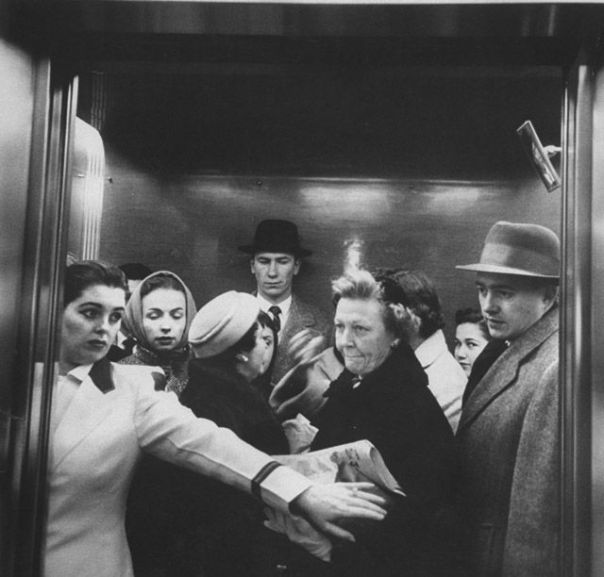
“People have always found ways to carve out moments of privacy in public space; this is part of what makes public space tolerable for everyone. Civil attention’s twin is civil inattention, ‘whereby one treats the other as if he has been seen but is not an object of undue curiosity,’ as Goffman described. We nod at the stranger stepping into the elevator and then return to staring at the ceiling or look up briefly from reading when other commuters get on the bus.
“Civil inattention is still a kind of acknowledgment, qualitatively different from being ‘looked at as through air.’ When we focus our attention on the glowing screens of our smartphones rather than on the people around us, never granting them even brief acknowledgment, we are not practicing civil inattention but civil disengagement. This is becoming the norm in public space.”
— Christine Rosen, The Extinction of Experience: Being Human in a Disembodied World
If ever mercy move you murder me, I pray you, kindly killers, let me live. Never conspire with death to set me free, but let me know such life as pain can give. Even though I be a clot, an aching clench, a stub, a stump, a butt, a scab, a knob, a screaming pain, a putrefying stench, still let me live, so long as life shall throb. Even though I turn such traitor to myself as beg to die, do not accomplice me. Even though I seem not human, a mute shelf of glucose, bottled blood, machinery to swell the lungs and pump the heart — even so, do not put out my life. Let me still glow.
“Late one winter afternoon as I was walking to a class that I had to teach, I noticed the beginnings of what promised to be one of the great local sunsets. There was just the right kind of clouds and the sky was starting to burn and the bare trees were black as soot against it. When I got to the classroom, the lights were all on, of course, and the students were chattering, and I was just about to start things off when I thought of the sunset going on out there in the winter dusk, and on impulse, without warning, I snapped off the classroom lights.
“I am not sure that I ever had a happier impulse. The room faced west so as soon as it went dark, everything disappeared except what we could see through the windows, and there it was—the entire sky on fire by then, like the end of the world or the beginning of the world.
“You might think that somebody would have said something. Teachers do not usually plunge their students into that kind of darkness, and you might have expected a wisecrack or two or at least the creaking of chairs as people turned around to see if the old bird had finally lost his mind. But the astonishing thing was that the silence was as complete as you can get it in a room full of people, and we all sat there unmoving for as long as it took the extraordinary spectacle to fade slowly away.
“For over twenty minutes nobody spoke a word. Nobody did anything. We just sat there in the near-dark and watched one day of our lives come to an end, and it is no immodesty to say that it was a great class because my only contribution was to snap off the lights and then hold my tongue. And I am not being sentimental about sunsets when I say that it was a great class because in a way the sunset was the least of it.
“What was great was the unbusy-ness of it. It was taking unlabeled, unallotted time just to look with maybe more than our eyes at what was wonderfully there to be looked at without any obligation to think any constructive thoughts about it or turn it to any useful purpose later, without any weapon at hand in the dark to kill the time it took. It was the sense too that we were not just ourselves individually looking our at the winter sky but that we were in some way also each other looking out at it. We were bound together there simply by the fact of our being human, by our splendid insignificance in face of what was going on out there through the window, and by our curious significance in face of what was going on in there in that classroom.
“The way this world works, people are very apt to use the words they speak not so much as a way of revealing but, rather, as a way of concealing who they really are and what they really think, and that is why more than a few moments of silence with people we do not know well are apt to make us so tense and uneasy. Stripped of our verbal camouflage, we feel unarmed against the world and vulnerable, so we start babbling about anything just to keep the silence at bay. But if we can bear to let it be, silence, of course, can be communion at a very deep level indeed, and that half hour of silence was precisely that, and perhaps that was the greatest part of it all.”
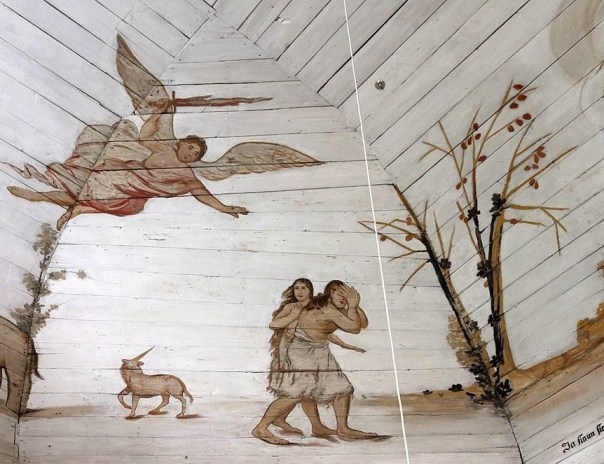
At this season of Thanksgiving as a holiday, it seems good to consider thanksgiving as a way of life, even a way to Life. First, D. Martyn Lloyd-Jones brings up a good point about the Garden of Eden:
“. . . The terrible fallacy of the last hundred years has been to think that all man’s troubles are due to his environment, and that to change the man you have nothing to do but change his environment. That is a tragic fallacy. It overlooks the fact that it was in Paradise that man fell. . . .”
—D. Martyn Lloyd-Jones, Studies in the Sermon on the Mount (1971)
Mikael Toppelius, Expulsion of Adam and Eve, Finland
Fr. Alexander Schmemann also mentions that garden:
“In the story of the Garden this took place in the cool of the day: that is, at night. And Adam, when he left the Garden where life was to have been eucharistic — an offering of the world in thanksgiving to God — Adam led the whole world, as it were, into darkness. In one of the beautiful pieces of Byzantine hymnology Adam is pictured sitting outside, facing Paradise, weeping. It is the figure of man himself.”
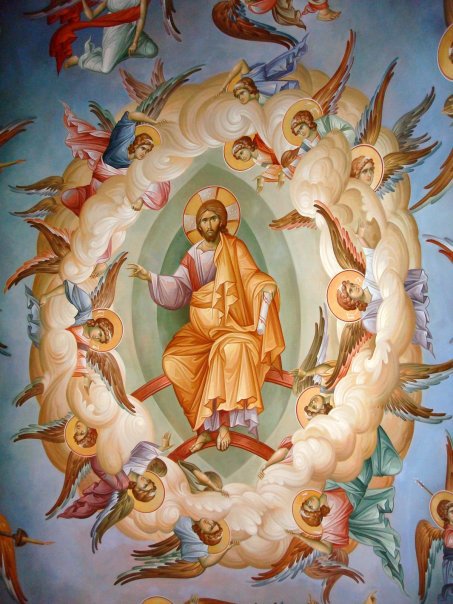
But that sad picture is not the end. The Son of God became incarnate, and Jesus Christ is the New Adam. He has fulfilled all that the first Adam failed to do, and now in the Divine Liturgy we can:
“…ascend to heaven in Christ to see and to understand the creation in its real being as glorification of God, as that response to divine love in which alone creation becomes what God wants it to be: thanksgiving, eucharist, adoration. It is here — in the heavenly dimension of the Church, with ‘thousands of Archangels and myriads of Angels, with the Cherubim and Seraphim … who soar aloft, borne on their pinions …’ — that we can finally ‘express ourself,’ and this expression is: Holy, Holy, Holy, Lord of Sabaoth. Heaven and earth are full of Thy glory. Hosanna in the highest. Blessed is He that cometh in the Name of the Lord. This is the ultimate purpose of all that exists, the end, the goal and the fulfillment, because this is the beginning, the principle of Creation.”
“In thanksgiving we recognize and confess above all the divine source and the divine calling of our life. The prayer of thanksgiving affirms that God brought us from nonexistence into being, which means that he created us as partakers of Being, i.e., not just something that comes from him, but something permeated by his presence, light, wisdom, love – by what Orthodox theology, following St. Gregory Palamas, calls the divine energies and which makes the world called to and capable of transfiguration into a ‘new heaven and a new earth,’ and the ruler of creation, man, called to and capable of theosis, ‘partaking of the divine nature.’”
-Fr. Alexander Schmemann
These three quotes from Fr. Alexander are from the book, For the Life of the World, an incredibly rich and deep explanation of Orthodox Christian theology. Our women’s book group and sisterhood at church are reading it right now during our Nativity fast, and I discovered that it can be found on YouTube being read in its entirety. You can listen for free here on the channel The Orthodox Voice: For the Life of the World.
“In everything give thanks, for this is the will of God.” I Thessalonians 5:18
Getting back to thanksgiving as a holiday, this year I’ll be giving thanks and praise with the angels in the morning in Liturgy, and in the afternoon feasting in the traditional American way. Whether your celebration is small and quiet, or large and festive, I hope you remember much to be thankful for ❤
 “Late one winter afternoon as I was walking to a class that I had to teach, I noticed the beginnings of what promised to be one of the great local sunsets. There was just the right kind of clouds and the sky was starting to burn and the bare trees were black as soot against it. When I got to the classroom, the lights were all on, of course, and the students were chattering, and I was just about to start things off when I thought of the sunset going on out there in the winter dusk, and on impulse, without warning, I snapped off the classroom lights.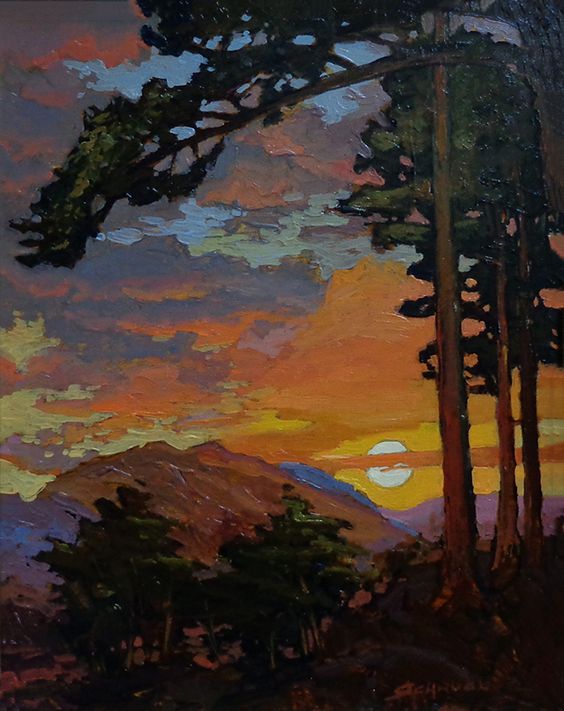
 calls the divine energies and which makes the world called to and capable of transfiguration into a ‘new heaven and a new earth,’ and the ruler of creation, man, called to and capable of theosis, ‘partaking of the divine nature.’”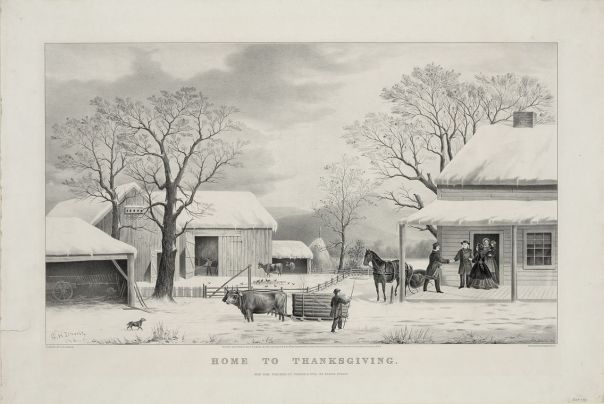
 Gladsome Lights