Category Archives: icons

Myrrhbearers

As St. Joanna was one of the women who bravely went to Christ’s tomb early in the morning to anoint his body, she is commemorated today as one of the Myrrhbearers — which makes today my name day!  I wrote a little more about this here; today I wanted to show an icon that was a gift from my husband, along with the eggs that daughter-in-law Joy knitted for me.

The angel came to the myrrhbearing women at the tomb and said, “Myrrh is meet for the dead; but Christ has shown Himself to be a stranger to corruption, so proclaim: The Lord is risen! Granting the world great mercy.”  — from the troparian of the day

myrrhbearers 14

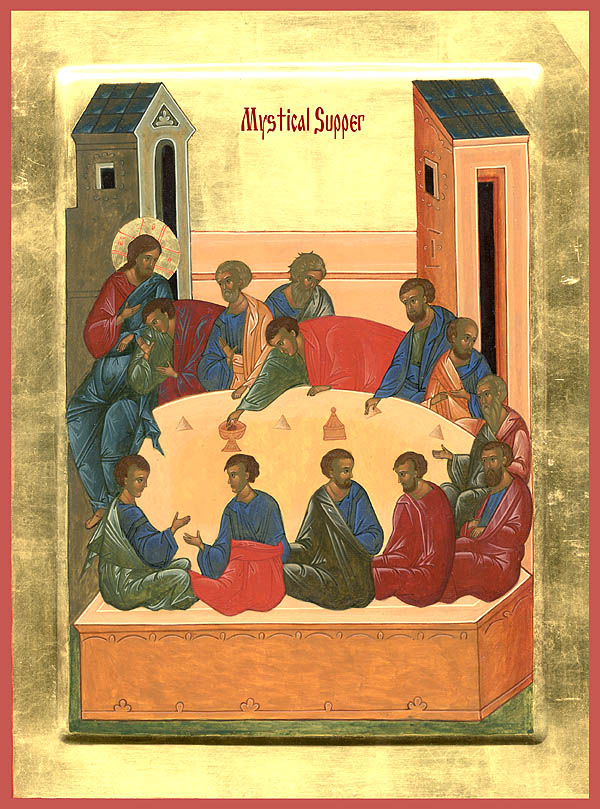
Mystical Supper

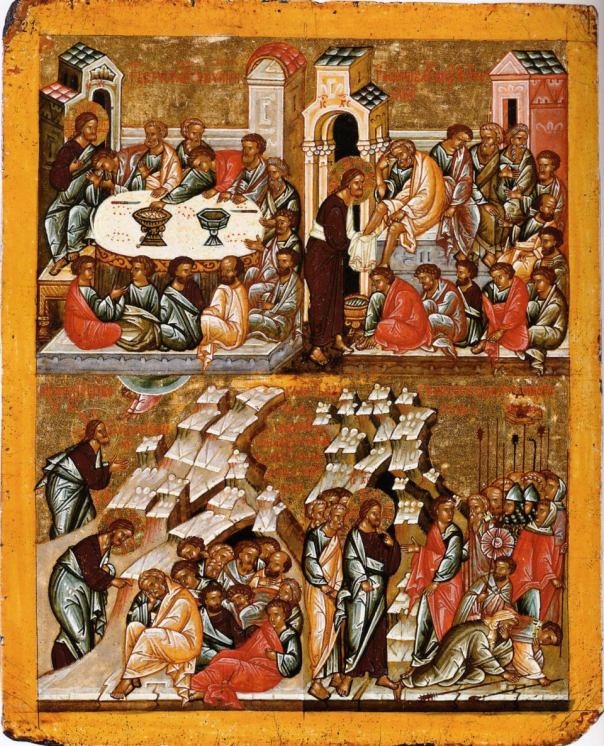
The Orthodox Church remembers so many events on Holy Thursday that it takes five mostly-long passages to comprise the Gospel reading. These events are: the washing of the disciples’ feet, the institution of the Sacrament of the Holy Eucharist at the Last Supper, the agony in the garden of Gethsemane, and the betrayal of Christ by Judas.

Icon Reader shares a 15th-century Russian icon that includes all of these events:

holythursday_15c_rus

This site explains at length all the commemorations of the day, including the Last Supper, which is our experience also in the Divine Liturgy as the article testifies: “In the Eucharist the Church remembers and enacts sacramentally the redemptive event of the Cross and participates in its saving grace.”

On his blog this week Fr. Stephen explores Judas’s “banal and prosaic” reason for betraying Jesus: the love of money. He writes: “Money is the anti-Eucharist. Like the Eucharist, it is a way of life.”

“Christ gives His disciples the Eucharist on the ‘night in which He was betrayed.’ … Christ loves the Father – and all that the Father has given to Him. The bread that Christ gives is life, and life more abundantly…God give us life!

mysticalsupper

Incessantly and Altogether Beautiful

Tonight marks the end of Lent in the Orthodox Church. We enter Holy Week with Lazarus Saturday, and of course we do fast until Pascha, but it’s not technically Lent anymore for us. We now stop thinking about whether we succeeded or failed at Lent, because we need to focus on what God has done and be fully present for these last days of the remembering of the death and resurrection of the Lord.

In our parish we had Matins of Lazarus Saturday, a time to remember the whole story of how Lazarus had been dead four days when Jesus came into town and his friends said, “If only you had been here, he wouldn’t have died.” And Jesus wept. Then He showed his power over death, and raised Lazarus. And then followed the events that sent Him to His own death, which He also overcame for our sakes. His powerful beauty is still filling this world.

Despite the effects of the Fall and despite our deep sinfulness, the world continues to be God’s creation. It has not ceased to be “altogether beautiful.” Despite human alienation and suffering, the Divine Beauty is still present in our midst and still remains ever active, incessantly performing its work of healing and transfiguration. Even now beauty is saving the world, and it will always continue to do so. But it is the beauty of a God who is totally involved in the pain of the world that He has made, of a God who died on the Cross and on the third day rose victorious from the dead.

–Metropolitan Kallistos

christ passion