O Lord Jesus Christ our God, who didst lead the people of Israel in a land unknown, a land of drought and deep darkness, a land none may pass through or dwell in: do thou, the same Lord, lead me all the days of my life, giving me to discern the times and their signs, and to redeem time’s passage – for the days are evil – guiding me in the way that I should go, that I may ever say: I love thee, O Lord, for thou hast heard the voice of my supplication from my mother’s womb, yea, from all eternity, and thou art the Way and the Truth, and the Resurrection and the Life, the Sunshine that ripens all who live and repose in thee, the Peace of God, and also our Peace with him: always, now and ever and unto ages of ages. Amen.
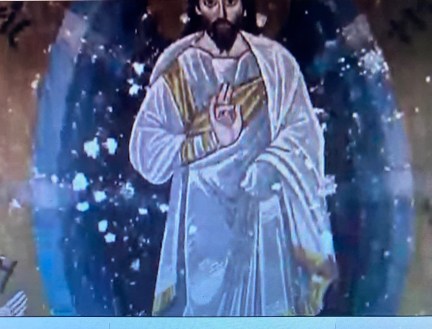
This mosaic dating from the 6th century is in the apse of the great basilica at St. Catherine’s Monastery, Mt. Sinai, built by Emperor Justinian before 565. I found it when I was looking at icons on the internet of Christ’s Transfiguration, which we commemorate today.
I also watched a fascinating video, the Conservation of the Transfiguration Mosaic, featuring an informal and entertaining lecture by an eminent Italian archeologist, conservationist and expert on mosaics, Roberto Nardi. It is informal in that he does not read a paper, but gives the best kind of commentary on the extensive video footage shown. The video is from 2012, so maybe I am one of the last to see it.
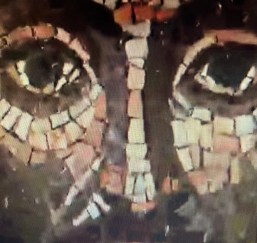
He starts with the history of the monastery, which he admits goes back to Moses and the burning bush, on through St. Helen and St. Justinian; the mosaic was installed soon after the church was built. In 1847 a Russian monk named Samuel did a huge amount of restoration work on the mosaic, and in 1957 archeologists sounded an alarm about its deteriorating condition, but it lasted 50 more years to the point where this 5-year project began. By then, 20,000 tiles were missing (though of course monks had saved them in boxfuls), which equaled 4% of the total, and a great number of the remainder were no longer actually attached to the base layer.
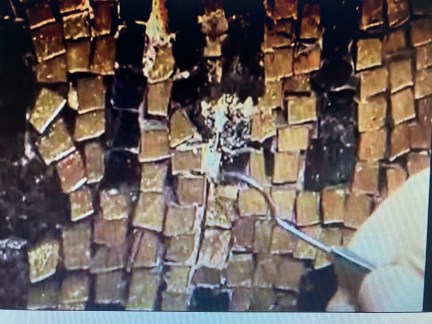
I could watch this video over and over, all the tedious detail work so well documented. What they did about the missing tiles (shown as white spots in the picture just above) was the outworking of a series of complex deliberations. I hope you will check out at least a bit of the video, because I don’t know where to stop, telling you all the things about this long project that impress me. How the conservators came to learn to appreciate the experience and perspective of the monks — the ones who live with the icon and pray with it every day — was a touching part of the story. The pictures I show you are just teasers, blurry because I took them of the video on my desktop computer monitor.
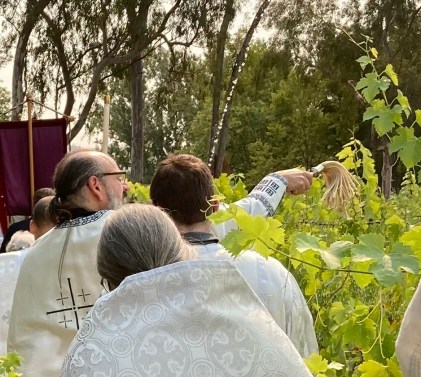
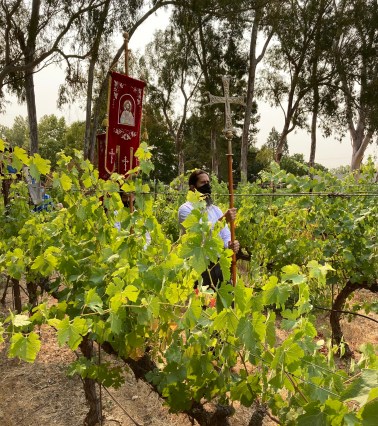
Back in the U.S.A., our parish celebrated the feast with all the important elements intact. If you want to read more content on the feast itself you can find a lot from past years here. I don’t always get to be part of the procession through the church vineyard, and sometimes I have forgotten to bring a basket of fruit, but today I managed both!
The monks celebrating the Divine Liturgy under the icon of the Transfiguration at Mt. Sinai, and the Orthodox parishioners in California — we are all singing this hymn of the feast:
O Lord, we will walk in the light of Thy countenance, and will exult in Thy Name forever.
(Ps. 88:15)
Icon of the Transfiguration, St. Catherine’s Monastery, Mt. Sinai
When You did fulfill the dispensation for our sake,
And unite earth to Heaven:
You did ascend in glory, O Christ our God,
Not being parted from those who love You,
But remaining with them and crying:
I am with you and no one will be against you.
–Hymn for the Feast of Ascension
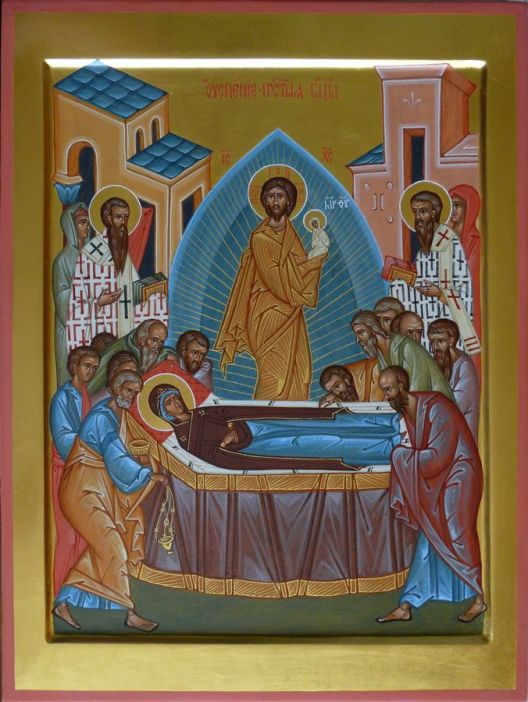
It’s something I can’t grasp, with my very earthly mind, how Christ the God-Man is now in Heaven. As we heard in the homily this morning, when Christ ascends, “He takes created flesh to a place Creation has never gone before.” I understand that Heaven is not a place on a map somewhere, but just what or where is it?
In any case, if the heavenly realm is open to the Son of Man, it’s open to us. We were exhorted not to forget that it’s what our life is really about, this journey to the Kingdom. Or put another way, the Kingdom is in us already, if only as a seed. “Divine energies are working in us,” as our priest explained.
And getting back to historical events, Jesus had told his disciples that He would send the Holy Spirit, the Comforter. Ten days from now we will celebrate that event on The Feast of Pentecost. The Holy Spirit will help us on our heavenly journey!
The angels had something more to tell after Christ was received into a cloud, “Ye men of Galilee, why stand ye gazing up into Heaven? This same Jesus, Who is taken up from you into Heaven, shall so come in like manner as ye have seen Him go into Heaven.”
I do understand this much: God is with us, and good things are up ahead.
All the blessings of this feast to you all!
(This post is from the archives of my blog. I’m in Colorado for Ascension, but plan to be home in time for Pentecost.)


 He starts with the history of the monastery, which he admits goes back to Moses and the burning bush, on through St. Helen and St. Justinian; the mosaic was installed soon after the church was built. In 1847 a Russian monk named Samuel did a huge amount of restoration work on the mosaic, and in 1957 archeologists sounded an alarm about its deteriorating condition, but it lasted 50 more years to the point where this 5-year project began. By then, 20,000 tiles were missing (though of course monks had saved them in boxfuls), which equaled 4% of the total, and a great number of the remainder were no longer actually attached to the base layer.