California poppies with Iceland poppies in foreground – April 2020
In spring, the California poppies (Eschscholzia californica) swamp the front of my garden, and after a few weeks of exulting in their glory I have to pull them all out and uncover the irises, salvia and other plants that I want to see. A few more weeks, and the poppies have sprouted new leaves and sometimes blooms as well. Here’s an example at left, from just now.
The classic orange color is dominant, so orange flowers keep appearing, and I remove them as much as possible, so that my favorite pale yellow ones can shine.
But this week in the back yard, far from any other poppies, close by the bulbine, I saw a new red one blooming on a little plant. I think I may have scattered seeds for red California poppies here last fall, and forgot about it. This one flower is encouraging me to do that again.
I took my root beer popsicle outside — the way we often require children to do — and wandered around the garden. On the earth and becoming part of it I spied three plums that must have fallen sometime since the day I thought I had picked the last of them. That makes — ta da!! — a total of 52 plums this summer, way, way more than ever before. It may have something to do with the copper dormant spray I applied last winter. The foliage has been looking healthy ever since it leafed out.
With a popsicle in hand, I couldn’t very well gather up armfuls of pine needles or do much of anything about the overgrown mess the garden has become, so I sat in a chair facing my little carved stone icon of Mary, and my quite large fig tree. A week ago an afternoon windstorm blew down bushels of crisp, russet brown pine and redwood needles all over the garden, even into the little shelf in front of the Theotokos. The lavender I had put there was long ago dried up.
On this side of the garden the invasion of dead plant matter is from the neighbor’s redwood tree; the twigs get caught on everything on their way down and continue hanging on the guava, the salvia, the fig… Below you can see the swellings of baby pineapple guava fruits:
Drying up jumble that it is, to me it is a lovable mess. In the past I would feel overwhelmed with the task of keeping up with it all, but lately I have accepted the reality that it’s too much for me to manage even well, much less perfectly. And anyway, a garden that always looks perfectly orderly is probably not the best kind of pollinator garden, and here where we get no summer rain many things are going to look a bit dried up at this time of year. But the bees don’t notice; they are still after that African Blue Basil that never stops putting out new flowers. I haven’t used it for cooking, though, because it’s too medicinal tasting.
Bee on lambs’ ears.
I’m focusing less on management and more on friendliness with my plants, and appreciation for their unique cultures and seasonal changes. They keep growing even if I don’t do all the tasks at the right time. Week by week it’s always a little sad to clean up “the mess” — such as the acanthus blooms that have turned from fresh green-and-white to tan, and then brown. Here and there a milkweed stem leans over so far it is lying on the ground, and the tall Indigo spires salvia likewise, but many more of them.
I worked hard in the last few weeks to clean up, though. Three weeks in a row I needed to use space in my neighbors’ bins; two of those weeks I completely filled three 96-gallon yard waste containers and wheeled them to the street. I had removed all the superabundant asparagus and several shrubs, thinned out many patches of lambs’ ears, the fig tree, the juniper…. on and on.
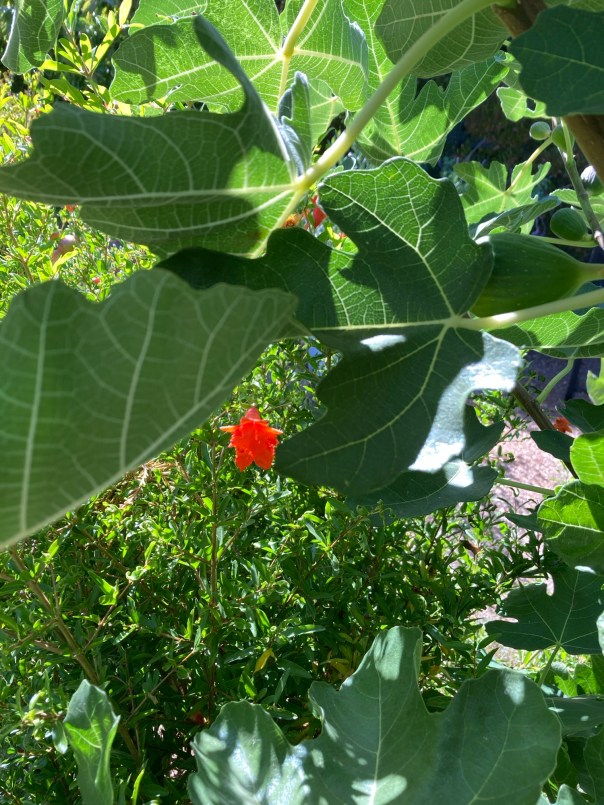
I finished my popsicle and my rest, and as I was headed back to the house, something glowing red in the sunlight caught my eye, among the leaves of the fig tree…. and when I looked in there, surprise ! it was a dead ripe fig (actually black) — I picked it and two more that were hiding in the shade inside. Now begins the bountiful fig season; I knew it would be a good year for them, because of our several heat waves, in contrast to last summer being a cool one and me getting zero figs. I better get my dehydrator ready.
Granddaughter Maggie was here for a few days with her mother Pearl. Maggie continued her road trip back to college but Pearl is with me still. They fill my heart and my days by being their sweet selves. Since I typically do all my own work, I am constantly startled when I notice that someone is loading the dishwasher or shredding the lettuce for tacos or whatever task, before I even get to the point of realizing it needs doing.
We went wine tasting for a short while one day; at one vineyard we took a one-mile walk through the rows of vines, and it smelled really good in there: chardonnay, cabernet, syrah, viognier, dried grass, all lending their scents to the air, but mildly, because it was a coolish day.
Ice plant at the beach.
The next day, to the beach! Pearl and I walked down the shore quite a way, and when we came back we all just lay there in the sun. I lost consciousness for at least a few minutes, lying on my back with the sun heating my face through my hat. As we stared out past the edge of land to the vast Pacific, Maggie said that the ocean seems to our eyes as big as outer space. I thought how nice it would be if I could restart the regular beach outings that I made so often in 2020 and 2021.
My granddaughter spent quite a while collecting tiny pieces of sand. She was conceiving a plan to use them in the Instagram-alternative scrapbook she is starting; she will glue them on to the page and then paint over them with clear nail polish so they might continue to look wet.
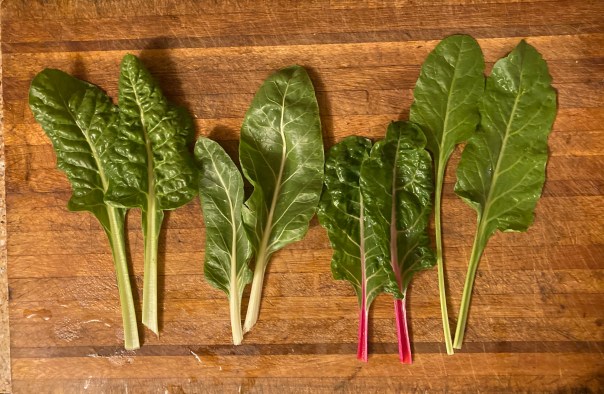
That evening we were able to sit on the patio for a dinner that I made, which included chard from my garden. I had washed it up a few days before, during which process I realized that I had four varieties of Swiss chard growing out there.
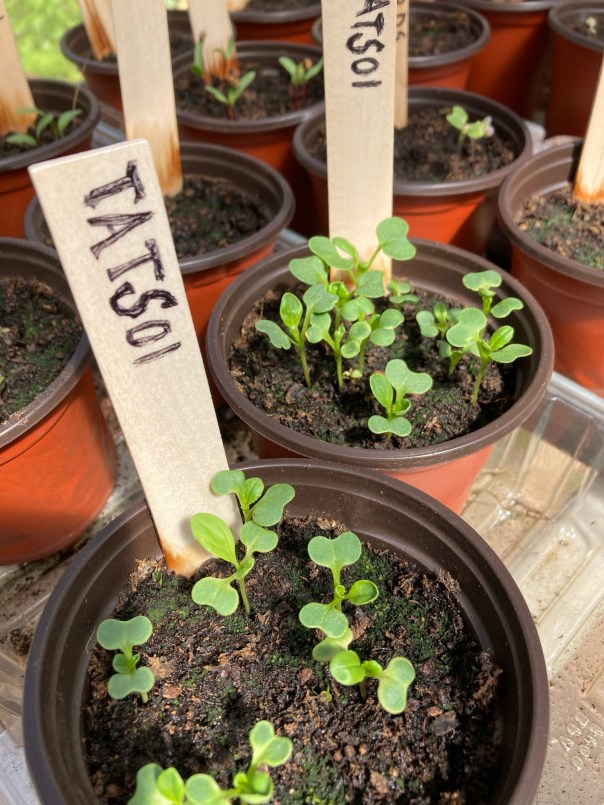
I pulled out some of that chard, to make room for new plants that I grew from seed in the greenhouse over the last month, and most of which I have set out in the planter boxes. Portuguese Kale, two varieties of collards, Italian Silver Rib Chard — and a new one from the mustard family: Tatsoi. Here it is when its true leaves were barely emerging.
Also Detroit Red Beets. If half of the seedlings I set out thrive, I should have plenty of greens to get me through the winter and into next spring.
Lastly, I show you the barrel planter, where the the snapdragons and Tropical Sage seem to take care of themselves and keep reseeding and blooming. The salvia that was pink for two or three years just last week sprouted stems of red-orange flowers. I saw them from the kitchen window, and had to run out right away to see what they could possibly be. When I give my attention to the garden, even just a little bit, it rewards me abundantly.
I’ve showed up again to tell you that summertime is the best thing. Lucky me, I live in a temperate climate, and do not have to rush about meeting deadlines put upon me from other people; my days often pass in what seems like a natural and unhurried way, even at my work: in winter I carry wood and build fires, and at this time of year, there is lots of strenuous gardening to do.
Excepting the occasional heat wave, it’s typically just Very Warm midday, with the nights down to 50, and the cold fog often hanging on until late morning. One morning in July I used the furnace, which showed me that I am turning into an old lady. This week included another extra-chilly awakening, but I took the conservative route and added a wool cardigan to my first two layers.
Peder Monsted
So, summertime is perfect, in my case, for sharing a poem mentioning The North Wind. His counterpart around here is The Marine Breeze. I’m not that close to San Francisco, but I do often think of the comment (mis)attributed to Mark Twain: “The coldest winter I ever spent was a summer in San Francisco.”
What I love is that at least by noon, and usually much earlier, I can walk around my garden in the pleasant air and eat breakfast next to the pineapple guava tree, where graceful arches of salvia flowers lean in, and the Sun persuades me to take off my sweater.
Coucher de Soleil Sur le Village, Leon DeSmet
THE NORTH WIND AND THE SUN
Betwixt the North wind and the Sun arose A contest, which would soonest of his clothes Strip a wayfaring clown, so runs the tale. First, Boreas blows an almost Thracian gale, Thinking, perforce, to steal the man’s capote: He loosed it not; but as the cold wind smote More sharply, tighter round him drew the folds, And sheltered by a crag his station holds. But now the Sun at first peered gently forth, And thawed the chills of the uncanny North; Then in their turn his beams more amply plied, Till sudden heat the clown’s endurance tried; Stripping himself, away his cloak he flung: The Sun from Boreas thus a triumph wrung.
The fable means, “My son, at mildness aim: Persuasion more results than force may claim.”
-Babrius, aka Aesop (2nd century) Syria Translated by James Davies

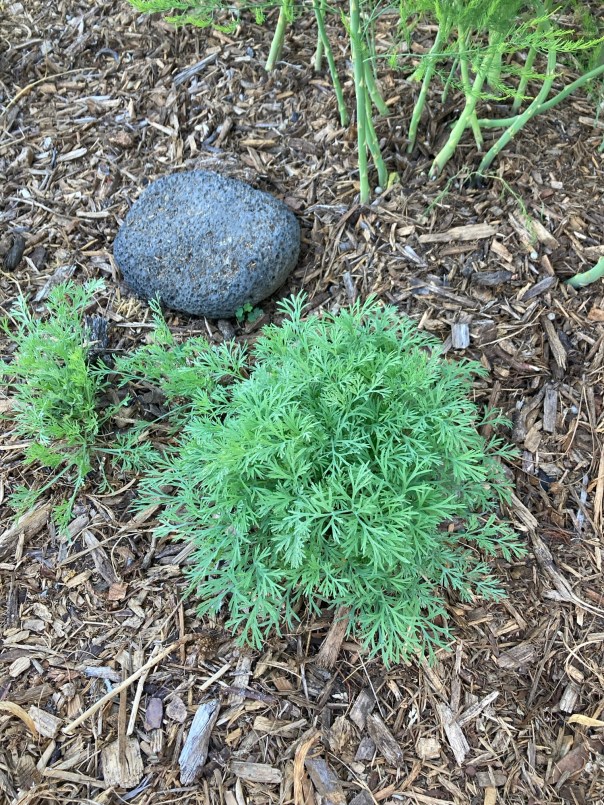 In spring, the California poppies (Eschscholzia californica) swamp the front of my garden, and after a few weeks of exulting in their glory I have to pull them all out and uncover the irises, salvia and other plants that I want to see. A few more weeks, and the poppies have sprouted new leaves and sometimes blooms as well. Here’s an example at left, from just now.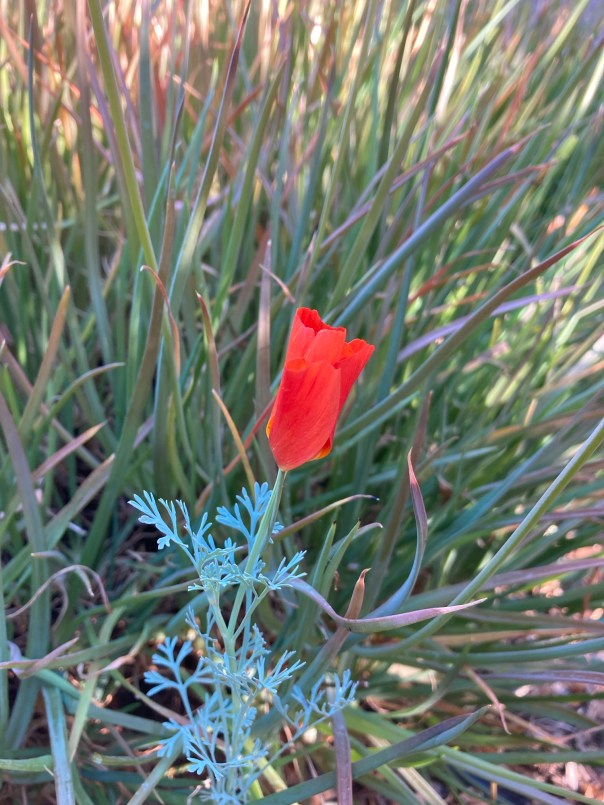
 I took my root beer popsicle outside — the way we often require children to do — and wandered around the garden. On the earth and becoming part of it I spied three plums that must have fallen sometime since the day I thought I had picked the last of them. That makes — ta da!! — a total of 52 plums this summer, way, way more than ever before. It may have something to do with the copper dormant spray I applied last winter. The foliage has been looking healthy ever since it leafed out.





 Gladsome Lights