My church friend Ana and I flew to Florida last week for the Symbolic World Summit in Tarpon Springs, and returned on Sunday. I am still processing all the quite stimulating and encouraging lectures and discussions we heard; Ana and I also enjoyed the extended time together over five days to talk about our loves and lives, including many books and ideas. We attended services at St. Nicholas Greek Cathedral in town after the event.
In the paragraph above I notice that I effortlessly included six noun or adjective conjunctions; does that habit flow from my general tendency to the “Yes, And” point of view, I wonder? I hope you don’t mind, because I’m not in the mood for polishing up my writing skills right now. It could be that the Summit increased my leanings toward expansiveness… but it’s an effort I am always making to keep the conjoined words to only two.
Orthodox Lent is almost here! And there is plenty for me to focus on, of the sort of things that help us on our Journey to Pascha. A few of the speakers at the conference gave us their unique short list of “action points,” for going forward in our personal lives on the theme of the event. That theme was Reclaiming the Cosmic Image, which right there seems a very Lenten goal. Maybe I will share about it in future posts.
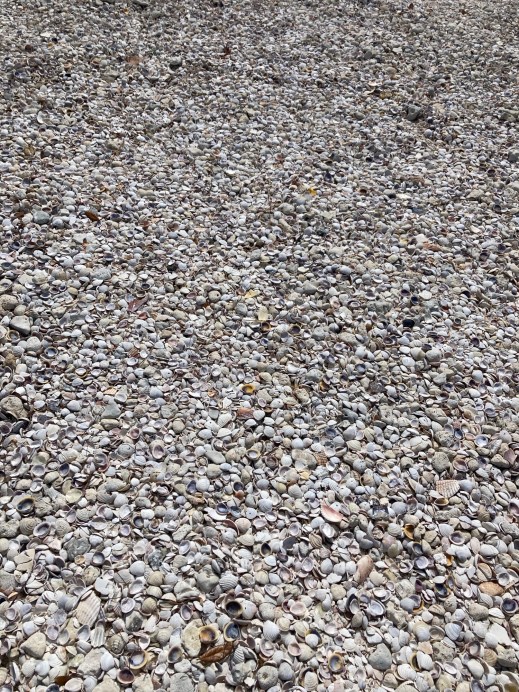
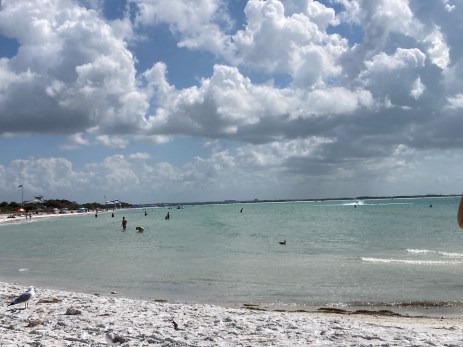
For now, I just wanted to document the Florida sands. I had never been in that part of the country before, or anywhere on the Gulf of Mexico. When we first walked from our car to the beach, the bright whiteness struck me first. And then, to walk barefoot on that soft, soft sand, everywhere full of broken pieces of shells, was such a different experience from California’s North Coast, which is my normal experience. We rarely see any but mussel shells on our beaches, but there in Florida intact shells were also in great abundance, and in places laid out in wide swaths. Of course, the air was balmy, but not hot.
Shells not yet made into sand, and therefore not soft.
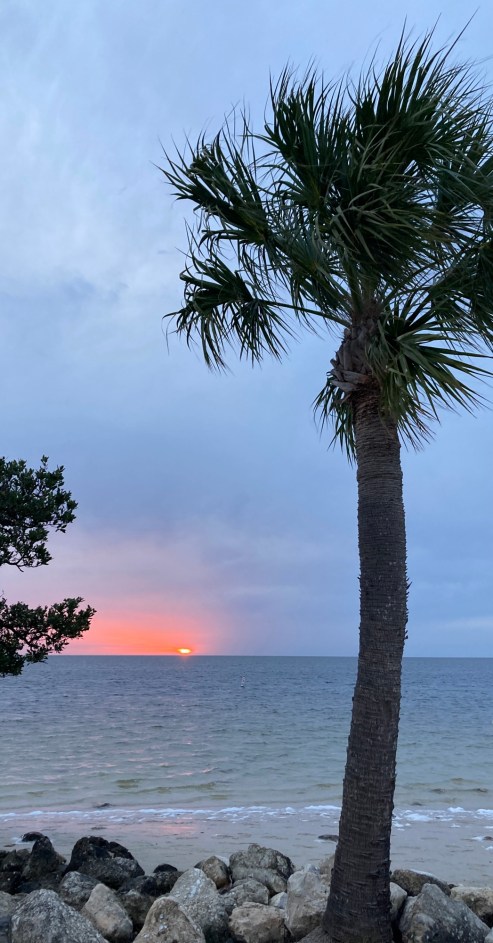
We visited Sunset Beach on Friday (at sunset), and Honeymoon Island on our way to the airport Sunday. Both outings were fairly brief, because most of our weekend was at the conference venue.
We collected a few shells, and my purse collected a lot of the fine, glittery sand. I even carried a big handful back to the car, where Ana found a ziplock bag for me to put it in. I have been neglecting my sand collection in the last couple of years, but now I will get it going again, and will have added one little bottle of white sand to show that I truly was once upon a time in Florida.
The rain stopped this evening, just in time for me to walk on the bike path to the bridge. This wooden bridge spans two little creeks where they join and flow on westward through my patch of suburbia. I figured out that when I have a few more minutes available than it takes to walk around the block, I can go on this more woodsy walk to the middle of the bridge and still be back in less than 15 minutes.
What got me excited was just the utter freshness of the air after days of steady rain, and getting to see the creeks fuller than usual. It’s interesting how one is so much muddier than the other. Many wonderful plant scents were in the cool and damp air, underneath the bolder smell of wood smoke.
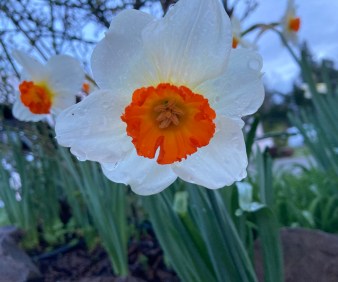
Between my house and that bike path, one of my neighbors has my favorite color of daffodils blooming right now. Their faces were heavy with rain, so I had to stoop down to get a good view of their happiness.


 Orthodox Lent is almost here! And there is plenty for me to focus on, of the sort of things that help us on our Journey to Pascha. A few of the speakers at the conference gave us their unique short list of “action points,” for going forward in our personal lives on the theme of the event. That theme was Reclaiming the Cosmic Image, which right there seems a very Lenten goal. Maybe I will share about it in future posts.