Category Archives: nature

The triumph of the machine.

THE TRIUMPH OF THE MACHINE

They talk of triumph of the machine,
but the machine will never triumph.

Out of the thousands and thousands of centuries of man
the unrolling of ferns, white tongues of the acanthus lapping at the sun,
for one sad century
machines have triumphed, rolled us hither and thither,
shaking the lark’s nest till the eggs have broken.

Shaken the marshes, till the geese have gone
and the wild swans flown away singing the swan-song at us.

Hard, hard on the earth the machines are rolling,
but through some hearts they will never roll.

The lark nests in his heart
and the white swan swims in the marshes of his loins,
and through the wide prairies of his breast a young bull herds his cows,
lambs frisk among the daisies of his brain.

And at last
all these creatures that cannot die, driven back
into the uttermost corners of the soul,
will send up the wild cry of despair.

The thrilling lark in a wild despair will trill down arrows from the sky,
the swan will beat the waters in rage, white rage of an enraged swan,
even the lambs will stretch forth their necks like serpents,
like snakes of hate, against the man in the machine:
even the shaking white poplar will dazzle like splinters of glass against him.

And against this inward revolt of the native creatures of the soul
mechanical man, in triumph seated upon the seat of his machine
will be powerless, for no engine can reach into the marshes and depths of a man.

So mechanical man in triumph seated upon the seat of his machine
will be driven mad from within himself, and sightless, and on that day
the machines will turn to run into one another
traffic will tangle up in a long-drawn-out crash of collision
and engines will rush at the solid houses, the edifice of our life
will rock in the shock of the mad machine, and the house will come down.

Then, far beyond the ruin, in the far, in the ultimate, remote places
the swan will lift up again his flattened, smitten head
and look round, and rise, and on the great vaults of his wings
will sweep round and up to greet the sun with a silky glitter of a new day
and the lark will follow trilling, angerless again,
and the lambs will bite off the heads of the daisies for very friskiness.
But over the middle of the earth will be the smoky ruin of iron
the triumph of the machine.

-D.H. Lawrence
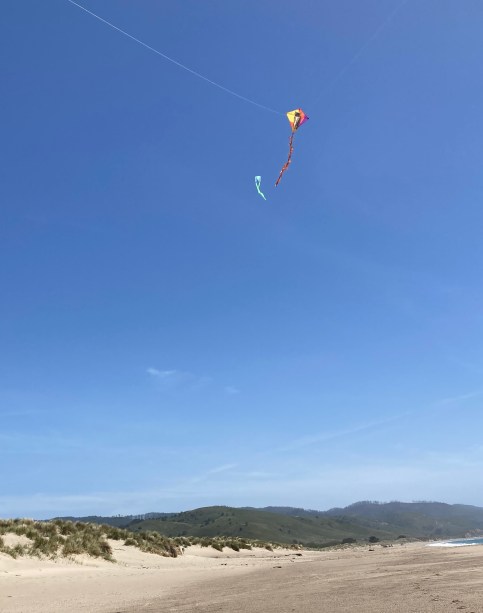
Kites fly high at Limantour.

Even though his older brother is the one I call Pathfinder, my son Soldier took the lead in planning our family outing yesterday. Both of them wanted to include not only a hike but some  beach time, coming as they did from places where one can’t make a day trip to the ocean.

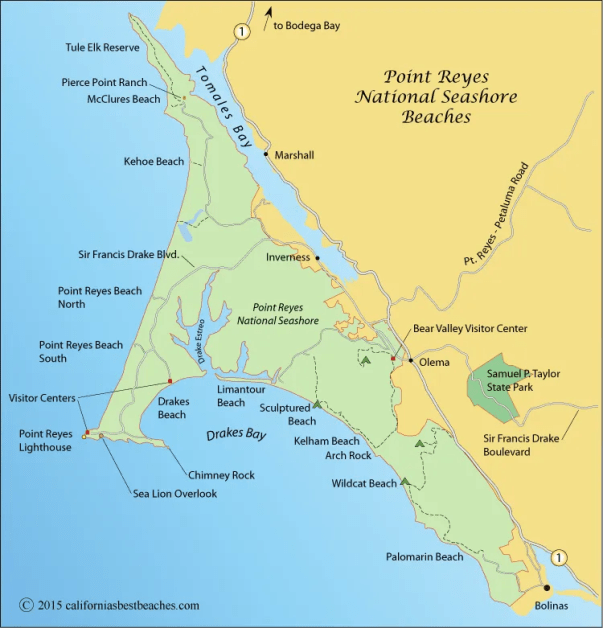
All eight of us were able to go in one car, which added to the fun. The children who had recently endured 12-hour days on the road were cheerful, even though it took us a while to get to our destination, a beach farther south than we usually venture: Limantour. The main thing I always retain in my memory of this beach is that it faces south, so it is a little warmer than many North Coast beaches. It is on a long spit of land on Drakes Bay, named for Sir Francis Drake. In the article, “Drake in California”, you can read the many keys to the identification of this bay as the place where the explorer thanked God for a safe haven.

This map shows you where we were in relation to San Francisco:

And this next one reveals Limantour Beach in the Point Reyes National Seashore:

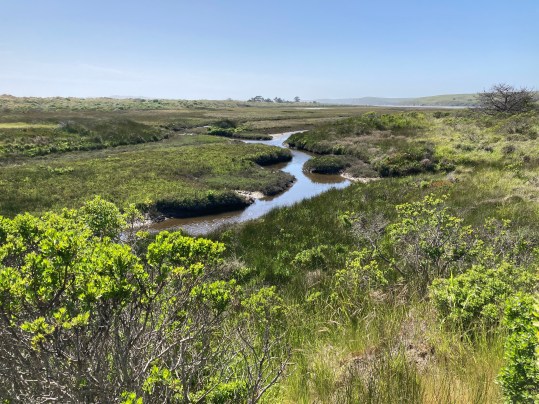
We piled out of the car at the trailhead and hiked about two miles out to the beach, through dense woods opening up from time to time to views of the estuary and wide blue skies; irises in three shades of violet and purple dotted the sunnier banks. Under the trees stands of giant nettles extended back into the dappled shade, with swaths of forget-me-nots or candy flowers at their feet by the path.

Candy Flower – Claytonia sibirica

It was the sort of hike where Grandma, with one or two companions, falls behind the main group to examine and hopefully identify wildflowers, and then eventually catches up when the group stops to wait. Liam spied the Indian Paintbrush first.

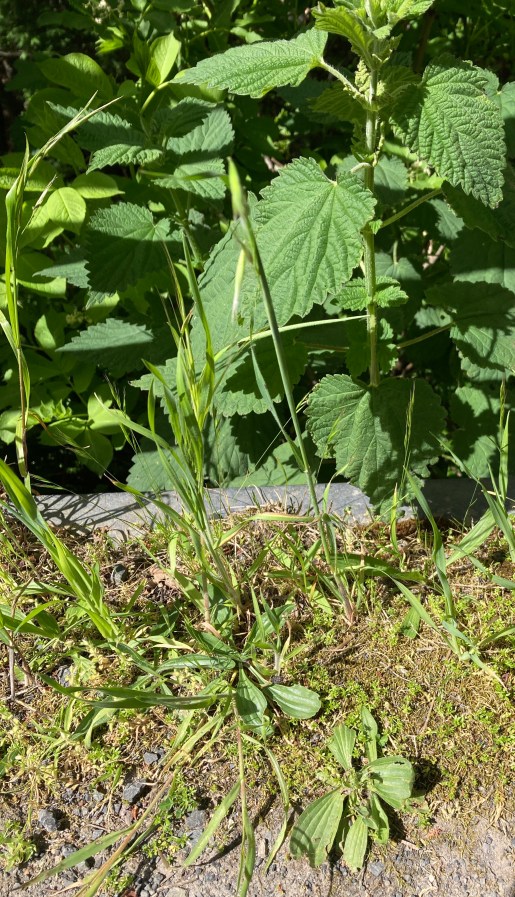
The trail was bordered by a lush jungle of trailing blackberry and manroot, strawberries, buttercups and ocean spray. I couldn’t stop for everything that was interesting, and I can only mention a few of the hundreds of plants. But at the time, I pointed out to anyone who would listen, how conveniently the plantain herb was growing near the nettles: if you were to get a nettle sting, you might chew up a few plantain leaves into a poultice to put on the burning flesh to soothe it. Or so I’ve been told many times.

In spite of my lagging, we arrived on the beach and oh, what a lovely, clean and white expanse it was to behold; we didn’t pause, but walked right on out to the shore.

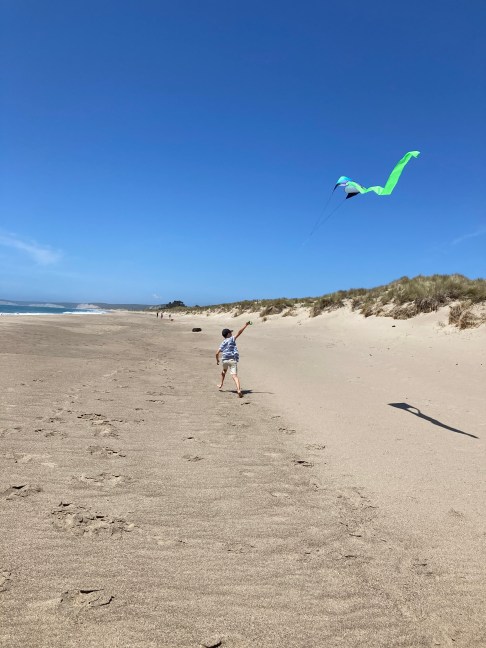
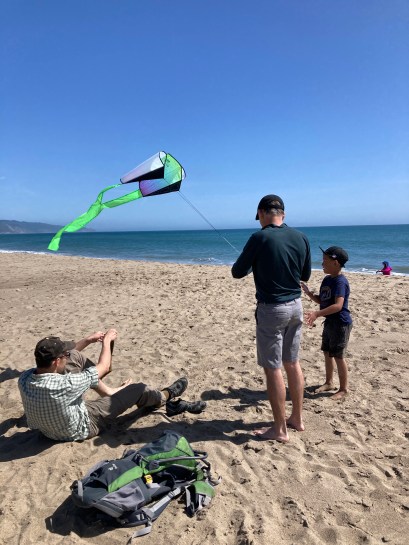
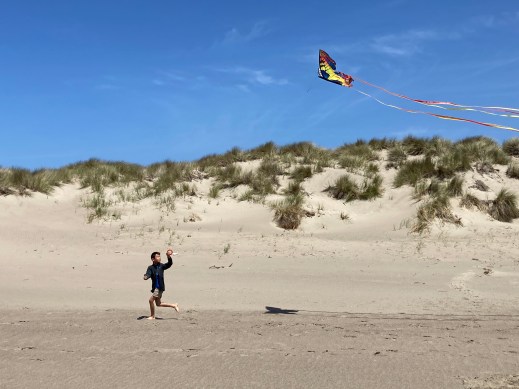
We had brought along three kites, so all the children had plenty of time
holding the fliers against the wind. It was a perfect day for that.

This one above, once it got up, flew by itself all afternoon at the end of its tether,
while we ate a picnic on the sand, and the men dug holes for the waves to flow into.

Then it was time to reel it in, and head back out the way we had come.


It was only on our way out that I had time to really notice these grand bushes of purple lupine, a relation no doubt of the big yellow version I’ve seen so much of farther north, and have even grown in my garden.

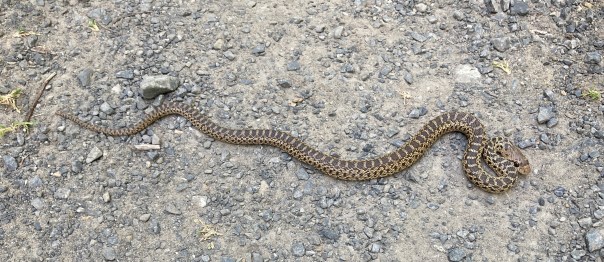
Almost the last thing I took a picture of was a baby rattlesnake lying still as could be on the path. It was too young to have rattles, but as we stood around looking at it, the other adults told us about how the shape of its head and neck helped them identify it as a rattlesnake, and how the venom of juveniles is very potent.

I couldn’t see his eye until I saw the picture I had taken enlarged; he was definitely alive and awake. We were told that rattlers aren’t able to strike effectively if they are not coiled up. But we moved on very soon, stepping around the rattleless tail.

My family all departed this morning very early, before the sun was up, and while fog was still lying low in the neighborhood. All day I’ve been reeling myself in! I had hoped to go to bed early tonight, but instead, before I move on into May — coming right up! — I wanted to finish my story of kites and wildflowers, and my dear people.

Books are needy.

“Books you have read share a deep ontological similarity with books you haven’t: both can be profoundly fuzzy. At times books you haven’t read shine more brightly than those you have, and often reading part of a book will shape your mind more decisively than reading all of it; there is no inherent epistemic superiority to having read a book or not having read it.”

-John Durham Peters, The Marvelous Clouds

After my first and second postings of quotes from this book that I still haven’t read, I found this declaration from the author quite generous, even if he does use both ontological and epistemic in one paragraph. In 2016 and 2019, which seems ages ago now, several of my readers said that they had been prompted to order the book, or at least put it on their TBR list. Did any of you pursue it further?

The Artist’s Wife by Henry Lamb

I know very well by experience what he is talking about here, how impactful books can be just by their presence on my shelves. I read the intro to The Marvelous Clouds twice already, and it evidently did not shine brightly enough in my mind for me to remember anything of it, or to continue.

I found the quote above on Goodreads, where I do quite a bit of mining from time to time. Reading a few quotes from a book is certainly a very small part, but these bits can provide a lot to chew on. Here is another thought provoking passage from the book that I also got by cheating:

“Schopenhauer remarked that buying books would be better if you could also buy the time to read them. Books are different from natural objects in that they can overwhelm us in a way that nature’s abundance rarely does. There has always been too much to know; the universe is thoroughly baffling. When we walk into a bookstore, it is easy to feel oppressed by the amount of knowledge on tap. Why don’t we have the same feeling in a forest, at the beach, in a big city, or simply in breathing? There is more going on in our body every second than we will ever understand, and yet we rarely feel bothered by our inability to know it all. Books, however, are designed to make demands on our attention and time: they hail us in ways that nature rarely does. A thing is what Heidegger calls zunichtsgedrängt, relaxed and bothered about nothing. A plant or stone is as self-sufficient as the Aristotelian god or Heidegger’s slacker things, but books are needy. They cry out for readers as devils hunger for souls.”

It could be that somewhere else in the book Peters mentions the different kinds of knowledge. When you are walking in a forest you are getting to know the trees and the air in a non-intellectual way, and that makes all the difference. It would be a shame to know rocks and trees and clouds only by reading about them.

A man may as well expect to grow stronger by always eating as wiser by always reading. ~Jeremy Collier

I had intended to think and write more about all of this, but just now ditched that plan and am headed out to see the clouds with my own eyes. It might happen that while I am gazing up there, the contents of the cloud will empty on my bare head and give me an even more intimate knowledge of its wet self. I’d rather not get experiential knowledge of the rocks along the path by tripping on them, but you never know what might happen when you get your nose out of a book.

Needles + ice = grapes.

What the weather did up at Pippin’s place (far northern California) where they recently had a great dumping of snow. I’ve been shivering in our very cold rain and hail, and we have snow on the low hills visible from here, but I have no exotic pictures of my own to display. Scout knew I would like this one and asked his mother to send it to me. ❤