Category Archives: nature

What we found on Highway 6.

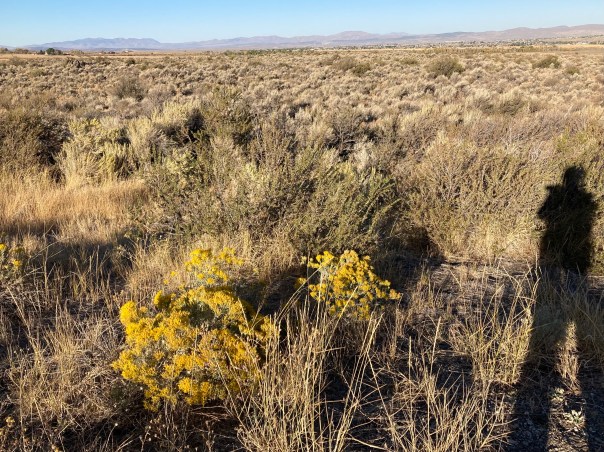
Driving from Baker, Nevada to Mammoth Lakes, California took most of the day, and filled our vision with wide views. Pippin took the picture above showing one fine example.

We stopped within a few minutes to take pictures of clouds. Scout rode with me for a while, long enough to tell me stories of third-century Rome, especially of the tetrarchy of the emperor Diocletian. When we pulled over for car and human fuel Ivy took his place, and for about an hour we didn’t have enough of a mobile signal to listen to a book together, so I asked her to tell me about The Black Stallion, which she read very recently. She is a good storyteller; I think she remembered more details from her first reading than I even noticed the last time I read it.

As soon as possible, we started listening to The Call of the Wild, which she chose from my Audible library. I hadn’t read it since I was just a little older than she is now. We finished the whole book during our drive, and Ivy paid close attention. The next day on the trail, she was composing poems as we hiked, one of them about a husky dog in the northern wilds.

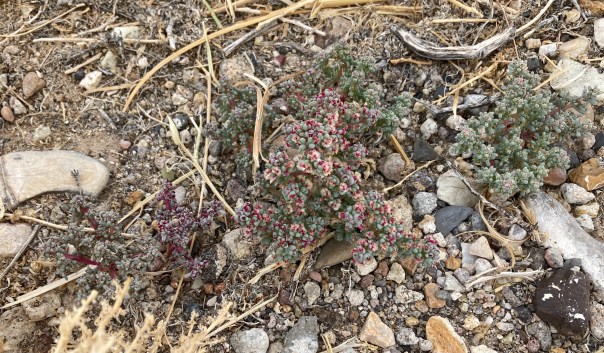
We saw plenty of mountains in the distance as we pushed on toward California, but the plant life seemed thin. Only when we parked our cars along a wide spot in the road in the Stone Cabin Valley did Pippin and I see the truth. Darling and diminutive flowers in a rainbow of pastel colors were scattered all over the gravelly sand.

The Professor was amused at the sight of our happiness in what many would call a “godforsaken place,” as we scanned the ground for just one more version of what the Seek app told us was “Saltlover.” Here is the picture he took of us:

What we learned later when we were able to research it online was surprising and a little sad. This plant Halogeton glomeratus is not a native plant but was introduced from Russia and China; it is a noxious weed of the amaranth family in rangelands of the American West, because of what it does to livestock and to the soil. Grazing sheep are especially vulnerable and can be killed by the high levels of oxalates it contains, and the mineral salts it excretes into the soil make it hard for other plants to survive. Two different species of plants have been introduced that tolerate the salts and might compete under the harsh conditions of that territory. The seeds of Saltlover “have the ability to germinate within one hour after being exposed to water.” That is vigor!

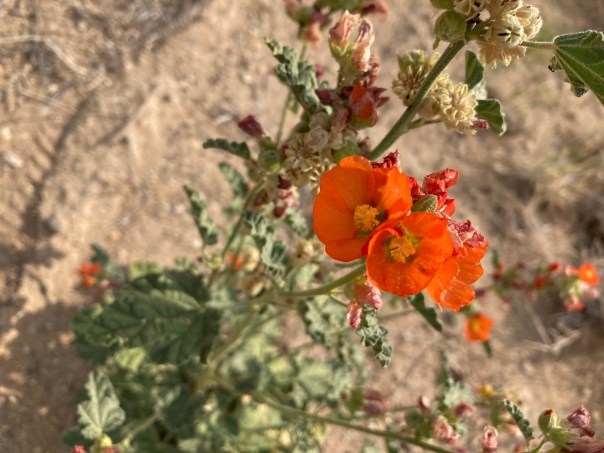
A bright orange flower stood up above these little spires in a few places, the Desert Globe Mallow:

And colorful rocks also caught our eye. I wanted to take this big one home, but after I dislodged it I could see it was too large and heavy:

Not to worry, several other smaller ones were just as brilliant, and before we piled in our cars again and continued on our journey, I had squeezed a few in the back of my Subaru. I told the children that when I die, they should be sure to take these rocks out of my garden and keep them as their own continuing memorials to the time Grandma came along on their mountain and desert explorations.

Lamoille

I am in Nevada with Pippin’s family. We met last night in Lamoille Canyon in the Ruby Mountains, after they had driven one long day to get here, and I had taken two shorter days. I arrived less than two hours before them, because I dawdled so much on the way — which was, after all, what I had made provision for by traveling in a more leisurely way.

But did you know that the speed limit is often 80 mph in the wide open spaces of Nevada? Though that aspect of my journey might not seem leisurely, I did very much enjoy the hours of passing through ever-changing magnificent rock formations and groupings of different colors and textures of sage and other scrub brush. I had lingered over breakfast with friends in Reno yesterday and appreciated being able to take my leisure at high speed.


I wish I could write one of my leisurely travelogues, too, but I prefer to give my time to gawking at monoliths, studying beaver dams, and walking up Lamoille Creek to the place where the grandchildren have their fairy houses and boats (built for toy dragons nowadays).

But  I’d like to show you enough pictures to make a proper representation of this glorious place. I am staying in an Airbnb lodging on a cattle and chicken ranch with a view of those Ruby Mountains out my bedroom window. I can see the stars from my bed at night, and it takes only 15 minutes to drive up to the campsite where the rest of the group are staying. Their campsite looks very much like the one that our family used more than 30 years ago, and Pippin does remember being here.

We’ll be in Nevada for a couple more days, and I hope to post again about my expedition.

As large as alone.

Mountains are giant, restful, absorbent. You can heave your spirit into a mountain, and the mountain will keep it, folded, and not throw it back as creeks will. The creeks are all the world with all its stimulus and beauty; I live there. But the mountains are home.

– Annie Dillard

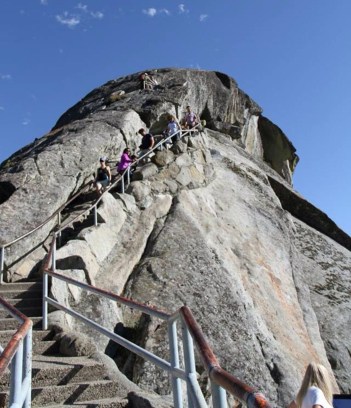
Moro Rock in Sequoia National Park – web photo

A granite dome was the focus of my mother’s most memorable hiking experience. She told me many times the story of how, at the urging of my father, she climbed Moro Rock when she was great with child (me). That is, so far, my only experience of it.

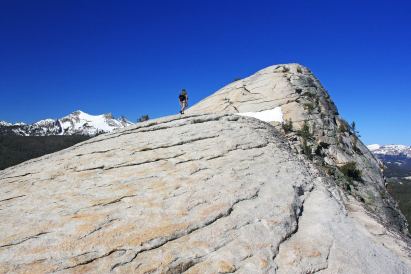
On our yearly camping trips decades later, my own children’s father would hike to the summits of other domes of rock with them, and a few of those times I was along. Lembert Dome was long my favorite, looming over Tuolumne Meadows on the Tioga Pass, in Yosemite National Park. Even at three years old Pippin could get to the top of it, with someone to hold her hand on the gradual ascent up the back slope.

Lembert Dome in Yosemite – web photo

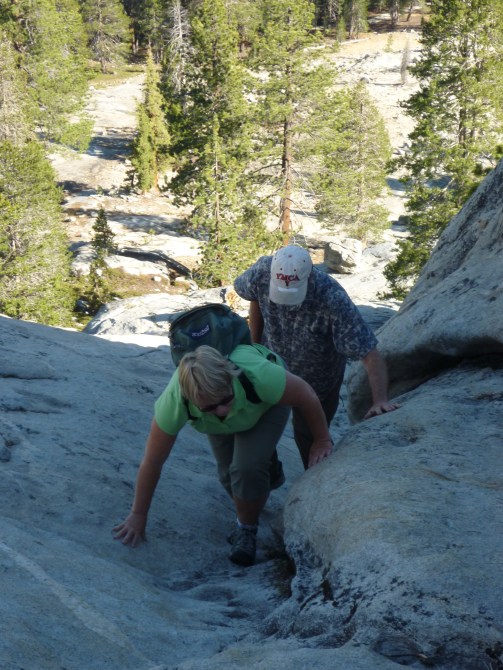
In the latter half of my life, my favorite dome is the one behind our mountain cabin. Several features of it make it accessible to me, the most important one being that I can walk to its base in a few minutes. I read recently that one summer, a small group of us climbed to the summit of this dome in the morning and again in the evening of the same day. My late husband took the picture below of our companions coming up behind him, about eight years ago. You can see why I wouldn’t want to try it alone.

During my recent mountain retreat, I set out one morning before breakfast, thinking that I would just walk over that way to get a view of the lake from the other side of what we have nicknamed Gumdrop Dome. Within ten minutes I had changed course and decided to approach from a different direction and to do a new thing: walk all the way around the base. I came through the trees to the north side, and headed to my right, around the west side of the rock. That side is a steep wall, decorated by veins of different colored minerals, and by lichens.

I refreshed my memory just now about different types of clast, or broken rock. I think what lies there at the bottom of the wall would not be classified talus or scree, but is just plain clast. On this side you can clearly make out where the base of the dome is.

I walked along in the clast, it moved under me, and then — whoopsie! Down I went on my behind. While I sat, I thought I should take advantage of the camera angle:

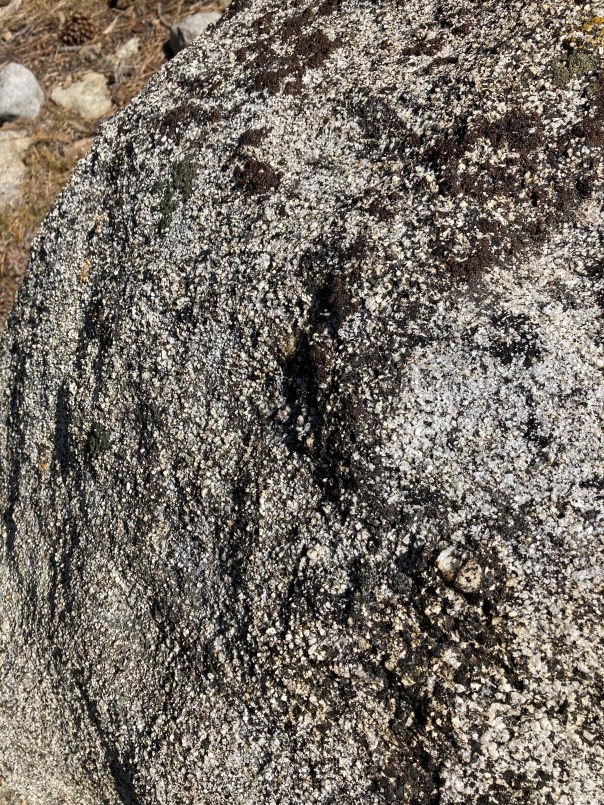
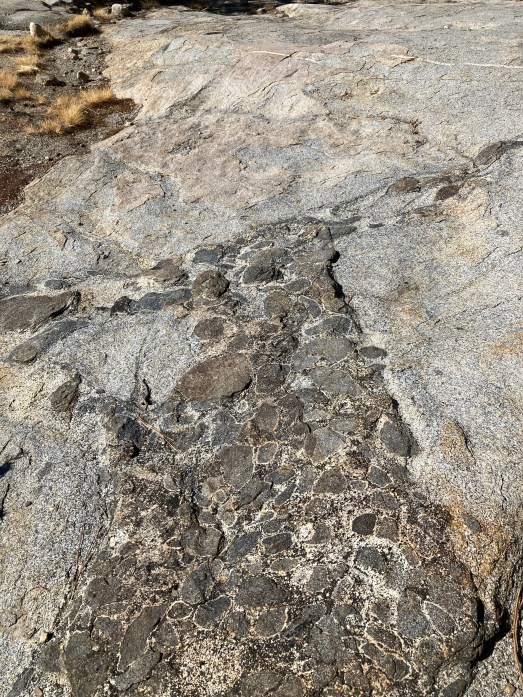
It wasn’t the only time I fell. A few minutes later I stumbled forward, and scraped my hand on some of that sharp granite. My euphoria was untouched; it was such incredible good fortune, that I should find myself completely alone, yet in rich company: God, and a friendly monster of a rock. Still, I navigated more carefully after that. The boulder to the right of the pine cones in the picture below is an example of the coarsest grit of granite imaginable; and the one below it, also.

I began to search for stones, keepsakes of my solitary walk around “Gumdrop.”

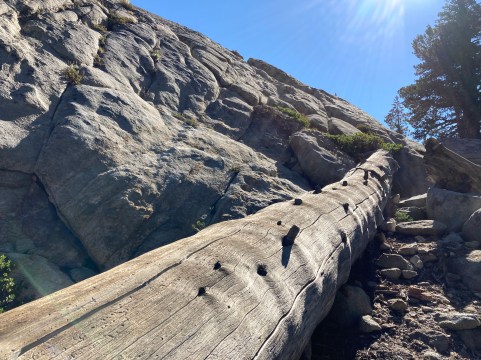
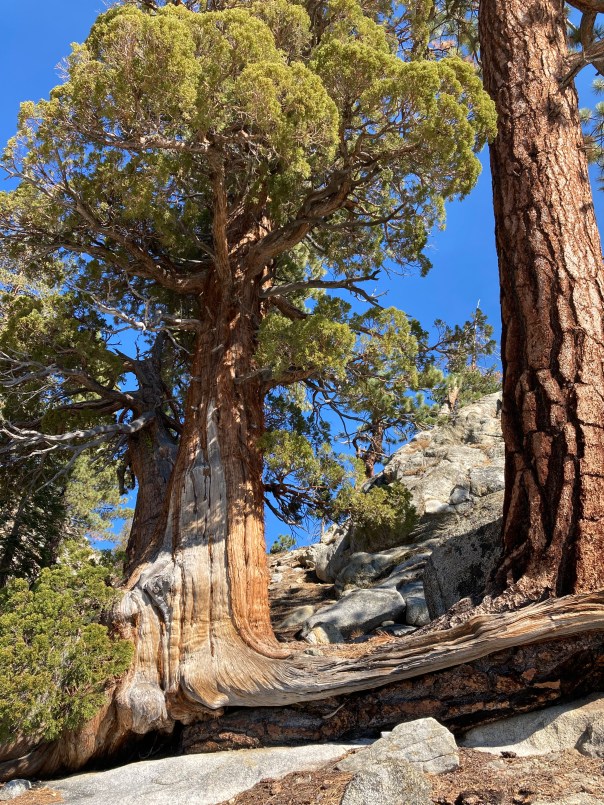
On the back side, the line between dome and not-dome is vague, as that granite face stretches away in an ever flattening  grade, down into the trees. There is still lots of rock there, but giant conifers grow out of cracks in it, and their duff lies thickly on top. Granite domes like this are called bornhardts; there are several theories about how they form.

For a long time I gazed at the wide views from my high perch, a flattish boulder-bench, and felt the cool breeze growing warmer as the sun rose to my left.

“O, Lord, how manifold are Thy works! In wisdom hast Thou made them all.”

From here you can see other domes in the distance, but of course you can’t get a good idea of what the dome you are standing on looks like. The best vantage point I’ve ever had is from the lake, as in this picture that was taken some years ago:

This area below I call the amphitheater. It’s a good place from which to watch the show!

If I had brought a snack, I might have stayed hours longer. It was all delicious and satisfying as a feast for the soul, but pure bliss was not going to prevent me getting shaky (elevation about 8500′) if I kept putting off nourishment such as was waiting for me back at the cabin; so I stood up and continued my explorations.

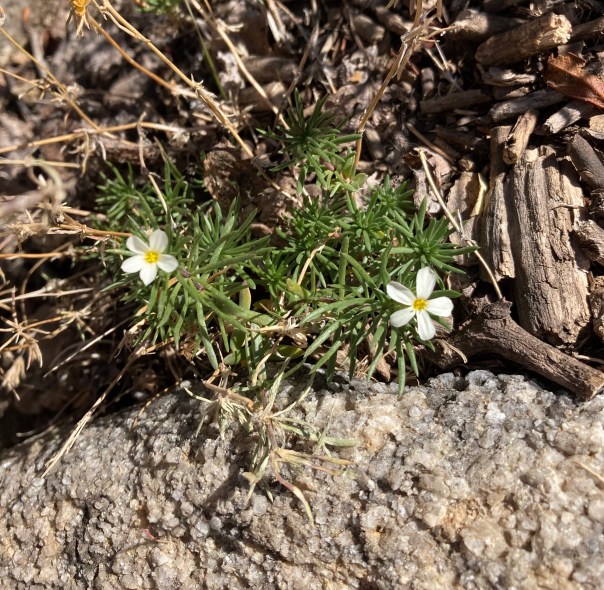
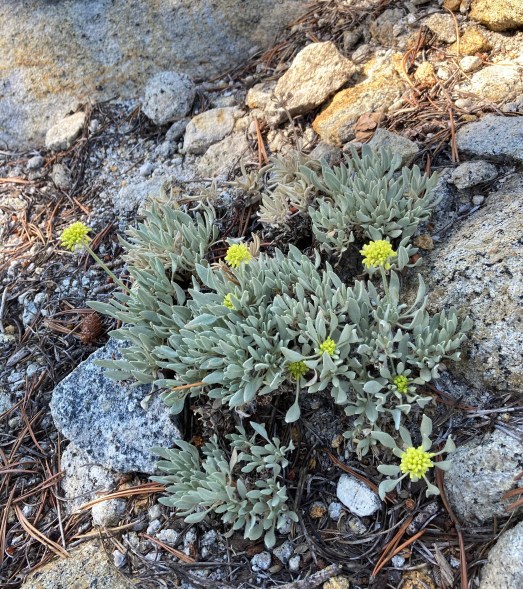
Frosted Buckwheat

This couplet below does not at all fit with the stones that I collected on the dome, as far as their smoothness, or the number of them. But the poet’s metaphor echoes somehow that of Annie Dillard at the top of this post, and they both understand what I left behind on that mountain dome, and what I brought home.

“may came home with a smooth round stone
as small as a world and as large as alone.”
-E.E. Cummings

Here is my last look at Gumdrop, when I had circled around to my starting place. From this angle it seems that it might not be impossible to climb that particular slope. I wonder…. Well, next time I have a companion, I’ll have to bring him or her to this place and give it a try! But for now, Good-bye Gumdrop! Good-bye mountains! Thank you for inviting me. I had a good time!

When the poor and needy seek water.

I drove boldly past many “FOREST CLOSED” signs on my way up the mountain earlier this week. The United States Forest Service has closed them because of the drought and fire danger. Our cabin is one of a group on a little piece of private property in the middle of the forest, so I brought along proof of ownership. There are currently no fires nearby, and the skies are clear and blue, but the air was brown-tinged a few thousand feet lower down, from the smoke that drifts in from fires in the north.

So I saw few other vehicles or people, but the hummingbirds, chipmunks and jays are more to be seen than in my recent memory. This forest family stared at me as I passed:

My sister came up for a couple of nights, and we talked until late. She drove us down to the lake bed in her “mule,” and we walked around for awhile. The part of the lake visible through the trees from our cabin showed a bit of blue water when I arrived, but the next morning it had turned to mud. The water is used for irrigation, so it’s not an unusual situation at the end of the summer, and not surprising that it would be the case this year.

As soon as I entered the forest, on the last leg of my journey, the noise and strain that had been with me on the highways began to be absorbed by the deep silence, and the fullness of presence, not only of living and growing trees and animals, but massive rocks. Those slabs and domes were here eons before the lake, and they comfort me.

Sister Nancy showed me an osprey nest when we were down at the shore/lake bed, and though it was kind of far away, I took a picture anyway. I didn’t see the greater context while I was focused on it, and was surprised when looking at my pictures later, to see what looks like a cloud picture. Just to the right of the odd blue dot is the osprey nest at the top of a tree.

Something has gone wrong with my settings on my devices, and I can’t seem to insert most of the pictures I wanted. I really don’t want to spend any more time up here fiddling with technology, so this may be my only post about my little retreat. I am hardly disappointed that the lake is so low, because The Mountains are where I am, and they are so much more. When I saw this reading for a church feast this morning, it made me think about the living waters that God provides, the Living Water that He is for our souls, no matter how dry the landscape:

Comfort ye, comfort ye my people, saith your God.  Speak ye comfortably to Jerusalem, and cry unto her, that her warfare is accomplished, that her iniquity is pardoned: for she hath received of the LORD’S hand double for all her sins. The voice of him that crieth in the wilderness, Prepare ye the way of the LORD, make straight in the desert a highway for our God. Every valley shall be exalted, and every mountain and hill shall be made low: and the crooked shall be made straight, and the rough places plain: And the glory of the LORD shall be revealed, and all flesh shall see it together: for the mouth of the LORD hath spoken it. When the poor and needy seek water, and there is none, and their tongue faileth for thirst, I the LORD will hear them, I the God of Israel will not forsake them. I will open rivers in high places, and fountains in the midst of the valleys: I will make the wilderness a pool of water, and the dry land springs of water.  Drop down, ye heavens, from above, and let the skies pour down righteousness: let the earth open, and let them bring forth salvation, and let righteousness spring up together; I the LORD have created it. Go ye forth of Babylon, flee ye from the Chaldeans, with a voice of singing declare ye, tell this, utter it even to the end of the earth; say ye, The LORD hath redeemed his servant Jacob. And they thirsted not when he led them through the deserts: he caused the waters to flow out of the rock for them: he clave the rock also, and the waters gushed out. Sing, O barren, thou that didst not bear; break forth into singing, and cry aloud, thou that didst not travail with child: for more are the children of the desolate than the children of the married wife, saith the LORD.  (Isaiah 40:1-5; 41:17-18; 45:8; 48:20-21; 54:1)

Our lake in a wetter year.