Category Archives: nature

Lavender and little scythes.

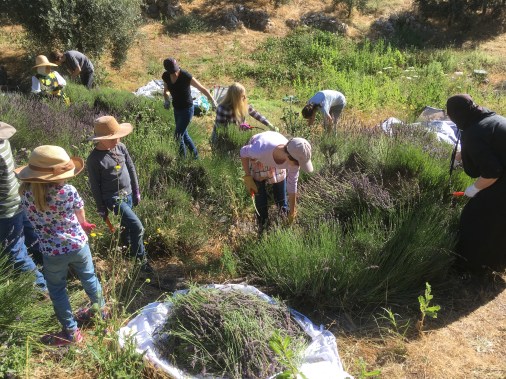
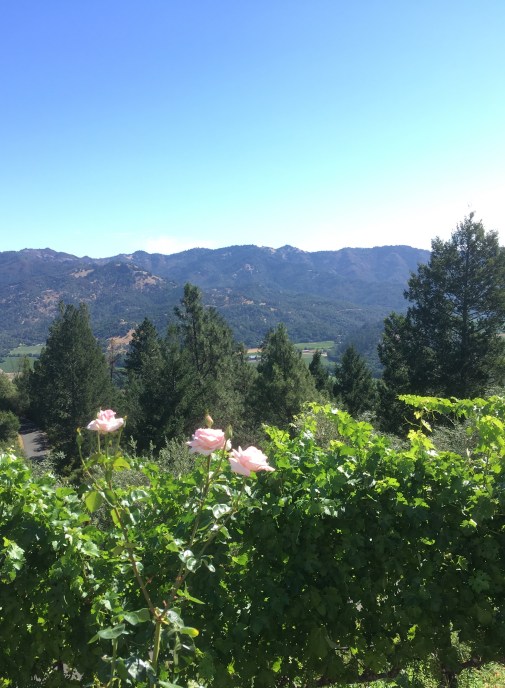
The nuns at a nearby monastery harvest lavender every summer at various neighbors’ properties up in the hills and mostly at the end of long unpaved and/or winding roads. They had asked the young people from parishes in the area to help them today, and when some families had to back out at the last minute, several adults including me pitched in.

I had to get up before 5:00 to get fueled up and make the drive to arrive early enough for the sisters to give us a hearty breakfast. But even before that, we learned that Mother Anna who recently fell asleep in death had still not been buried, and we might go into the church and say good-bye to her. Mother Angelina was reading Psalms at the head of the casket when we went in; we all filed past and kissed the little icons that were next to her, and the Gospel. It was sweet to have this opportunity.
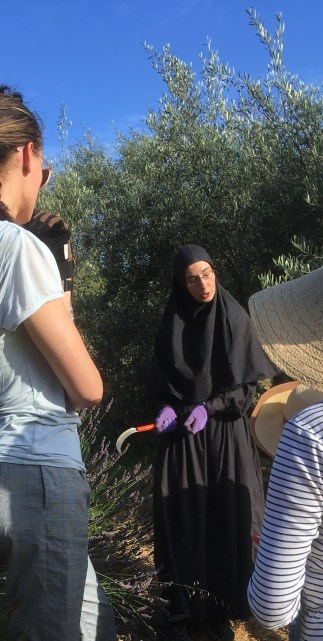
After breakfast and chatting we caravaned to the first and most scenic spot, where we picked from a big clump of lavender bushes stuck in a low spot among olive trees at a vineyard. We were given little scythes, which seem the perfect tool for any bush you want to grab hunks of and slice off, to shear it. I plan to get one for my own garden right away, so I can give a break to my finger joints.

As we were packing tools and water, and applying sunscreen and bug spray — the sisters said they had been “chewed up” by chiggers one year — Mother Tabitha was on the phone a lot trying to arrange for Mother Anna to be buried this afternoon.

One of the lavender friends, with the most to pick, cancelled our visit because they didn’t think their insurance covered children on the property, and they had seen a few rattlesnakes lately. But the monastery had already this season delivered 200 pounds of lavender flowers to the distiller, so they were not worried. Some of what we were tackling was past its prime and too dried out to use. We sheared it off anyway but put it in the discard pile.

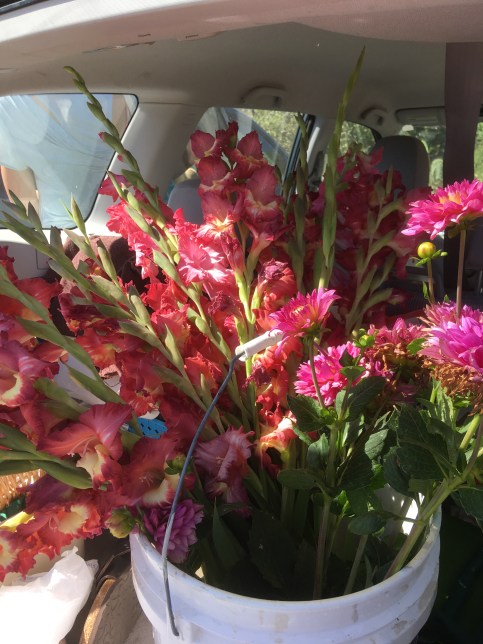
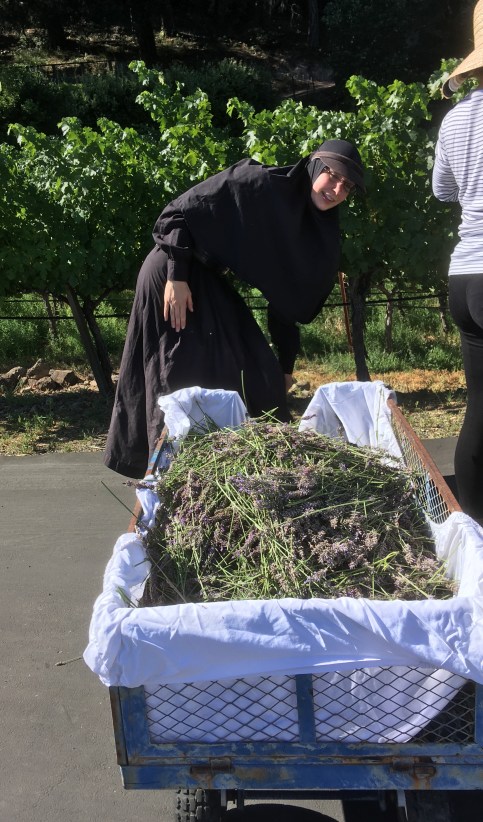
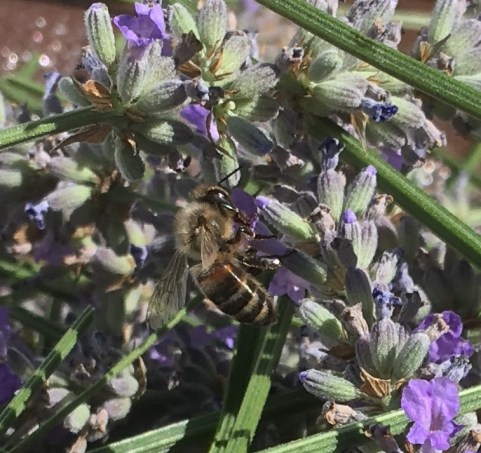
We eventually filled the back of a pickup truck with the blooms. Bees were thicker on them in the truck than they had been in the field. The farmer lady gave us plums and peaches for a snack, and insisted that the sisters take buckets of dahlias and gladiolas for the burial of Mother Anna.
The second, smaller harvest was at a house that had barely missed destruction in the fires of 2017. Most of their lavender bushes, which had formerly lined the long driveway, had burned and not been replaced. To the south and to the north, close to the front and back of the house, were patches of blackened trees where the wildfire had swept through erratically.

Soon we were headed back to the monastery, hot and dusty, and again they fed us very well! But Mother Macrina drove the pickup load straight to the distiller, to have its essential oil extracted. The by-product hydrosol, the lavender water that is left over, they also use, to make sprays good for cleaning and dusting, and deodorizing. Next time I have a chance, I’ll buy some lavender products from them. And maybe tomorrow I’ll look at my own lavender bushes and see if they are ready to harvest!

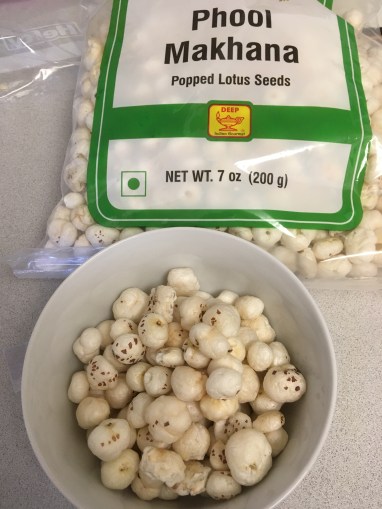
Lotus seed for the world.

One package I picked up at the Indian market was a large bag of phool makhana or puffed lotus seed, a sort of popped-corn form of the seed of the lotus plant Nelumbo nucifera. When I was in India one restaurant that specialized in salads sprinkled a few of these puffs on top of one concoction that I loved.
I read about lotus seeds online, where there is a wealth of enthusiastic promotion of the food item as a cure-all, physically and spiritually. Unfortunately much of the prose resembles the spam comments I get on my blog, and gives me the giggles.

“… eaten as a fasting food in India as it considered a very pious. And, is also used to worship God.” Well, of course. “Whether you eat or drink, or whatever you do, do everything for the glory of God.” (I Corinthians 10:31)

Even Wikipedia seems to gush: “Lotus seeds can be processed into moon cake, lotus seed noodles and food in forms of paste, fermented milk, rice wine, ice cream, popcorn (phool makhana) and others, with lotus seeds as the main raw material. Fresh lotus seed wine has thirst quenching, spleen healing and anti-diarrheal advantages after drinking.[40][41] Lotus seed tea is consumed in Korea, and lotus embryo tea is consumed in China and Vietnam.”

One website that sells various flavors of puffed lotus seeds has this to say: “Focusing on ‘co-creation’ at all levels, we aim to bridge the gap between nature and consumers… to create an offering by combining the natural foods with modern techniques so as to enable the human kind to rejoice these gifts. POPMAK … is a healthy munching solution for all ages… which can add values in your life. We are just four years old company, aiming big to deliver and in this endeavor we will remain child like enthusiast for ever. Expect more surprises from us soon!!!!”

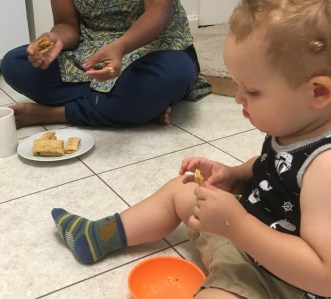
I must mention here a couple more Indian snacks that are in the house right now. Kareena bought these flaky fenugreek biscuits that she often eats for breakfast and shares with Raj.

I’ve eaten a few of them myself and they are really nice — crispy and subtly flavored.

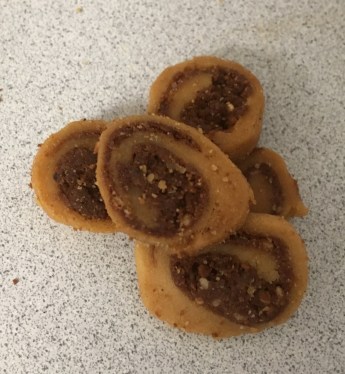
We bought some bhakarwadi which I have already eaten all up. They are like a cross between a barely-sweet cookie and a cracker with Indian spices, mildly hot.

Bhakarwadi

The popped lotus seeds straight out of the bag were pretty bland and had the texture of stale popcorn. I roasted them in a pan with ghee, salt and spices, which transformed them into another light and crunchy, addictive Indian snack. Rejoice!

The sun and a spider mite.

The sun up above does feel like the ball of fire it is, today when the thermometer stands at 100 degrees. Summer caught up with itself and arrived with stored up (solar) energy!

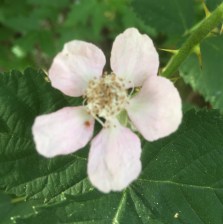
It was too late to take a walk, on a day like this, but I did it. Maybe it was the heat that made the phrase “ball of fire” come to my mind as I watched a spider mite racing around on a blackberry flower, never stopping. What can a mite accomplish if it never pauses? It’s the little smudge appearing in a different spot in each of the shots below.

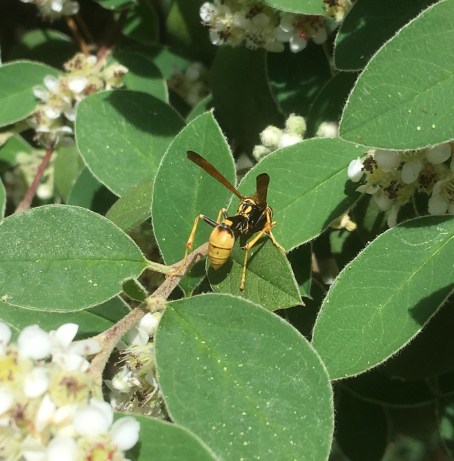
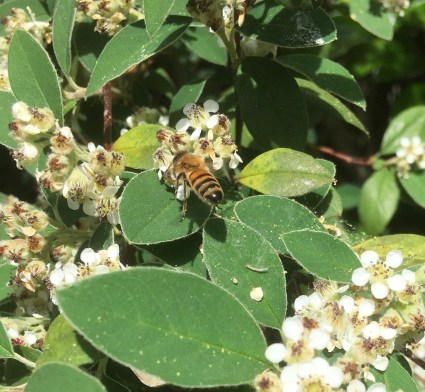
I also looked at the bees and flowers. I saw a syrphid fly and had to learn all over again when I got home that it was not a bee. In the process I learned that in the United States alone there are 4,000 species of bees. Here is another insect I don’t know… Is it a wasp or a fly? At least, I know it’s not a bee. [A year later, my Seek app thinks it’s a Western Paper Wasp.] (below)

I also can’t remember what this shrub is that all three insects are posing on. [So fast! My first commenter reminded me that it is cotoneaster.] Maybe I never have known. But I didn’t really want to spend today doing insect or plant identification. I need to wash the dishes and strip the bathroom floor! So if any of you know about my insect or shrub perhaps you can tell me.

syrphid fly

Most of the salsify have scattered their seeds, but some flowers are still opening.

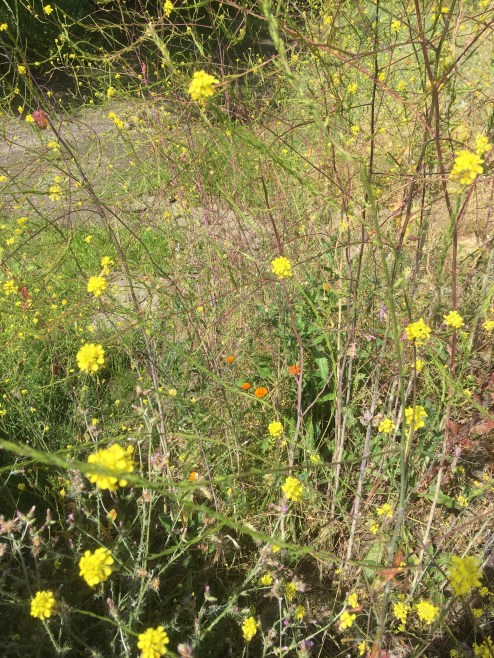
Mustard plants eight feet tall are growing out of the drying-up creek, along with lots of thistles. What is that orange spot that catches the eye…? Not a piece of trash, surprisingly, but California poppies! I’ve never seen them down there before.

All of this life, in many colors, pushing forth. I wondered… if I focus my camera on one small part of the very ugliest thistle, might I see something pretty? I did:

Last night at church we had a thanksgiving service for a couple celebrating their 50th wedding anniversary. When the husband retired from being a professor and a full-time Orthodox priest in Michigan, they moved from Michigan to California to be near their children. The wife said it was as though she had died and gone to heaven. 🙂 Since then they have been part-time participants in three parishes, and from all three of them people came to congratulate and rejoice with them.

I had been to only one other Moleben of Thanksgiving ever before, which was prayed for my husband and me in thanks and praise for God’s faithfulness during our 40 years of marriage. That was already seven years ago! This service was a joy – I was so happy to be part of it and to pray with them.

I had mixed up the time and arrived an hour early, which was kind of nice because I got to chat with the husband and his son a bit. The son was getting the barbecue ready for the party that would happen after the service. We were enjoying the shade of this beautiful catalpa tree whose flowers smelled like the fancy dessert was baking in the oven nearby. But this picture shows what my daughter told me about iPhone cameras, that they distort the sides of the image. Do you see how the buildings on the sides are both leaning in? Okay, now go back and enjoy the tree.

Before I go to my housework, I will have a tall glass of water, and before that, I’ll give you a little lotus weed in warm summery tones. I’ll meet you back here on a slightly cooler day.

I sip nectar with the tiniest.

I sat in my garden reading Penelope Lively, who when writing about garden fashions that come and go, kept using the word “rill.” I picked up my phone to look up that word and see what the British might mean by it, and quick as a wink a tiny fly, almost too tiny to see without reading glasses, lit on the screen, with its wings open for about one second, a flash of shimmering rainbows.

Then it fell off, on to my book. Was that the fly, merely a black gnat? I got him to crawl on to my finger and back on to the screen, where he was kind enough to display his bright wings again for a moment, and then took flight.

On my walk yesterday I saw just one insect in a sea of catsear blooms. And I worked hard to get a picture of a flower with him on it. Not like most years of my photography, when I tried to avoid bugs on blooms, and would be disappointed if my flower were spoiled by a spider or something I hadn’t noticed when I clicked. But most of those critters had come out blurry anyway. No, getting a sharp image of an insect is not easy with a little phone camera. But I have time, don’t I? And a lot of digital storage, too, in case I don’t get around to deleting all those blurry pictures.

I started looking for flowers with insects, and of course, there were bees! It was so warm by this time, they were flying fast and furious, and couldn’t decide which of many privet or blackberry blooms to drink from, like kids in a candy store. The best shot I got was of one flying away with her loot. And I found a near relation to catsear beetle closer to home, descending a wide staircase of rose petals.

Obviously, I also am a kid in my own candy store, and can’t choose just one or two pieces of ambrosia to gaze upon or aim my camera at or share with you. If the temperature were constantly mild when I sit out in that paradise, I think I would fill to bursting with the joy of the place. But usually I get too hot or too chilly or find a task to do, so I don’t get dangerously stretched.

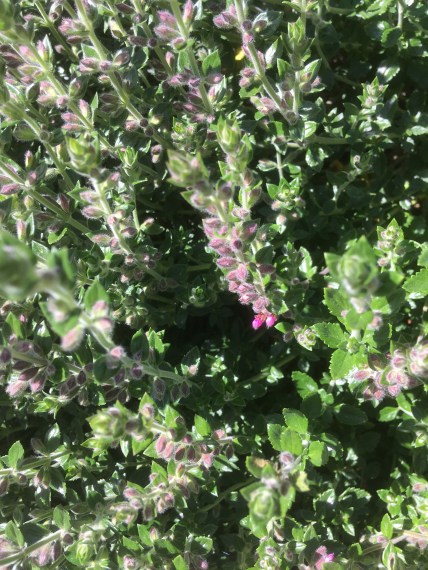
In my front garden many insects are buzzing back and forth and not lighting on any flower. I think they are just hanging around, or more precisely, swooping around — coming back to check every few minutes, so they can be the first to drink at the ocean of teucrium flowers that are going to start opening any minute now. I’m not sure that walkway will be wide enough for human feet to walk without colliding with honeybee wings.

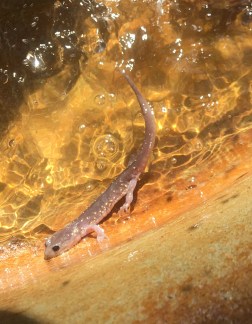
Many of the cistus, Jerusalem sage and helianthemum already need shearing! Alejandro my sometimes gardener was here yesterday and we moved one of the big pots that hold olive trees, and found two salamanders underneath! How they ended up in this droughty place I don’t understand, but I didn’t think about that at the time.
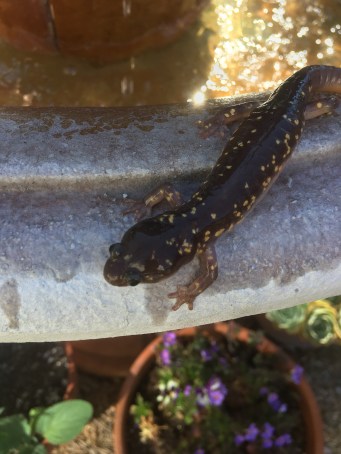
I grabbed the two of them, who looked like Mama and Baby, and put them to swim in the fountain for a minute while I ran into the house for my camera. Then I released them near a faucet with good luck wishes. Maybe I should have carried them to the creek? (Which reminds me, a rill in a British garden is a water feature.)


Back to the insect kingdom and their food… The word nectar carries a heady meaning. Drink of the gods – delicious. But the origin of the word is also pretty tasty if you like words: The first step back is to the Greek nektar (we’re talking about Greek gods, after all), “which is perhaps an ancient Indo-European poetic compound of nek- ‘death’ + -tar ‘overcoming,’ ‘cross over, pass through, overcome.'” No one used this word for the sweet liquid in flowers until about 1600.

Those links to the thought of overcoming of death could lead to an intellectual/writing exercise about how it’s all connected, but I’m not willing for that kind of workout today. I just want to join my fellow creatures in imbibing the sweets.