This new poem came to me by way of the website Poets.org, and their daily e-mail “Poem-a-Day.” But for it I might have forgotten that tomorrow is the summer solstice – obviously I haven’t been following my plan of keeping up with the moon and stars, etc.
I love the poet’s evocation of a warm summer’s day, and the sort of experience she describes, of spending the whole day outdoors, lolling by a pond and not even going home until night — even though it hasn’t often been my own.
When I was young we lived where we could not start this relaxed lingering until the evening turned the heat from scorching to comfortable. Now where I live with coastal and river influence, it’s rare to have a day in summer without chilly fog on one or both ends.
But today the sun shined as soon as it was up. No fog! And when I went outdoors in the morning I didn’t need a sweater. I was caressed by the earth’s atmosphere.
Soldier came over for a few hours to help me clean up and move things around the yard, to prepare for the huge demolition project that is happening soon. Yes, the concrete pool will be broken up and the hole filled with good ol’ dirt. The large utility yard will also have its crumbling cement layer scraped off so that I can make it more useful and beautiful.
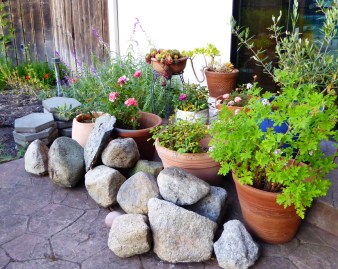
So…we had to move all the things one keeps in such a yard, or near the pool, to other places; Soldier sawed old stakes into kindling, and we piled it elsewhere. We moved potted plants, bricks, cinderblocks, and steppingstones; a bench swing, landscape rocks I’ve brought down from the Sierras over the decades, clay pots, tarps, buckets…and dumped out a barrel of water that had been saved since Y2K.
Next week a boy I know will help me move all my firewood, and then I’ll be ready to set a date for the heavy work to begin. I’m starting to use the pool water on my plants; the patio is getting crowded, and not with humans.
It was a very satisfying way to spend a few hours on this almost-solstice day. Maybe tomorrow I’ll loll about a little as well, and soak up the sweetness of light.
SOLSTICE
How again today our patron star
whose ancient vista is the long view
turns its wide brightness now and here:
Below, we loll outdoors, sing & make fire.
We build no henge
but after our swim, linger
by the pond. Dapples flicker
pine trunks by the water.
Buzz & hum & wing & song combine.
Light builds a monument to its passing.
Frogs content themselves in bullish chirps,
hoopskirt blossoms
on thimbleberries fall, peeper toads
hop, lazy—
Apex. The throaty world sings ripen.
Our grove slips past the sun’s long kiss.
If you’ve read my blog very much you know that I love to take pictures of wildflowers.
I also like to identify the flowers, so I know what to call them. I can’t enjoy them half as much if I don’t know their names or relations. If I know a flower’s name I feel more the reality that we are both creatures of our Father, and it is my own kin.
Plant identification was slow going until ten or so years ago. Our outings usually included a few children and a father who wanted to get to the mountaintop or some other destination. There never seemed to be time to stop and look through a wildflower guide to see if we could find a picture of what was before us next to the trail. That is, if we had even brought a guide.
If we even owned a guide. Several years of marriage and children passed before we invested in a wildflower guidebook. I hadn’t learned the names of these plants as a child, but when I married Mr. Glad he started teaching me the ones he knew, and that’s how my love of wildflowers began: Blue Dicks, Sticky Monkey, Tiger Lily, Lupine….those were my first flower friends.
I suppose it wasn’t until I had the tools for digital photography that I got inspired, surely by Pippin first, to take pictures of blooms and then go home to work further on the fascinating task of figuring out the name — if not of the exact species, at least the family or genus.
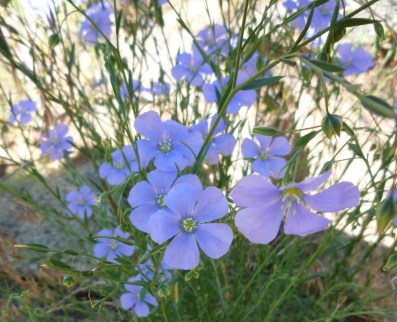
Flax – Oregon – 2010
My findings were often published on my blog. Then months or years would go by, and I would see the flower in the wild again, and not be able to retrieve its name from the corners of my brain — even if I had spent hours looking in multiple guides and on websites. So I would go back to my blog and try to find it there, if I had time for that job.
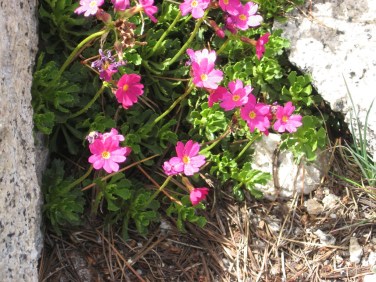
Sierra Primrose – Yosemite – 2009
A few years ago I got the idea of sifting through all those picture files, to scroll through scores of pictures from every hike or trip and find flowers that I had photographed and managed to identify — then I would copy them all into a big Wildflower folder (still on the computer) so I could easily find them again when my ailing memory failed me.
For a couple of days last month when I was too weary and sad to do anything else, I worked on that project, and it didn’t take as long as I’d expected.
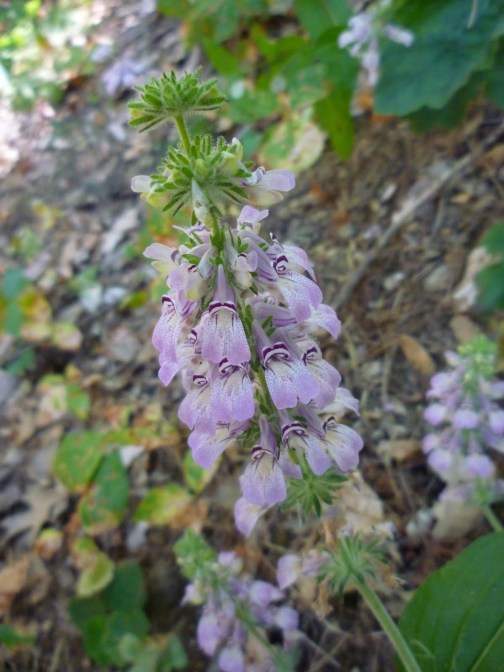
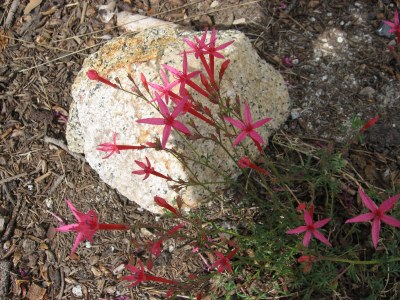
Many flowers remain unidentified, maybe more than I know the names of. I put some of them in the folder, too, with a “Q” in the file name, for Question. A question mark would be ideal but it’s not allowed in those file names. If the date and place the picture was taken are known, I add that information.
I am sharing a few of the pictures I put into this new folder, not the recent ones, but specimens that haven’t been on my blog for several years. Some of these flowers I haven’t yet encountered again since I first made met them, but I hope there will be many more chances in my future.
Sunday morning instead of driving to church I packed my car and drove up into the Sierras, not to one of the familiar destinations but to a lake on the Sonora Pass where I’d only been once before. I was meeting my three cousins for a very brief reunion. It was only two years ago that I’d met them as though for the first time, for their mother’s memorial.
Maybe because it was Sunday morning, as I headed out along the most familiar roads I tried to listen to a sort of sermon in the form of Richard Rohr’s Falling Upward, in which he speaks (and reads his own book in a very pleasant voice) as a would-be life coach to those anticipating or making big transitions in life. I liked one line I heard in the introduction: “We are the clumsy caretakers of our own souls.” But the paradigm he presented, of a life span in two halves, The First Half of life and The Second Half, was not at all useful to me. In other ways as well I didn’t feel like a member of his intended audience, so I wasn’t sorry when I realized my listening set-up was not giving me enough volume and I had to give up on books for this trip.
I had been looking forward to crossing the valley, this farmland that feeds the whole nation its fruits and vegetables, and where alfalfa and sunflowers and more also grow in plots of hundreds of acres. Even though I’ve written about this aspect of the California landscape before, I was as excited to make this drive as I was to see my relatives at the end of it. It’s because I love California, I realized with joy, and not just the agricultural parts. Thanks to my late husband, I was introduced to pretty much every region of our vast state, and it’s Home. I’m so glad I can keep on living here, where My People have lived for six generations now.
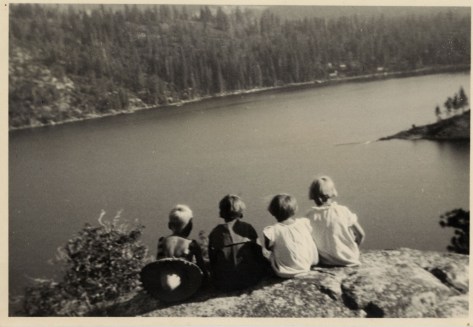
the previous generation in the 1920’s
My destination was Pinecrest Lake, where my father and his family, including my cousins’ mother, had often camped as children with their parents. They lived in Berkeley, and from there it was not too daunting an effort to get a carful of family up into the aromatic pines and cedars where the women and children might stay for the whole summer, while the menfolk would keep working down below and drive up most weekends. Eighty or a hundred years ago it probably took twice as long as my journey did, but it would have been easy to leave the city and cook dinner in camp on the same day.
I was only able to stay with my cousins one night and half a day, but during that time we took a boat out on the lake. I had a bum foot so it was just as well that they had hiked earlier while I was on the road. While we were on the water a bald eagle flew back and forth above us against the blue sky, which we took as friendly interest on his part, but he is just a speck on a cloud in the only photo I got of that encounter.
Mr. Glad at Pinecrest in 2007
We went out to dinner and told stories about our ancestors, and kept straying from that obvious subject to many others. Maybe it was being in the outdoors that led our conversation to the topic of rats and mice, and to comparing tales of house or tent visits, or downright infestations, of undesirable critters. When cockroach stories entered the stream, we tried harder to talk instead about something more appealing before the food arrived. And then we went on laughing and being happy together until a late bedtime.
After my father died several years ago, I made a point of visiting his youngest sister, my aunt Bettie, trying to hold on to whatever thin conduit might remain in the world, that might still connect me to him and that part of my history. Her family had always lived so far away that we rarely saw them and I didn’t know my cousins growing up.
I found her to be much more than a fulfillment of my familial longings; she was a warm and gracious and funny person who was quite admirable in herself, and I soaked up as much love and kindred feeling as I could in a too-brief visit. I planned to come back soon and spend more time, but those many miles prevented me, and then she died too. I was so thankful that I was then able to connect with her daughters, and now we will be catching up until we die.
Of course I cherish my brother and sisters as a link to my father, and for themselves even more, but it helps me to have cousins in my life now, too. My father didn’t pass on family history to me until it was too late to imbibe very much, but my aunt was telling her daughters stories their whole life long, and from a woman’s perspective. They can help me to know my father and even my mother better, as she and my aunt were close friends when they were young, before ripples of effects of war and family changes put such a geographical distance between them.
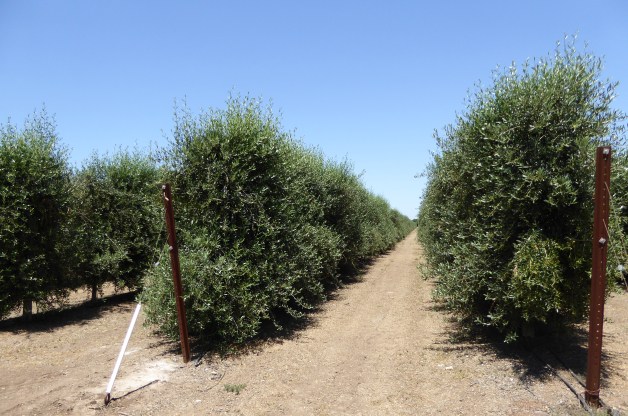
On Monday the oldest of these cousins, Renée, came home with me for a couple of nights. We didn’t stop often on the way down, and the sun was too bright for taking pictures, but even so I had to note these trellised olive trees that intrigued us as we drove across the Central Valley.
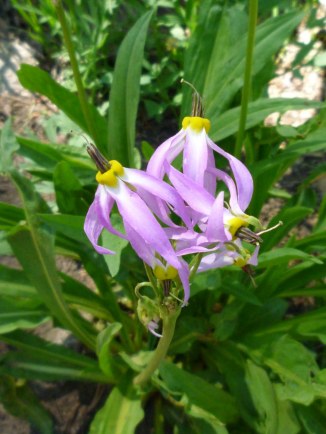
Renée wanted to help me weed my garden or whatever else would ease my grief and weariness. So we spent the next morning on the front yard, and the afternoon on the back yard. She was amazed at the difficulty of digging the taproot of a weed out of our clay soil, and amazed too that anything grows in this kind of dirt. We filled up the yard waste with pine needles, rockrose trimmings, wisteria vines and spent calla lilies. And she told me that one of my most hated weeds is Jack-in-the-Pulpit — but I don’t think so. Compare these pictures:
My weed is on the right, and Jack on the left.
Does anyone know what “mine” is? It looks like a lily of some sort… [Update: see in comments below for the full answer to my question. It’s an Italian Arum Lily.]
My last several days have been incredibly full and rich. In the wee hours of yesterday I woke to hear rain falling — in June in California! A special gift. It continued all morning and maybe contributed to the horrible traffic on the way to the airport, which made Renée almost miss her plane. When I came home and was eating my lunch I was surprised to nearly fall asleep in my tea; until then I hadn’t realized that so much talking instead of sleeping had taken such a toll that I could actually — and must — take a nap.
So I slept for most of the afternoon, and got up late today, and I think I could nap again! When I’m this tired I’m very susceptible to the floods of emotion that show me I am always on the verge of being a bit depressed. The liberty I have to pace myself is a great blessing.
Before my nap yesterday I’d read Albert’s blog post where he shared a “bit” from another blog, and even though the rain we had just experienced on our way to the airport was not cold and hard, the basic idea seems to fit how I quoted from this blog post:
Do what you can – because sometimes it is going to rain on your life and then you can only do what you can. And sometimes it is Cold hard rain. And sometimes it is on the day you had pegged to cut hay. And that is what we had yesterday. Wet, cold, hard rain. But the work went on – just in a different direction. We don’t need to save the world every day. Some days we just do what we can then take to the swing chairs when enough is done.
I do have a bench swing on the patio and I may use that this afternoon, after my nap. See ya later!
The days were gleaming in a manner more often heard about than seen in June, and the surrounding fields and skies were shining with signs and answers and promises and prophecies and praise. The roller clattered, the dust rose, and the tractor gave choking trouble at intervals, but I could not help being aware of that glitter and that gleam. And I marvelled at the thought of night coming soon, the mighty opposite, when all that radiance would go and all those colours pass. A common experience, night following day? Yet we may doubt if between the pram and the bath-chair we will ever see anything more fantastic than this change. Every dawn is the re-enactment of the world’s genesis, and the rising up of the light is the rising up of life.
— John Stewart Collis in The Worm Forgives the Plough
 a-Day.” But for it I might have forgotten that tomorrow is the summer solstice – obviously I haven’t been following my plan of keeping up with the moon and stars, etc.
 When I was young we lived where we could not start this relaxed lingering until the evening turned the heat from scorching to comfortable. Now where I live with coastal and river influence, it’s rare to have a day in summer without chilly fog on one or both ends.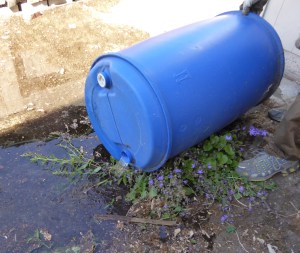
 now will help me move all my firewood, and then I’ll be ready to set a date for the heavy work to begin. I’m starting to use the pool water on my plants; the patio is getting crowded, and not with humans.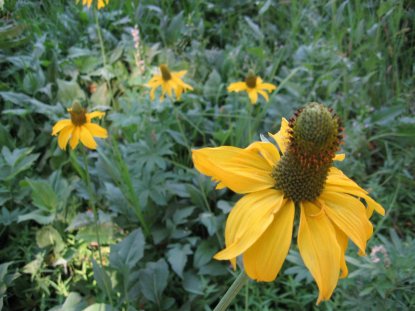




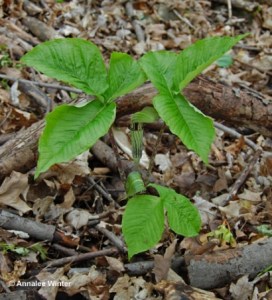 right, and Jack on the left.
 Gladsome Lights