Category Archives: poetry

Reasons to read a baseball poem.

The poem below makes me want to go to a Giants game. It has all the imagery and concrete details that help convey the poet’s experience to the reader. If I were going to write a poem about how baseball is for me, I would want to leave out the miserably cold wind that I suffered at more than one night game in San Francisco, in the middle of summer, but I would work hard to describe something of the smells of the ball park, and how the Giants uniform, in all its variations, looks so beautiful against the green grass.

April is National Poetry Month, and if you have children I especially encourage you to hop over to The Poem Farm and see for yourself what a wealth of poetry-teaching resources Amy Ludwig VanDerwater has collected there. This one is by Amy herself, but she keeps a huge collection of poetry from all over.

REASONS

crack of a bat
smack in a mitt
pop of a fly
feel of a hit
spit and a pitch
steal of a base
slide into home
look on a face
dive and a catch
quick double play
tag and a throw
excitement
dismay
extra inning
cheering
winning

it’s not hard
to find a reason
baseball is my
favorite season

© Amy Ludwig VanDerwater
Used with permission

59fa6-p102057428229giantshats

Be more quiet.

“Prayer is food for the soul. Do not starve the soul, it is better to let the body go hungry. Do not judge anyone, forgive everyone. Consider yourself worse than everyone in the world and you will be saved. As much as possible, be more quiet.”  –St. Joseph of Optina

4e3cf-lake01canoe

KEEPING QUIET

Now we will count to twelve
and we will all keep still.

For once on the face of the earth,
let’s not speak in any language;
let’s stop for one second,
and not move our arms so much.

It would be an exotic moment
without rush, without engines;
we would all be together
in a sudden strangeness.

Fisherman in the cold sea
would not harm whales
and the man gathering salt
would look at his hurt hands.

Those who prepare green wars,
wars with gas, wars with fire,
victories with no survivors,
would put on clean clothes
and walk about with their brothers
in the shade, doing nothing.

What I want should not be confused
with total inactivity.
Life is what it is about;
I want no truck with death.

If we were not so single-minded
about keeping our lives moving,
and for once could do nothing,
perhaps a huge silence
might interrupt this sadness
of never understanding ourselves
and of threatening ourselves with death.
Perhaps the earth can teach us
as when everything seems dead
and later proves to be alive.

Now I’ll count up to twelve
and you keep quiet and I will go.

–Pablo Neruda, from Extravagaria

Wing to wing, oar to oar.

Amy and Leon Kass edited an anthology of “readings on courting and marrying.” I have a copy of the book, which I bought after hearing them interviewed at length on the Mars Hill Audio Journal. In that series of discussions, “Wandering Toward the Altar,” they said that they found, from talking with many of their students — and they were both university professors — that modern young people aren’t prepared to fall in love in the way their ancestors found so easy. They hoped that providing certain thoughtfully-chosen literary readings for these impaired youth might compensate for the unfortunate changes iAmy and Leon small_0n society as a whole that had led to this sad situation, which did not facilitate good marriages, and worked against people getting married at all.
I have always wondered if their project bore fruit, if the Kasses ever heard of anyone being helped toward a normalization of love and marriage by the reading of their anthology. I’d like to go back and listen again, to think more about their assessment of the problem and its causes, but that is not the subject of my post.  I mention them because for the title of the anthology they used a phrase from Robert Frost, found in a poem he wrote on the occasion of his daughter’s wedding. That poem is the main thing I wanted to share here.

For the Kasses the poem captures “the togetherness of the married couple empowered to resist the flux of wind and water. Frost is not the first to use the language of speed or quickness to show how love may quicken the life of a couple into a vitality that far exceeds what each partner might attain alone. But Frost also plays on the archaic meaning of ‘speed,’ ‘prosperity or success in an undertaking,’ as well as on its Latin root, spes, meaning ‘hope,’ to point to the possibility of rest within motion, permanence within change, the eternal within the perishable.”

~ Amy A. Kass and Leon R. Kass, from Wing to Wing, Oar to Oar: Readings on Courting and Marriage

THE MASTER SPEED

No speed of wind or water rushing by
But you have speed far greater. You can climb
Back up a stream of radiance to the sky,
And back through history up the stream of time.
And you were given this swiftness, not for haste,
Nor chiefly that you may go where you will,
But in the rush of everything to waste,
That you may have the power of standing still —
Off any still or moving thing you say.
Two such as you with master speed
Cannot be parted nor be swept away
From one another once you are agreed
That life is only life forevermore
Together wing to wing and oar to oar.

~ Robert Frost

They rise against their rootedness.

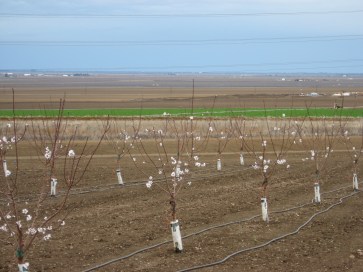
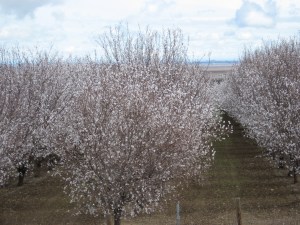
February is one of my favorite months for driving up and down the center of our very agricultural state. I won’t have that pleasure this year, but a few Februarys when I managed to visit family and the land where I grew up, the expanses of almond orchards were to be seen out my window for at least as many miles as it took me to drive one of the hours through what is called the West Side of the Central Valley. They are especially pretty on stormy days when the clouds are also playing their melodrama in the skies above.

The landscape along Highway 5 is never static, and not just because the seasons change. Our drought, and the loss of aquifer, mean that some farms will have to change what they grow, or downsize, or go out of business. One grower recently announced that they will be taking 10,000 acres of almonds out of production this year.

So I will enjoy the orchards I see, and not presume on their future. Richard Wilbur in this poem helps me to see aspects of fruit trees that I might not consider on my own, such as lifespans. Is it old orchards that are being “taken out,” or young trees that will never have the chance to be fully grown? What are the West Side bees meditating about this year?

gl w-side alm nurs closer

YOUNG ORCHARD

These trees came to stay. w-side alm med close
Planted at intervals of
Thirty feet each way,

Each one stands alone
Where it is to live and die.
Still, when they are grown

To full size, these trees
Will blend their crowns, and hum with
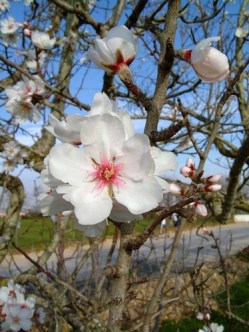
Meditating bees.almond-tree-flower

Meanwhile, see how they
Rise against their rootedness
On a gusty day,

Nodding one and all
To one another, as they
Rise again and fall,

Swept by flutterings
So that they appear a great
Consort of sweet strings.

~ Richard Wilbur

gl w-side alm orch clouds