Category Archives: poetry

It flows out of you into everything.

If I don’t write more often about moments like this one that I chronicled several years ago, it’s not because “happiness” does not continue to fall on me without warning. I’m glad the poet — and even I – did write about the phenomenon at one time, so we can go back for a washing of joy and thanksgiving. But there’s nothing like right now, for being receptive to our Father’s lavish dispensations. The original post:

As I drove away from the Office Max parking lot yesterday afternoon, “Scheherazade” was playing on the radio, and I crossed myself in a prayer, and immediately wondered why I did that. Why was I suddenly so full of joy and peace that I had to acknowledge the Holy Trinity and the fact that I was in His presence? It was a response to the beauty of the music, and a praise to the Creator of humans in His image, who are empowered to become co-creators after Him. But it was also a gift, unexplainable, this gladness to be alive. It is something to accept, and a place to live in, for however many moments I can keep it.

I have been reading a lot of poems lately. I want to say I’ve browsed through volumes large and small, collections by various poets….but I think a different word would be more honest, something like rummaged or skipped, or plowed. It doesn’t seem very respectful of the poets’ work, or quite civilized — until I find a poem to sink into, and then I am calmed and fed.

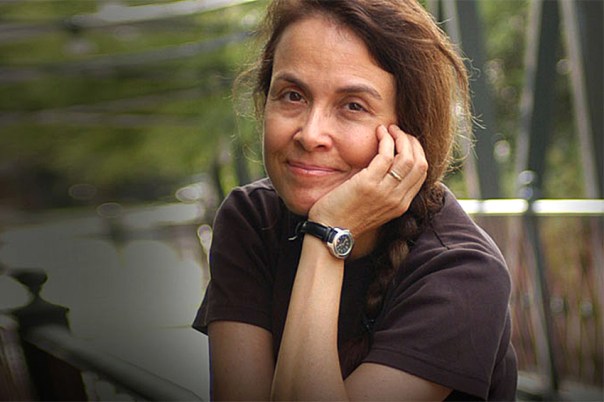
This morning I am sitting in the garden, listening to the fountain gurgle nearby. Also to the vague rock music coming through the walls of one neighbor’s house, and a saw sound buzzing over from another neighbor. After I finished breakfast I copied a couple of poems by Naomi Shihab Nye into my notebook, but this one I wanted to put up here instead, as it reminded me of that wonderful minute that I received. [Eight years ago — and such events as continue to happen remain mostly indescribable.]

Star Dancer – by Marcel Marien

So Much Happiness

for Michael

It is difficult to know what to do with so much happiness.
With sadness there is something to rub against,
a wound to tend with lotion and cloth.
When the world falls in around you, you have pieces to pick up,
something to hold in your hands, like ticket stubs or change.

But happiness floats.
It doesn’t need you to hold it down.
It doesn’t need anything.
Happiness lands on the roof of the next house, singing,
and disappears when it wants to.
You are happy either way.
Even the fact that you once lived in a peaceful tree house
and now live over a quarry of noise and dust
cannot make you unhappy.
Everything has a life of its own,
it too could wake up filled with possibilities
of coffee cake and ripe peaches,
and love even the floor which needs to be swept,
the soiled linens and scratched records…..

Since there is no place large enough
to contain so much happiness,
you shrug, you raise your hands, and it flows out of you
into everything you touch. You are not responsible.
You take no credit, as the night sky takes no credit
for the moon, but continues to hold it, and share it,
and in that way, be known.

-Naomi Shihab Nye

Queen Anne’s Lace

Sweetness and gravities.

Li-Young Lee has written at least two poems about peaches; I am guessing they are in many ways connected in his memory to his childhood. Here is the most recent one I came across, which is about much more than the sweet fruit itself:

THE WEIGHT OF SWEETNESS 

No easy thing to bear, the weight of sweetness.

Song, wisdom, sadness, joy: sweetness
equals three of any of these gravities.

See a peach bend
the branch and strain the stem until
it snaps.
Hold the peach, try the weight, sweetness
and death so round and snug
in your palm.
And, so, there is
the weight of memory:

Windblown, a rain-soaked
bough shakes, showering
the man and the boy.
They shiver in delight,
and the father lifts from his son’s cheek
one green leaf
fallen like a kiss.

The good boy hugs a bag of peaches
his father has entrusted
to him.
Now he follows
his father, who carries a bagful in each arm.
See the look on the boy’s face
as his father moves
faster and farther ahead, while his own steps
flag, and his arms grow weak, as he labors
under the weight
of peaches.

-Li-Young Lee

And here is the poet reading another poem more focused on the subject, which I shared some years ago without the audio. This one really makes me want to drive an hour or two into California’s Central Valley to find some peaches that fit his description:

The house had to be quiet.

T.F. Simon

Oh, how I love this aspect of the experience of summer as I have known it,
in my youth and now in my older years… 

The House Was Quiet and The World Was Calm

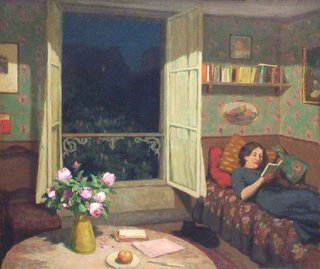
The house was quiet and the world was calm.
The reader became the book; and summer night
Was like the conscious being of the book.
The house was quiet and the world was calm.
The words were spoken as if there was no book,
Except that the reader leaned above the page,
Wanted to lean, wanted much most to be
The scholar to whom his book is true, to whom
The summer night is like a perfection of thought.
The house was quiet because it had to be.
The quiet was part of the meaning, part of the mind:
The access of perfection to the page.
And the world was calm. The truth in a calm world,
In which there is no other meaning, itself
Is calm, itself is summer and night, itself

Is the reader leaning late and reading there.

-Wallace Stevens

St. John’s Eve is on my mind…

This year in my parish the birthday of St. John the Baptist, June 24th, falls on Holy Spirit Day, and our youth are also heading off to church camp, so I wasn’t paying close enough attention. Ideally I’d have shared about it last night, on St. John’s Eve, because this year that is the day that has captured my imagination.

Father Malcolm Guite has written more than one sonnet for the celebration of St. John’s Day, the birth of St. John the Baptist. Here is one of them, prefaced by his notes on the feast:

“Now, with the summer solstice, we have come to midsummer and the traditional Church festival for this beautiful, long-lit solstice season is the Feast of St. John the Baptist, which falls on June 24th, which was midsummer day in the old Roman Calendar. Luke tells us  that John the Baptist was born about 6 months before Jesus, so this feast falls half way through the year, 6 months before Christmas!

“The tradition of keeping St. John’s Eve with the lighting of Bonfires and Beacons is very ancient, almost certainly pre-Christian, but in my view it is very fitting that it has become part of a Christian festivity. Christ keeps and fulfills all that was best in the old pagan forshadowings of his coming and this Midsummer festival of light is no exception. John was sent as a witness to the light that was coming into the world, and John wanted to point to that light, not stand in its way, hence his beautiful saying ‘He must increase and I must diminish’, a good watchword for all of those who are, as the prayer book calls us, the ‘ministers and stewards of his mysteries’.”

Midsummer Eve Bonfire – Nikolai Astrup

ST. JOHN’S EVE

Midsummer night, and bonfires on the hill
Burn for the man who makes way for the Light:
‘He must increase and I diminish still,
Until his sun illuminates my night.’
So John the Baptist pioneers our path,
Unfolds the essence of the life of prayer,
Unlatches the last doorway into faith,
And makes one inner space an everywhere.
Least of the new and greatest of the old,
Orpheus on the threshold with his lyre,
He sets himself aside, and cries “Behold
The One who stands amongst you comes with fire!”
So keep his fires burning through this night,
Beacons and gateways for the child of light.

-Malcolm Guite

To hear Fr Guite read his sonnet: Go here.

On Spanish Lanzarote Island

I just now figured out from this Wikipedia entry the source of the word bonfire:

“In England, the earliest reference to this custom occurs in the 13th century AD, in the Liber Memorandum of the parish church at Barnwell in the Nene Valley, which stated that parish youth would gather on the day to light fires, sing songs and play games. A Christian monk of Lilleshall Abbey, in the same century, wrote:

“‘In the worship of St John, men waken at even, and maken three manner of fires: one is clean bones and no wood, and is called a bonfire; another is of clean wood and no bones, and is called a wakefire, for men sitteth and wake by it; the third is made of bones and wood, and is called St John’s Fire.'”

The summer solstice always marks in my mind the beginning of summer, so I’m out of sync with the ancients who called it Midsummer…. even though the other end of the year does seem like Midwinter. Where I am, the heat is just now escalating, and definitely not at its peak, and for that reason I think my personal date for Midsummer would be sometime in July or August. When I get that certain feeling, I’ll let you know what date I choose.

Jules Breton – Midsummer Night Dance in Courrires

Only recently did I learn about St. John’s Eve celebrations at all. [Update: see the video link from Lisa in the comments below, for much more history of the day.] Some online Christian friends in England and Ireland gathered around bonfires last night — while I in California was still at church celebrating Pentecost. I doubt I will ever be able to join such festivities over there… maybe I should try to rouse interest in planning a West Coast Midsummer Fest for 2025. Does that sound fun to you? And do you feel that where you are, it is truly Midsummer — or Midwinter?

The Sun — Giuseppe Pellizza da Volpedo

(If you enjoy the sonnets from Malcolm Guite, remember that most of them have been published in his several collections. The one here can be found in Sounding the Seasons, his cycle of seventy sonnets for the Church Year.)