Following on the theme of language, I’m re-posting this poem from Dana Gioia. As my situation is different from seven years ago when I first put it up here, so is my response to the poem. Then, I was often with my late husband, and we would tell each other the names of things, and amplify our knowledge and appreciation of the world together. Or, we would simply be together in silence, in those moments of happy existence in the world that does not need words.
Nowadays, I still have the impulse to tell all these things, or attempt to bring my readers into the wordless experiences I have — by means of words! Of course, I can’t even attempt to describe more than a fraction of the moments, the stones and sunlight and shadows. So I am learning — a little — to just sit with the things, “no less real for lying uncatalogued and uncounted.” There is Someone with me, after all, who doesn’t tell me the names of things, but Who is the Reality from which they came into being. He also needs no praise, so we praise Him always.
WORDS
The world does not need words. It articulates itself in sunlight, leaves, and shadows. The stones on the path are no less real for lying uncatalogued and uncounted. The fluent leaves speak only the dialect of pure being. The kiss is still fully itself though no words were spoken.
And one word transforms it into something less or other – illicit, chaste, perfunctory, conjugal, covert. Even calling it a kiss betrays the fluster of hands glancing the skin or gripping a shoulder, the slow arching of neck or knee, the silent touching of tongues.
Yet the stones remain less real to those who cannot name them, or read the mute syllables graven in silica. To see a red stone is less than seeing it as jasper – metamorphic quartz, cousin to the flint the Kiowa carved as arrowheads. To name is to know and remember.
The sunlight needs no praise piercing the rainclouds, painting the rocks and leaves with light, then dissolving each lucent droplet back into the clouds that engendered it. The daylight needs no praise, and so we praise it always – greater than ourselves and all the airy words we summon.
In your language every line begins from an opposite end. The pronunciation of its words changes from day to night and their orthography changes with the change of seasons. A new word enters it on some special day and on some days a familiar word is made obsolete. The shape of its letters changes with your change of clothes. You make no effort to put together words that are crushed under feet from your carelessness, because your language is the world’s richest. The first kiss, the second kiss and any count of kisses are all identified in your language with separate words. If anything ever causes you to become tearful, all the books in the whole world written in your language become drenched.
-Afzal Ahmed Syed Translated from the Urdu by Musharraf Ali Farooqi
This week so far I have seen patches of the starry sky through the window from my bed, and through narrow gaps in the tree canopy as I walked along the gravel road coming back from a campfire.
Those glimpses are lovely, but not as powerful as what I experienced a few years ago when I was alone here in the High Sierra, standing on the deck at night, looking up: I was aware of the stars as somehow sentient beings that were intently and personably crowding and pressing down on me. The poem below expresses the thrill of such a meeting as I had, with added feelings that I didn’t experience.
The composer Tchaikovsky, in a letter to the Grand Duke Konstantin Konstantinovich, wrote: “I place some of his poems up there with the very highest that there is in art. In this respect there is one which I am determined to illustrate musically some day.” This is the poem he copied in:
UPON A HAYSTACK ON A SOUTHERN NIGHT
Upon a haystack in lands of South, I lay, while facing skies of night, The choir of stars, alive and couth, Was trembling, spread at every side.
The earth, mute as a dream half-hidden, Was fast receding into space, And I, as if the first in Eden, Alone met the black night’s face.
Did I race to the depth profound, Or did the stars race straight to me? In mighty hands, it seemed me how, I hanged above abysmal sea.
With heart, so sinking and bewildered, I measured with my look a depth, Into which, every moment sighted, I sink, and nobody helps.
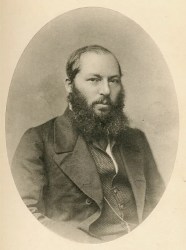
-Afanasy Afanasevich Fet, (1820-1892)
One odd thing is, the way Luis Sundkvist translated the letter from Russian, the second line of the poem reads, “I lay with my face towards the ground…” How this happened I can’t imagine, because of course the poem makes no sense like that.
Golgol and Tolstoy also thought Fet’s poetry was stellar. The writer and publisher Nikolay Nekrasov wrote: “Not a single poet since Pushkin has managed to give such delight to those who understand poetry and readily open their soul to it, as Fet does.”
The surname of Fet was assigned by authorities to Afanasy because of some question in Russia about the legitimacy of his birth; his parents’ marriage had been registered in Germany. In his later years he wrote to his wife, “You cannot even imagine how I hate the name Fet. I implore you never to mention it… If someone would ask me to give one single name to all the trials and tribulations of my life, I’d say without hesitation, this name is ‘Fet'”. Later still he was able to get back the name of his father, Shenshin, but as his poems were all published under the name Fet, so he is known. Evidently not much of his work has been translated into English, which makes this one even more special.

 This week so far I have seen patches of the starry sky through the window from my bed, and through narrow gaps in the tree canopy as I walked along the gravel road coming back from a campfire.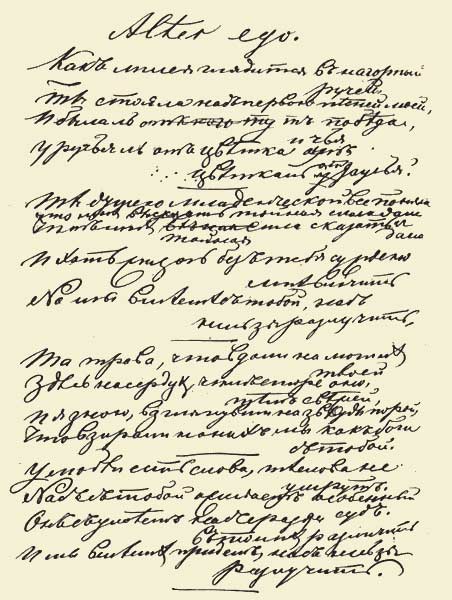
 Gladsome Lights