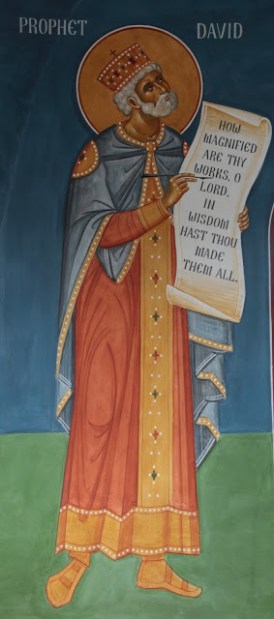
I am a sojourner on the earth, hide not from me Thy commandments. My soul hath longed to desire Thy judgments at all times. ….. Remove from me reproach and contempt, for after thy testimonies have I sought. For princes sat and they spake against me, but Thy servant pondered on Thy statutes. For Thy testimonies are my meditation, and Thy statutes are my counsellors. My soul hath cleaved unto the earth; quicken me according to Thy word. ….. My soul hath slumbered from despondency, strengthen me with Thy words.
Wholeness was the plan, when God created the cosmos. Then, humans distanced themselves from their maker, the one with whom they had walked in the garden. Harmony between the man and the woman was broken, and they both lost connection with their true selves, which had been grounded in the Giver of Life.
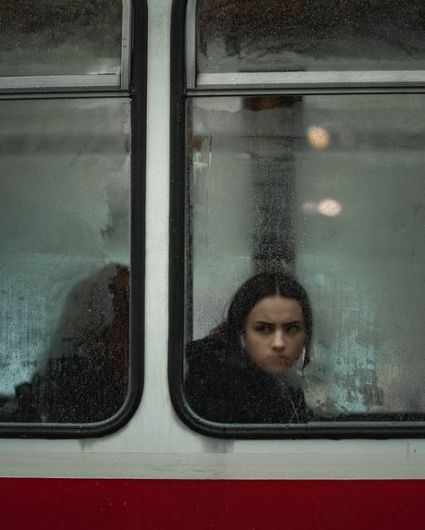
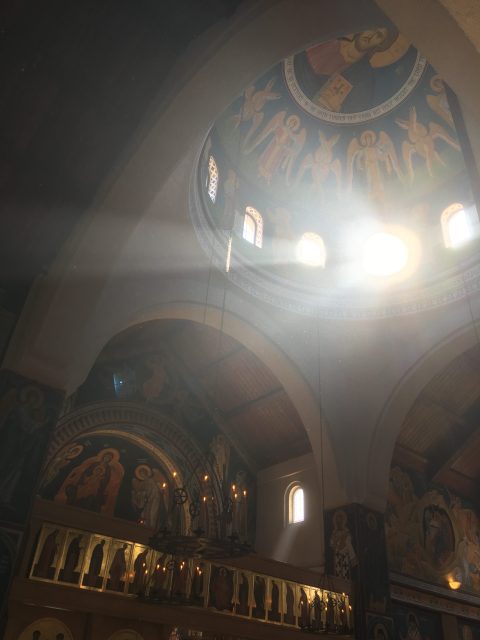
C.S. Lewis imagines how an unfallen world might have looked, in his novel Perelandra, which I recently re-read. A scientist with a utopian vision comes from Earth to a strange planet — of course, we have plenty of this stuff to export! — to be the tempter of the Eve figure, the Green Lady. She struggles to maintain her natural and primal, essential oneness with her god, and the drama that ensues is full of suspense.
I suppose it is because of my non-fiction fallen-world perspective that I despaired of the Green Lady being able to withstand the arguments of the oily Weston, even while descriptions of the grace-full divine dance with humans lifted my hopes. I don’t think it’s in my power to say more about this book or the whole trilogy, and what I have just written probably makes little sense, but the story came to mind when I read the poem below. Because the Green Lady won’t remain firm unless the strength comes from knowing who she is.
In this in-between world, the time of waiting for the fullness of the Kingdom, we get moments and glimpses of unity and wholeness, an intuition of how it might feel to be in full communion with one’s own being and one’s Maker, and from there, with other people. But our parts are mostly disjointed and disconnected.
IMPOSSIBLE FRIENDSHIPS
For example, with someone who no longer is, who exists only in yellowed letters. Or long walks beside a stream, whose depths hold hidden porcelain cups — and the talks about philosophy with a timid student or the postman. A passerby with proud eyes whom you’ll never know. Friendship with this world, ever more perfect (if not for the salty smell of blood). The old man sipping coffee in St.-Lazare, who reminds you of someone. Faces flashing by in local trains— the happy faces of travelers headed perhaps for a splendid ball, or a beheading. And friendship with yourself —since after all you don’t know who you are.
-Adam Zagajewski
Father Alexander Schmemann writes about this in The Eucharist:
“… nowhere is the darkness of ignorance into which we were immersed with our fall from God more obvious than in man’s staggering ignorance of himself, and this in spite of the insatiable interest with which, having lost God, man studies himself and endeavors in his ‘sciences humaines’ to penetrate the mystery of man’s being. We live in an era of unrestrained narcissism, universal ‘turning into one’s self.’ But, as strange and even terrible as this may seem, the more elemental is this interest, the more obvious it is that it is nourished by some dark desire to dehumanize man.
“The thanksgiving offered by the Church [in the Eucharist] each time answers and destroys precisely this not only contemporary but age-old lie about the world and man. Each time it is a manifestation of man to himself, a manifestation of his essence, his place and calling in the light of the divine countenance, and therefore an act that renews and recreates man. In thanksgiving we recognize and confess above all the divine source and the divine calling of our life. The prayer of thanksgiving affirms that God brought us from nonexistence into being, which means that he created us as partakers of Being, i.e., not just something that comes from him, but something permeated by his presence, light, wisdom, [and] love….”
This morning I had a date to iron altar cloths at church. If it hadn’t been for that, I think I might have read poems all day. Bright and early I found myself listening hungrily to The Daily Poem podcast, which I sometimes ignore for weeks at a time. Today, by contrast, its offerings seemed like my necessary food, cultivating hope and peace in my heart the way bodily exercise generates endorphins for the brain and psyche.
Not all poems are tasty, but even the bitter ones supply certain kinds of trace elements, hints and explorations of the worlds that lie underneath the clamoring and crowded surfaces where we walk every day. I like very much the engagement with the poets themselves, people who often do appreciate the mystery of things, but I usually avoid long poems. These very short poem podcasts help me to focus and enjoy works I might not normally read, even some longer poems; because it’s all auditory, and I can’t see how long of a poem or portion will be read, and be put off by it.
Today one of the podcast hosts, Heidi White, talked about the poem “Velvet Shoes,” by Elinor Wylie. She told us about her own longing, two days after Christmas, for peace and quiet, after the busyness of the holiday, and how this poem conveys the heaviness of the snow, and how that heaviness creates silence and a kind of weighty peace, “…the feeling you get going into the nave of a great cathedral.”
VELVET SHOES
Let us walk in the white snow In a soundless space; With footsteps quiet and slow, At a tranquil pace, Under veils of white lace.
I shall go shod in silk, And you in wool, White as white cow’s milk, More beautiful Than the breast of a gull.
We shall walk through the still town In a windless peace; We shall step upon white down, Upon silver fleece, Upon softer than these.
We shall walk in velvet shoes: Wherever we go Silence will fall like dews On white silence below. We shall walk in the snow.
-Elinor Wylie, 1885-1928
The longing expressed in the few stanzas is impressive. We do start to wonder if the narrator will break out of the future tense and make it the present. Personally, I think that if she were truly hopeful of walking in the whiteness, she would do the activity first, and then write about it. Unless it is a sort of love letter, to someone not present at the moment. It seems to be as much about longing — and maybe purity? — as it is about snow.
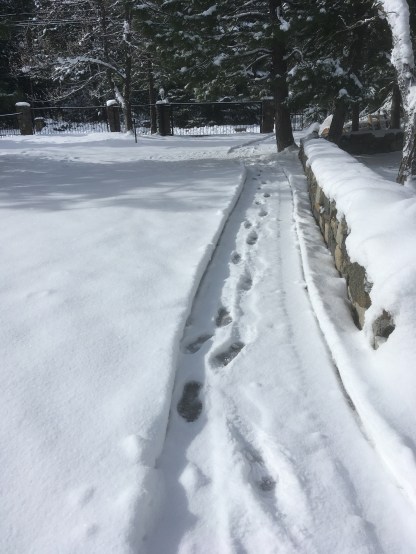
Winter at Pippin’s place.
The Daily Poem hosts talked to me about several other poems as I was getting dressed, by W.H. Auden, Edward Thomas, George Santayana and Mary Oliver. Of course, many of the recent offerings have been autumnal or Advent-themed poems, but I enjoyed them all. I may save some to post here in the appropriate season next year.
“Velvet Shoes” may have especially impressed me because I am anticipating walking in the snow myself this week, if my plans work out to visit Pippin. And here I was, just yesterday, going on about fire and warmth….
I always think I do not want to visit snowy and cold places, but whenever I do, it’s fun. Did you notice that in spite of the narrator’s silk and lace garments, there is no mention of the cold? That might mean that it is just the poem for me!
I haven’t baked much yet this Christmas. I may start in a few days, to prepare for a couple of events coming up. I made two of my traditional treats for the cookie platter: Ginger Spice Cookies in a gluten-free version and Cranberry Jellies.
The one new kind I tried so far is from Dorie Greenspan’s book: Double Chocolate Buckwheat Cookies. Here are the last of those, in the cookie tin, at right. They are buttery and chocolaty, but I don’t think I will make them again. I did buy five kinds of Christmas cookies from Trader Joe’s, so we didn’t suffer.
Here are a few scenes from the last busy days:
I also want to share this poem again, a song from Canada called “The Huron Carol.” Here is a video version of it sung by Tom Jackson.
THE HURON CAROL
’Twas in the moon of wintertime when all the birds had fled, That Mighty Gitchi Manitou sent angel choirs instead. Before their light the stars grew dim, and wand’ring hunters heard the hymn: Jesus, your King, is born;
Jesus is born,
In excelsis gloria!
Within a lodge of broken bark the tender Babe was found, A ragged robe of rabbit skin enwrapped His beauty round. And as the hunter braves drew nigh, the angels’ song rang loud and high: Jesus, your King, is born;
Jesus is born,
In excelsis gloria!
The earliest moon of winter is not so round and fair As was the ring of glory on the helpless infant there. And chiefs from far before Him knelt with gifts of fox and beaver pelt: Jesus, your King, is born;
Jesus is born,
In excelsis gloria!
O children of the forest free, O sons of Manitou, The Holy Child of earth and heav’n is born today for you. Come kneel before the radiant Boy, who brings you beauty, peace, and joy: Jesus, your King, is born;
Jesus is born,
In excelsis gloria!
~ Jean de Brébeuf, S.J. (1593-1649)
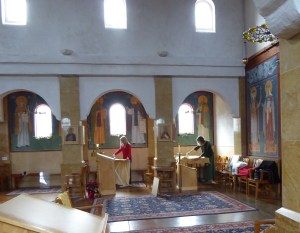
My grandson Pat and his wife came on Christmas Eve to hike and feast and play games with us for most of the day. This morning Soldier and Joy’s family came to church with me and that was lovely; we came home and had a lovely festal brunch before opening gifts. Christmas Day always surprises me, as the last few days of Advent are like being on a train that speeds up just before getting to the station.
Thank you for your Christmas greetings to me! If you are kneeling before the radiant Boy just now, I’m right there with you. Christ is born!