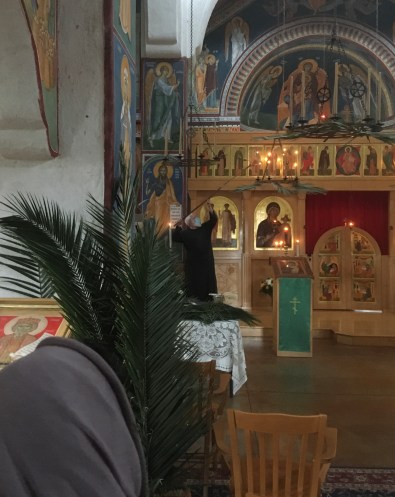
Today was Palm Sunday for us Orthodox Christians, and tonight I attended the first of the Bridegroom Matins services. Until this year, at least as long as I’ve been a member, our parish has held this service in the morning, but this year we are doing it in the evening. Here is an explanation of the tradition:
“Bridegroom Matins is a service specific to the first four evenings of Holy Week and commemorates the last days in the earthly life of the Lord. Incorporated into these services is the theme of the first three days of Holy Week; which is the last teachings of Christ to his disciples. As such, these services incorporate readings and hymns inspiring this theme. The mood of the services is to experience sorrow and to feel Christ’s voluntary submission to His passions and highlight the purpose behind the evil that is about to  take place against the Lord. The atmosphere is one of mourning (for sins) and is symbolic of the shame the Christian should feel for the Fall of Adam and Eve, the depths of hell, the lost Paradise and the absence of God.”
Those mornings that seem so long ago, I would arrive in the dark, and come out from the service after the sun had risen; many times I’d walk around the church property and take pictures before driving home. This evening, I came straight home and visited my own garden, which was radiant with the setting sun after a rainy day.
One of the Gospel stories featured in today’s Matins service is the parable of the barren fig tree. Here is my own tree, that is not likely to be fully illustrative of that parable, come fall.
At least seven Psalms are read at every Orthodox Matins service, and tonight two more were read, including this one:
Psalm 19 (20)
May the Lord hear thee in the day of tribulation:
may the Name of the God of Jacob protect thee.
May he send thee help from the sanctuary:
and defend thee out of Zion.
May he be mindful of all thy sacrifices:
and may thy whole burnt offering be made fat.
May he give thee according to thine own heart;
and confirm all thy counsels.
We will rejoice in thy salvation;
and in the Name of our God we shall be exalted.
The Lord fulfill all thy petitions:
now have I known that the Lord hath saved his anointed.
He will hear him from his holy heaven:
the salvation of his right hand is in powers.
Some trust in chariots, and some in horses:
but we will call upon the Name of the Lord our God.
They are bound, and have fallen,
but we are risen, and are set upright.
O Lord, save the king:
and hear us in the day that we shall call upon thee.

 more during Lent. He suggested the Psalms, because the use of them is a tradition that was without doubt handed down to us by the Apostles.
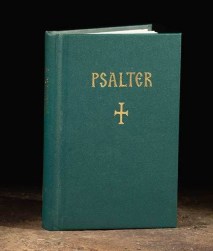 The Psalms of the Bible are the poetry that I am focusing on this year in National Poetry Month. They are helping me to also keep a Lenten focus. I’ve had my eye on two Psalms in particular that I wanted to memorize, but deliberately working at memorizing seems to “not be happening.” Maybe if I at least read them (a little) more frequently some of the lines and verses will start to stick. I love this green pocket Psalter so much. It is from
  This literal reading of the Psalms however is only the beginning. As one prays the Psalms one soon begins to realize that the enemy, the Amalekite or the Philistine, the nations that rage against God, are not people or situations outside myself, but are most poignantly referring to the wicked impulses and evil thoughts that I must battle within myself. The psalmist’s cry for deliverance becomes my own as I see within my own heart and mind the struggle between good and evil; the betraying thought, the accusing word, or the mocking laugh.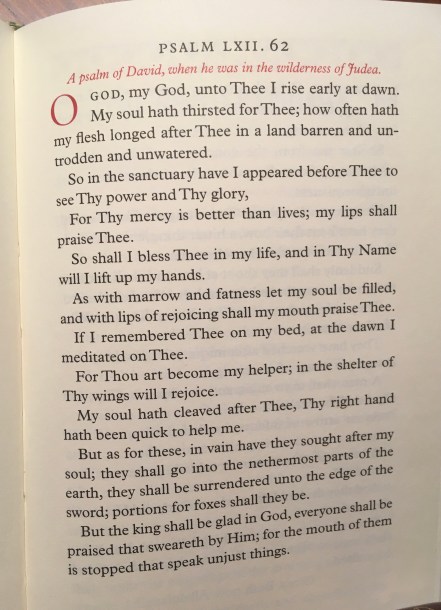

 Gladsome Lights