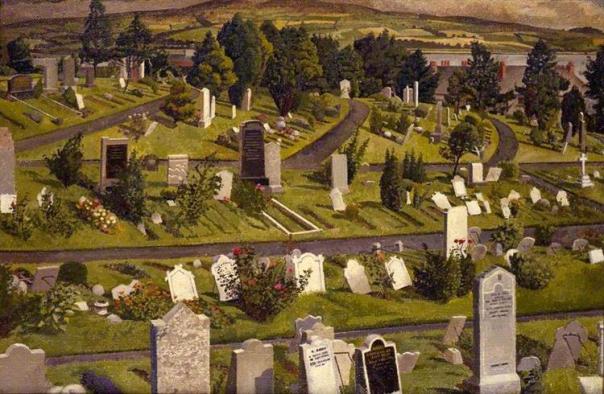
The poem below got me started thinking about mountains and their symbolism. I discovered a very long article on the subject, “The Transfiguration on Mount Tabor: The Symbolism of the Mountain,” which I don’t have time to read deeply, because as I type this draft, I’m in the midst of packing the car for five of us who will be in the mountains together by the time you read my post. I hope the article is not paywalled. It is a treatise on the subject going back millennia, opening with this from René Daumal:
“[The] summit touches the sphere of eternity, and its base branches out in manifold foothills into the world of mortals. It is the path by which humanity can raise itself to the divine and the divine reveals itself to humanity.”
The Transfiguration, Mount Tabor
The author examines traditions throughout the world, beginning in ancient times and concluding with thoughts on what The Mountain means for us Christians who are on a continuum with those 2,000 years ago. Here is one excerpt to help you know if you are interested in the subject from a scholarly perspective :
“In the traditional Hebrew and Christian understanding of the world, places are what they are by their teleology: it is not so much by the material or structural elements that they are recognized, but by their function. Things are what they are because of their purpose and their place in a web of relationships within reality which help create our own map of meanings. Therefore, it is very difficult to understand from a purely geographical (time-space) position where God dwells with regards to this or that mountain. For this reason, many physical mountains have been ‘the mountain of God’. There is only ‘one’, but it’s not confined to one geographical space-time location as we modern people understand it.”
I guess it’s obvious that I myself am interested, and I thought of printing this article to take with me to the high country, but I’m afraid I won’t have time to read it up there, either. My family and I will be too busy playing around our grandfather’s knees.
THE MOUNTAIN
The Mountain sat upon the Plain In his tremendous Chair— His observation omnifold, His inquest, everywhere—
The Seasons played around his knees Like Children round a sire— Grandfather of the Days is He Of Dawn, the Ancestor—
“The intimate darkness of our most precious cognitive organ constantly reminds us – whether we like it or not – that the “inner” content of any human is never absolutely available to our cognitive powers. The most powerful among the senses, thus, recognizes the deepest human cognitive powerlessness precisely during the encounter with the most powerful sense organ of another human being. However carefully we approach or analyze it, the unique personal existence of every human always stays partly hidden in the darkness of the unknowing.
“And this is most expressively manifested when we encounter the small black dot that is the pupil of the eye. At this place we truly do “enter into the human soul,” but at the same time –confusingly and paradoxically – we realize that we cannot enter it. In this kind of darkness, we can get lost and go crazy, or feel warm and safe – for the same reason: because we cannot possess what it reveals/hides. This darkness can be scary or the most welcoming place in the world for the very same reason: because, herein, we recognize the utmost freedom of the human being.
“Through the encounter with the pupil of another human being, we fall directly into the other’s personal infinity, which can never be fully attained – even if our faces are only a few centimeters from each other. Experiencing this kind of infinity, finally, becomes the cognition of the utmost human freedom – freedom that does not depend even on itself.”
I added paragraph breaks to this excerpt from an article by Todor Mitrović from the Orthodox Arts Journal, on “The Epiphany of the Eye.”
I found the author’s ideas fascinating, and convincing. I am not an artist, but I do gaze upon icons quite a bit. When I do, I am looking through the “window,” not caring to analyze what features of the image are having what effect on me. This article nonetheless does help me to better appreciate the whole phenomenon. The artistry of an icon is not the most important thing about it, but contributes to its beautiful effect on our souls, our deepening relationship to Christ through prayer.
It’s not even midmorning as I am beginning to write this post, and already my Name Day has bestowed several particular delights. One of the first was the ability to take an early walk — it seems so easy when all the conditions are right, and somehow that rarely happens anymore. Hmmm…. Note the passive phrase that flows from my mind, referring to a thing that happens, instead of an action I take. But truly, I am always choosing a direction for my heart to follow, moment by moment, as I respond to constant promptings. This morning I felt no prompting from tired bones to stay in bed, and no prompting from the fog to mope — that tipped the balance.
St. Paisios of Mount Athos
Much as I love the church calendar, and the abundance of events and people to remember and celebrate every day, I don’t always keep in sync with it, or the civil calendar for that matter. Others have told me that they also might miss their name day if someone didn’t remember it for them and wish them a “Happy Name Day!”
I received such a prompt pretty early this morning, as it came from Greece. And the next name-day greeter shared a photo of the icon above, which is by the hand of Janet Jaime, a contemporary iconographer who is new to me. The friend who wrote me from Greece included an encouraging article about holy elders and saints whose prophecies have been much discussed of late, an example being St. Paisios.
Christ praying in Gethsemane
I do think about Current Events, of course. I wouldn’t want to close myself off from what my friends are thinking about, and right now I also have a personal reason to keep at least minimally informed, in that one of my own family members is living in the Middle East and very close to the recent action. Still, it’s important to detach from the stream of noise that is the news, for even half a day, or as long as possible. Because each of us has some work God has given us to do, whether washing the morning dishes or praying on your sick bed, managing a busy restaurant or walking across the street to check on a neighbor. We should be present wherever we physically are.
Today another thing “happened” that became a celebration of my name day, which was the long-awaited lunch together that my goddaughter and I have been trying to accomplish for two years. Naturally we had set the time and place, but without either of us realizing that it was the feast day of St. Joanna, until the day arrived. We spent half the afternoon catching up, and didn’t have a spare moment to talk about events outside of our realm of influence.
Father Stephen Freeman’s blog post for today just happened to be perfect for my name day and my mood: “Everything is in Motion”:
“God’s creation (as we should well know) is everywhere in motion. Every object in the universe is moving (further apart we are told). Even the particles of matter that compose so-called stationary objects (such as rocks) are in motion. Nothing is completely at rest.”
“Everything is in motion, and everything has its direction. That direction is its purpose – its reason for existence and reason for continuing in existence. This reason is its logos. The Logos of all logoi (plural), is Christ Himself.
In the beginning was the Logos, and the Logos was with God and the Logos was God. All things were made through Him… (John 1:1)
“Each of us has a purpose and reason for existence. For human beings (and all creation), that purpose is union with God…. We move rightly towards the end for which we were created. Salvation, like all things in God’s creation, is dynamic and not static.”
Fr. Stephen goes on to mention how “dizzying” it can be, to live in the midst of this constant swirl that is our world, and our life. He relates how monasteries on Mount Athos will at times set chandeliers swinging during services, which has been described as “representing the dancing of the angels before God.” We often do this in my parish, with four of the six chandeliers that hold real candles turning and twirling while the flames dance.
When I first experienced this I had no idea I would one day enter the Orthodox Church at that parish. I was sitting on the floor during a Vespers service, having come primarily for a weekend food fair. So much was going on in that space, people coming out and going into the altar, other people bowing before the icons or lighting candles, the choir singing beautifully, and no pause in the hymns of praises going up — that is, a lot of movement! — when my gaze was lifted up to the huge chandelier above me — at that time there being just one — which was being pushed by an altar server in such a way that it began to swing into a wide and majestic arc. I thought at the time, These are serious Christians, to worship so extravagantly.
Over the many years since then, I should have known this tradition was symbolic of something, and not just a random act of jubilation. I found a short video that shows one such otherworldly occasion, where multiple chandeliers are in motion, on the Holy Mountain: The Dance of the Cherubim.
You may find it a little jarring, as I did, when phones and cameras other than the one making that video come into view. But I comforted myself knowing that since the angels are immaterial, they are not able to be seen in person or caught in a video unless they choose to take on a material form. But they are probably too busy doing their work of crying “Holy!”, carrying messages, and dancing, to bother about our devices — at least the material kind.
My day is now coming to an end, and it’s time to bring this post to a full stop. The universe is still in motion, I know, but my rational mind and my fingers will cease moving for a few hours. Thank you, St. Joanna, whose name I bear, for your example in actively following Christ in His earthly life, and for your prayers. Thanks be to God for the many ways I have felt His movement, pulling me in, and giving me the strength and will to respond. It feels very much as though I am in The Dance.
Palm Sunday is the beginning of Holy Week, and here on the eve of it I’m sharing again, slightly updated, my experience of about ten years ago when I was in the middle of reading The Brothers Karamazov, and I came to the the part “From the Life of the Elder Zosima,” which takes place during this week leading up to Christ’s death and resurrection:
The Elder Zosima first relates about his older brother, who only at the age of seventeen and sick unto death, turned from anger and scoffing toward a path that might lead to repentance, and seemingly only to please his mother. But that is not an entirely bad reason.
… on Tuesday morning my brother started keeping the fast and going to church. “I’m doing it only for your sake, mother, to give you joy and peace,” he said to her….But he did not go to church for long, he took to his bed, so that he had to confess and receive communion at home. The days grew bright, clear, fragrant — Easter was late that year. All night, I remember, he used to cough, slept badly, but in the morning he would always get dressed and try to sit in an armchair. So I remember him: he sits, quiet and meek, he smiles, he is sick but his countenance is glad, joyful. He was utterly changed in spirit — such a wondrous change had suddenly begun in him!
The young man asked forgiveness of everyone and talked about his great sin, but at the same time was so happy and full of thankfulness and exhortations, that people thought he was going mad.
Thus he awoke every day with more and more tenderness, rejoicing and all atremble with love. The doctor would come — the old German Eisenschmidt used to come to us: “Well, what do you think, doctor, shall I live one more day in the world?” he would joke with him. “Not just one day, you will live many days,” the doctor would answer, “you will live months and years, too.” “But what are years, what are months!” he would exclaim. “Why count the days, when even one day is enough for a man to know all happiness. My dears, why do we quarrel, boast before each other, remember each other’s offenses? Let us go into the garden, let us walk and play and love and praise and kiss each other, and bless our life.”
This older brother died a few weeks after Easter, when the teller of the story, the elder Zosima, was only eight years old. Now now near death himself, he talks more about his childhood, and how it was also during Holy Week that he began to see more when he went to church.
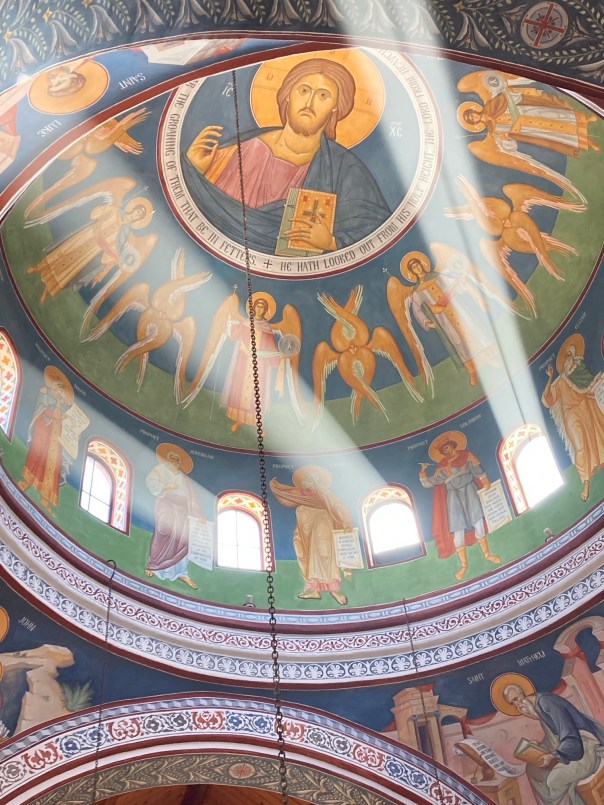
But I remember how, even before I learned to read, a certain spiritual perception visited me for the first time, when I was just eight years old. Mother took me to church by myself (I do not remember where my brother was then), during Holy Week, to the Monday liturgy. It was a clear day, and, remembering it now, I seem to see again the incense rising from the censer and quietly ascending upwards, and from above, through a narrow window in the cupola, God’s rays pouring down upon us in the church, and the incense rising up to them in waves, as if dissolving into them. I looked with deep tenderness, and for the first time in my life I consciously received the first seed of the word of God in my soul. A young man walked out into the middle of the church with a big book, so big that it seemed to me he even had difficulty in carrying it, and he placed it on the analogion [lectern], opened it, and began to read, and suddenly, then, for the first time I understood something, for the first time in my life I understood what was read in God’s church.
The reading was from the book of Job. I myself have attended these same services over the years, and they grow more precious every time I hear the readings and hymns. The gifts of the Church are too rich to ever plumb their depths, but there is no need to fret about our limitations, when, as the sick brother says, “even one day is enough for a man to know all happiness.” How many times have I also watched the beams of light shining down when I stood in church, and even felt their heat on my face, like the warmth of God’s love?
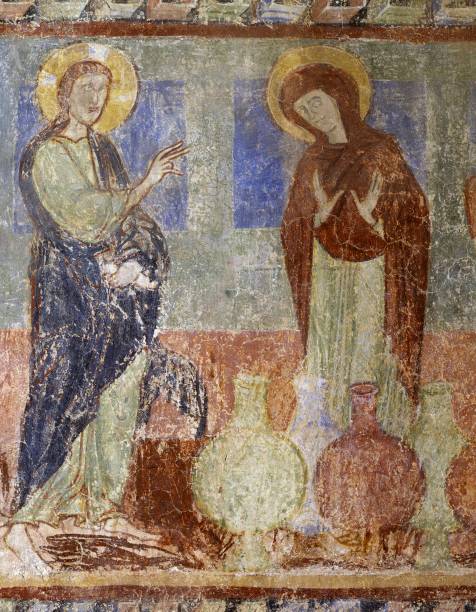
Christ the Bridegroom
The Elder Zosima is a fictional character, but he is believed to be based on a real-life monk in old Russia. In the novel the Elder proceeds from this point in his very moving fashion to tell his life’s story: “– and over all is God’s truth, moving, reconciling, all-forgiving!”
The “accidental” timing of my reading seemed to be a gift from God that morning, helping me in an unusual way to become even more receptive to His being with us at the evening service by means of hymns such as, “Let my prayer arise in Thy sight as incense….,” and the Psalms of Ascent — and the Holy Mysteries.
When our bishop was with us the previous week, he gave a good word about the last days of Lent — well, technically Lent has come to an end, but we are still in the anticipation and preparation that is Holy Week. He said that Lent is not about finding every bit of dirt in our souls, but about the bridal chamber, about discovering the great love that our Lord Jesus has for us. It is truly a “bright sadness” that colors these days as we accompany Him to the Cross.
Perhaps Zosima’s brother went to a Bridegroom Matins service on Tuesday; we have three of them during Holy Week. The Lord Himself has been filling my lamp with the oil of His Holy Spirit.