It’s a wonder, all the fascinating things I get to discuss and learn about, inspired by reading books to boys who range in age from two to six years old. Before they’d even shed their pajamas this morning they brought me a book found on the shelf here at the temporary house, a worn 1966 school discard by Isaac Asimov titled The Moon.
What instantly got my attention was the picture on the first page, a closeup of the moon showing its topography, with many names of craters, valleys and mountains. Where did these names come from? When were they given? Who is Piccolomini? Astronomy has never exactly sparked my interest; maybe because of my inability to grasp the spatial arrangement of bodies and trajectories in the Universe. But show me a map, and names that carry historic or literary or philosophical meanings as these seem to, and I’m intrigued.
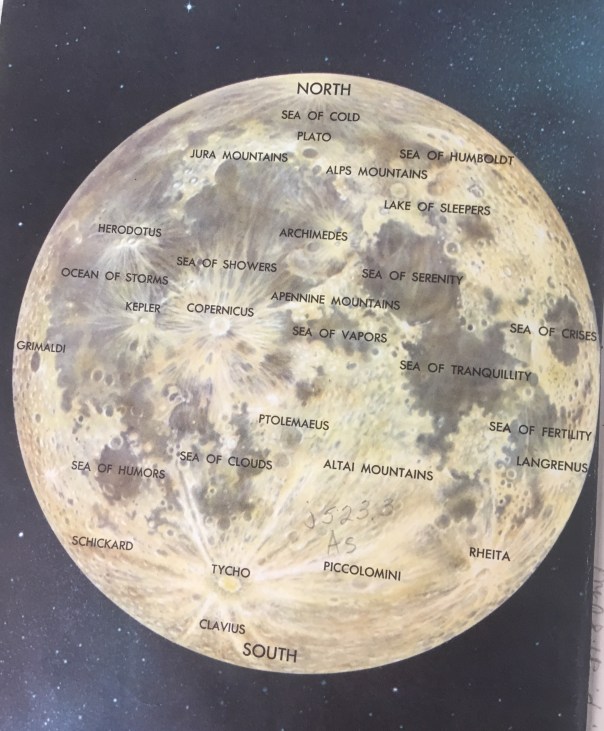
Mr. Asimov doesn’t get into all that. He goes right to theories of ages and descriptions of orbits. Liam was happy to stay with me a while on the names — remember, we both love words — and pointed out that Piccolomini has two words in it: piccolo and mini. This name is significant to our other “studies” as I will come back to later.
Before we could turn the page of this book, we had to sit down and eat the breakfast I’d made, and then the rest of the household who weren’t at work went to visit another new friend, and as I was simultaneously working on some oatmeal muffins for lunch I read about lunar topography. The man who came up with the first nomenclature for the moon, much of which is still used, was a Jesuit priest of the early 17th century, Giovanni Battista Riccioli. Riccioli considered himself first a theologian, but spent the vast majority of his long life researching and teaching about astronomy, as well as logic and physics, especially pendulums. What a learned and productive human, who lived in a challenging time for a natural philosopher. People debate about his possible secret beliefs, based on how he chose and arranged names of lunar features.
“He said that once the enthusiasm for astronomy arose within him he could never extinguish it, and so he became more committed to astronomy than theology. Eventually his superiors in the Jesuit order officially assigned him to the task of astronomical research. However, he also continued to write on theology…”
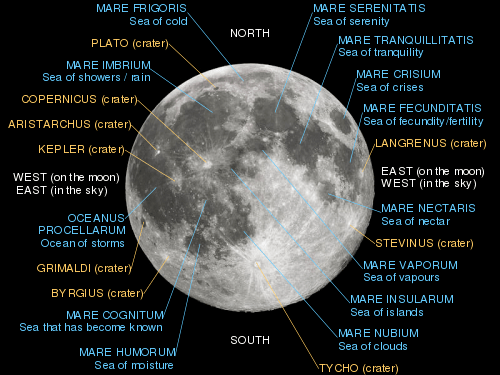
Will I integrate these evocative moon names into the tangled web of my mind’s musings? Perhaps the only thing I will have gained is another name for what’s in my head: “Sea of Vapors.” That name is from this newer map, featuring the waters of the moon, which I will leave at closing of this subject. Oh, and Piccolomini was an Italian poet and astronomer.

Soldier and Joy did bring along a big bag of their own books for the children, including several titles I wasn’t familiar with before, like this one about orchestral instruments. It made me think of the song I used to sing with my children, “Nous Sommes à la Musicale.” (“We are at the musical,” in French.) I couldn’t remember much of it, but Pippin came to my rescue and sent me a cute video of herself singing it. It’s ultra simple and catchy — there are no other French lines other than the names of the instruments — and you can hear a clip of it on this Folkways recording. Perhaps I borrowed the LP from the library once in the distant past.
 More singing: here is Liam sweeping while singing “I love the mountains, I love the rolling hills,” etc.
I wanted the children to be able to hear the sounds of all the instruments pictured in the book above, and I found quite a few good videos on YouTube, including a half-hour performance without any lecturing, from Benjamin Britten’s Young People’s Guide to the Orchestra. I loved it because it showed nearly every instrument and closeups of the musicians playing, and the conductor was fun to watch as well. There were many shots of the piccolo player!
The boys had heard “Peter and the Wolf” many times, but never seen it played. I found a charming ensemble of seven musicians from Qatar performing to a backdrop of a sort of shadow puppet show of the story, and that was a hit.
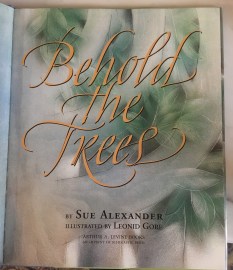
Browsing the library shelves last week with Laddie, I came across this beautiful book, Behold the Trees, by Sue Alexander, illustrated by Leonid Gore. It is a simple telling of the story of “living, life-giving trees” in the Holy Land, from ancient times when they were plentiful, to the 20th century when Jews all over the world contributed funds for planting trees to replace those that had been over the centuries and for various reasons cut down.

“They grew in stands and groves and great forests. They held back the sea, cooled the air, and protected the earth for the people and animals who lived there… So it was, for hundreds and hundreds of years….”
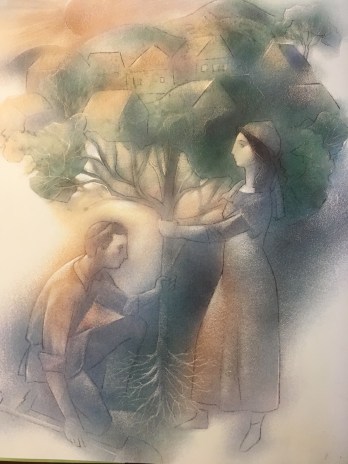
But then, people needed cleared land for farms and doors for shops; armies “cut down trees to build fortresses and palaces, shrines to their gods, cities and towns.” Whole forests were burned to remove hiding places for enemies. Eventually “the land became salt marsh and sand,” and animals disappeared.
I love the illustrations in this book showing these events and the people planting trees. And the names of the trees listed simply, and as elegant as a poem. I wanted to know more about the history of this re-greening effort, and I learned a few things online that were fascinating and encouraging.
As recently as the 1960’s the project was begun to plant Yatir Forest on the edge of the Negev Desert. A long Wikipedia article tells much about this “living laboratory” that is the largest forest in Israel, and on another site I found a succinct explanation of one way that the trees survive the climate that they are not suited to:
“Partial results of the research by Professor Yakir and his team show that the forest’s trees have adapted themselves to arid environmental conditions by naturally smart use of the high level of carbon dioxide in the air. Professor Yakir explains that because of the rise in the level of carbon dioxide in the air, the trees absorb all the carbon dioxide they require without needing to fully open all the stomas (apertures) in their leaves’ membranes. Partial opening of the stomas reduces the evaporation of the water on the leaves and so a tree uses less water without any damage to its development.”
The last of the recent book discoveries was one I found at a used bookstore just yesterday. I was headed straight toward Target, but when my eyes saw a sign declaring “BOOKS,” my feet veered that way. When I finally escaped I had bought several used books for me and for the children. The illustrations in Once There Was a Tree are rich, and do justice to the beauty of the forest, where the main character is a tree stump, and the questions are philosophical.

It might have been titled “Whose Tree is It?” or “Who owns the earth?” The fundamental message is gently told, of how countless numbers of us creatures benefit from as humble a piece of earth as nurtures a stump in the woods, and we should share. I intend to write on the end page Psalm 24:1: “The earth is the Lord’s, and the fulness thereof; the world, and they that dwell therein.”
Because truly He is the beginning and end, the source of all the wealth of gifts and resources that surround us, and of which I have been partaking by means of the sharing of so many of His creatures, from tree-planters to musicians, from a scientist-priest to a children’s book illustrator.

The world — my world — His world — is full of delights.
And I’m looking forward to tomorrow’s offering.
 Remember God more often than you breathe, says St Gregory of Nazianzus (d. 389). Prayer is more essential to us, more an integral part of ourselves, than the rhythm of our breathing or the beating of our heart. Without prayer there is no life. Prayer is our nature. As human persons we are created for prayer just as we are created to speak and to think. The human animal is best defined, not as a logical or tool-making animal or an animal that laughs, but rather as an animal that prays, a eucharistic animal, capable of offering the world back to God in thanksgiving and intercession.
 It is said by some that God has no boundaries regarding us, that He is God and may do with us (and to us) whatever He wills. This, of course, is true in an abstract sense. However, it is not true of God as He has made Himself known in Christ. Christ is a God who “asks.” He is the God who allows a freedom so great that it can kill Him.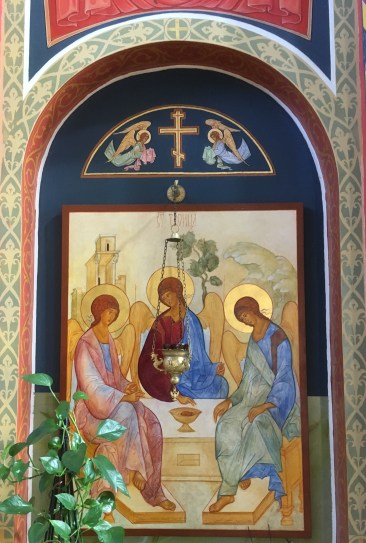
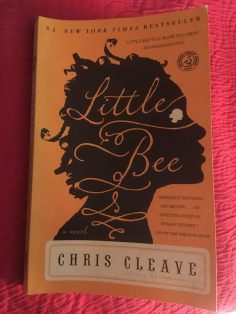 Little Bee is among a rare set of books in my personal Modern Era, in that I found it in “hard copy” right in front of me, and picked it up with my own hands, and read it through to the end without consulting Goodreads or Amazon in making a guess as to its worth or suitability. That day last week, when I visited the used bookstore in Colorado Springs, it was the four double-sided book racks on the sidewalk that drew me closer, and that’s where I found Little Bee carrying a $1 sticker like all its shelfmates. A cheap risk.
 Gladsome Lights