Category Archives: quotes

Through Athanasius wisdom shone.

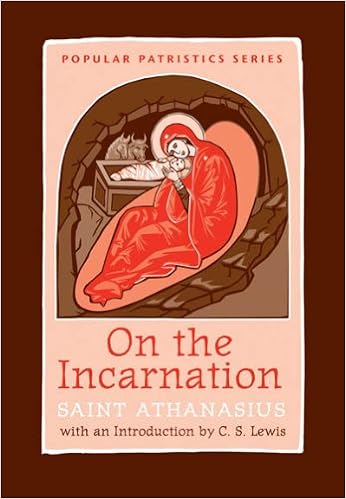
athanasius_frescoAthanasius of Alexandria has been highly regarded throughout Christian history, East and West. Today is one of his feast days In the Orthodox Church. I first heard of Athanasius when I was a Protestant, because his treatise On the Incarnation was recommended to me many times. I finally read it a few years ago at Christmastime, and found it very encouraging. I notice lots of discussion of Athanasius still going on in the blogosphere in this century.

Athanasius was born about 297 and was present as a deacon at the Council of Nicea in 325. It was he who suggested the word “consubstantial” (homoousion) to describe Christ’s relationship to the Father, in opposition to the Arians who believed Christ to be a creature. The word was immediately adopted and became an important point of sound doctrine from then on.

When Bishop Alexander of Alexandria died, Athanasius reluctantly consented to take the bishopric, and he remained bishop for 43 years, though he spent a total of 17 of those years in exile at the command of four different emperors, and was many times forced to leave the city under threats to his life. These incidents led to the phrase “Athanasius contra mundum” or “Athanasius against the world.”

I don’t need to repeat what I have written before, or tell you things about St. Athanasius that you can easily discover online, but I wanted to remember this important saint here. Here is are some excerpts from St. Nicolai in his Prologue for today:
Only for a while before his death did he live peacefully, as a good shepherd among his good flock, who truly loved him. Few are the saints who were so mercilessly slandered and so criminally persecuted as was St. Athanasius. His great soul patiently endured all for the love of Christ and, in the end, emerged victorious from this entire terrible and long-lasting struggle.

For counsel, for comfort and for moral support, Athanasius often visited St. Anthony the Great, whom he respected as his spiritual father. A man who formulated the greatest truth, Athanasius had much to suffer for that truth–until the Lord gave him repose in His kingdom as His faithful servant, in the year 373 A.D.

Through Athanasius, wisdom shone,
And the truth of God enlightened men.
The people recognized that wisdom is not bitter,
But, to all who drink it to the bottom, it is sweet;
To all who suffer for it, it is dear.
Always on the first step.

gl father_alexander_men

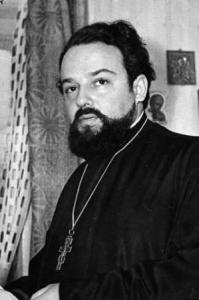
The most dangerous thing to do on the spiritual ladder is to look back and see how far you have come. There is no room for “tracking your progress” here, for if you were to experience success, you would soon also experience self-satisfaction, which would completely negate all previous efforts. You must consider yourself always to be on the first step. God can raise you up to the tenth step at any time.

–Fr. Alexander Men

Not an absence, but an antidote.

P1100719

From Father Stephen Freeman:

When the Fathers used the word “symbol,” they understood that something was actually, really and truly made present. A symbol makes present that which it represents. This is fundamental in the doctrine of the Holy Icons. In our modern world, a symbol represents something that is not there, it is a sign of absence. Indeed, because our modern world-view is essentially one of nominalism, we believe that the ancient notion of symbol is simply impossible. It feels like superstition to the modern consciousness.
…..
But this brings us to my description of sin as not being a “legal problem.” St. Justin says that “sin defiles a man and his being.” This is not contemporary language. He means exactly what he is saying. It is of a piece with St. Athanasius’ description of sin as death, corruption and non-being. Sin is something, not just a thought in the mind of God. It kills us, and not because God is doing the killing. Sin is death itself. The “lawlessness” of I John 3:4 is the anarchy, chaos, and disorder of death and corruption. Sin is utterly contrary to the life that is the gift of God.

This is why St. Justin (and the Church) can say that the remedy of sin is holiness, the “synthesis and unity of all the holy virtues and grace-filled energies.” When we partake of the holy mysteries of Christ’s Body and Blood, they “cleanse us from all sin.” This is not a simple change of our status in the mind of God. His Body and Blood are life. They are the antidote to death, decay, corruption and non-being. They destroy the lawlessness that is the anarchy, chaos and disorder of death and corruption.

You can read the entire article here: Secularized Sin

What makes Mrs. Quin happy.

gl-1-10-p1060501When Mrs. Quin was a wisp of a girl, the house called China Court was her favorite place to be, though she was only grudgingly allowed to cross the threshold, and that by the back stairs. She grows up and by strange twists and turns becomes the main character, an old lady who dies in her sleep in the first sentence of Rumer Godden’s novel China Court.

“Shouldn’ us pull the blinds down?” asked Mrs. Abel.

“She wouldn’t like it,” said Cecily. “She always says, ‘Don’t shut out the garden.'”

Soon begin flashes back to a younger  and younger Mrs. Quin at various stages of her life. We get to know her through the memories that play in the mind and heart of her in-laws and other people who held powerful positions in the family over the generations. Bits and pieces of stories of a score of relations, their suitors and servants are gradually revealed to the reader in a very realistic way. Haven’t we all had the experience of knowing someone personally for many years before we learn a surprising or even shocking fact about them?

In the case of this novel, we are taken back to the building of this granite house in the mid-19th century, and the first parents who birthed nine children there. Some of that first “Brood” marry unhappily, and some behave very badly, but by the end of the book you see them all, and the following generations peopled with similarly bumbling humans, with varying degrees of understanding. I think this is because of the example of Mrs. Quin, who has the ability to accept happiness when it comes to her, and to keep humble in the awareness of how little can be known, even of the ones we love and communicate with.

Homes must know a certain loneliness because all humans are lonely, shut away from one another, even in the act of talking, of loving. Adza cannot follow Eustace in his business deals and preoccupations….Mr. King Lee, kissing Damaris, has no inkling of the desolation he has brought her….Jared hides himself from Lady Patrick, and John Henry and Ripsie, in their long years together, are always separated by Borowis. The children especially are secret….It is better not to ask questions…. “Even if they told you,” says Mrs. Quin, “you would never really know.”

This kindness and compassion for her characters is one way in which Rumer Godden reminds me of author Elizabeth Goudge. Also, as with Goudge, there is the feeling that things will work out in the end, that in kairos, or God’s time, He will gather all the loose ends and broken parts together and even we will see the sense of them. For me, reading China Court was a chance to see a century’s worth of this household’s loves and sorrows with a fraction of that heavenly perspective.

Mrs. Quin had many years’ experience with being treated cruelly, and not getting what she so much wanted. But she early on seemed to learn the wisdom of seeing that she was quite content at present, so why make a fuss about all this water under the bridge? One of the things that always gave our protagonist great satisfaction and rest for her soul was the garden, so I can relate to that major aspect of her character.

A fact of history that didn’t seem to be fair, Mrs. Quin discusses with her daughter-in-law:

“I think that’s sad,” says Barbara.

“Sad and glad,” says Mrs. Quin.

How can something be sad and glad at the same time? For most of the Quin women, it has been like that. “All unhappiness,” says Mrs. Quin, “as you live with it, becomes shot through with happiness; it cannot help it; and all happiness, I suppose, is shot through with unhappiness. But I was usually happy….”

I enjoyed the descriptions of the girls’ Victorian party dresses, and of the old furniture that Mrs. Quin never bothered to re-upholster, and of the teatime ritual:

“Two teapots stood ready and warmed; the cups had to be warmed too for, ‘If the tea touches anything cold it loses the aroma.’ Mrs. Quin impresses Tracy with that. ‘Only vandals,’ says Mrs. Quin, ‘put the milk in first.'”

Towards the end of the book the serving of tea even brings a brief respite from squabbling among some relations whom Mrs. Quin would likely have relegated to the category of Vandals.

A thread that connects all the parts of the story, shown to us in Mrs. Quin’s bedroom in the first chapter and on the introductory page to each chapter after that, is a medieval Book of Hours. Other old and rare books and an old maid of the Brood who collects them come to play a crucial part in helping Mrs. Quin, in her death, to right many wrongly drifting tendencies in the family and to bring a very satisfying ending.

gl-1-10-p1060502