Category Archives: quotes

I dream, and wake to good things.

Recently I was laboring to find and write words to convey the empty feeling that persists deep in the bones of my psyche, a kind of panic at being a stranger in my own life. I had stepped back from that project, because this feeling is typical of emotions and imaginations in that it lacks substance. It is natural for someone in my situation, but not evidence of true emptiness.

I have an even deeper perception, in my spirit, of how God is “satisfying my desires with good things, and renewing my youth like the eagles’.” (Psalm 103) He has me all figured out and He knows who and where I am, even if I myself am sometimes confused. But while I was realizing that I didn’t want to spend time chasing nightmarish ephemera, I came across a poem that perfectly captures in a few words what it is like to have this “dream.”

Reading it brought on a healthy cascade of fresh grief, but now that I’ve revisited that I want to be awake again to today’s good things — which include the poem itself. It takes my experience and makes it into a cathartic story in which every word adds to the growing picture of a woman whose person and setting are more solid and convincing than my mind’s vague imaginations. I feel as though the writer has put the poem into my waiting hands, because I needed her to do with her skill what I couldn’t do for myself. I am so thankful for poets who give joy to the world the way musicians do, playing their instruments for love.

I had to look up “eelgrass,” and found that it is an ocean plant with ribbonlike leaves.

WIDOW’S WALK

When he visited Nantucket, Crevecoeur noted, “A singular custom prevails here among the women… They have adopted these many years the Asiatic custom of taking a dose of opium every morning, and so deeply rooted is it, that they would be at a loss how to live without this indulgence.”

Walter Teller,
Cape Cod and the Offshore Islands

Captain: the weathervane’s rusted.
Iron-red, its coxcomb leans into the easterly wind
as I do every afternoon swinging
a blind eye out to sea. The light
fails, day closes around me, a vast oceanic whirlpool…
I can still see your eyes, those monotonic palettes,
smell your whiskeyed kisses!
Still feel the eelgrass of embrace —
the ocean pounds outside the heart’s door.
Dearest, the lamps are going on. I’m caught
in the smell of whales burning! Vaporous and drowsy,
I spiral down the staircase in my wrapper,
a shadow among many shadows in Nantucket Town.
Out in the yard, the chinaberry tree
turns amber. A hymn spreads through the deepening air —
the church steeple’s praying for the people. Last night
I dreamed you waved farewell.
I stood upon the pier, the buoys tolling
a warning knell. Trussed in my whalebone,
I grew away from you, fluttering in the twilight,
a cutout, a fancy French silhouette.

-Elizabeth Spires


All of his riches are within.

On Sept 25th we are remembering St. Sergius of Radonezh, a Russian of the 14th century who “filled the wilderness with ceaseless prayer, and transformed the forest into a holy place of God.” From The Prologue of Ohrid I give you this sweet story:

A saint does not shine outwardly. All of his riches are within, in his soul. A peasant came from afar to the monastery to see St. Sergius. When he asked the monks for the abbot, they told him he was working in the garden. The peasant went to the garden, and there saw a man in poor, ragged clothes, digging like any other peasant on a farm. The peasant returned to the monastery dissatisfied, thinking that the monks had made fun of him. So, to make things clear, he asked again for the glorious holy father, Sergius. Just then, Sergius returned to the monastery, and welcomed the peasant, serving him at the table. The saint saw into the heart of his guest, and knew the low opinion he had of his appearance. He consoled him by promising that he would see Sergius in a little while.

A prince and his boyars then arrived at the monastery, and they all bowed low to St. Sergius, and asked his blessing. The monks then removed the peasant from the room in order to make room for the new guests. In amazement the peasant looked on from a distance, to see that the one he had sought had been nearby all the time. The peasant rebuked himself for his ignorance, and was greatly ashamed. When the prince departed, the peasant quickly approached the saint, fell at his feet and began to beg his forgiveness. The great saint embraced him and said to him: “Do not grieve, my son, for you are the only one who knew the truth about me, considering me to be nothing–while others were deluded, taking me for something great.”

sergius-of-radonezh-1899-mikhail-nesterov

painting by Mikhail Nesterov

Minding our proper burden.

imacdod001p1

It has been well said that no man ever sank under the burden of the day. It is when tomorrow’s burden is added to the burden of today that the weight is more than a man can bear. Never load yourselves so, my friends. If you find yourself so loaded, at least remember this: it is your own doing, not God’s. He begs you to leave the future to Him and mind the present.

-George MacDonald (1824-1905)

Shy and Peruvian, black and beautiful.

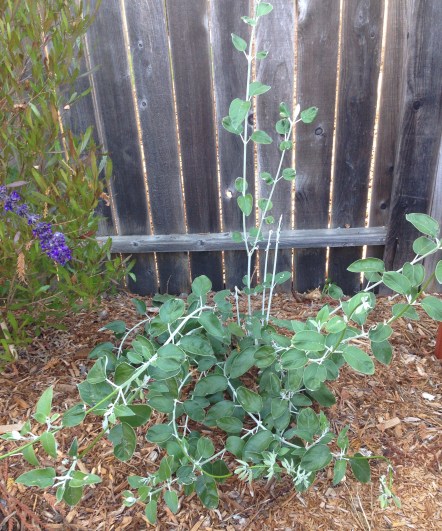
gl-15-img_3268-peruvian-sage-sep-16
salvia discolor

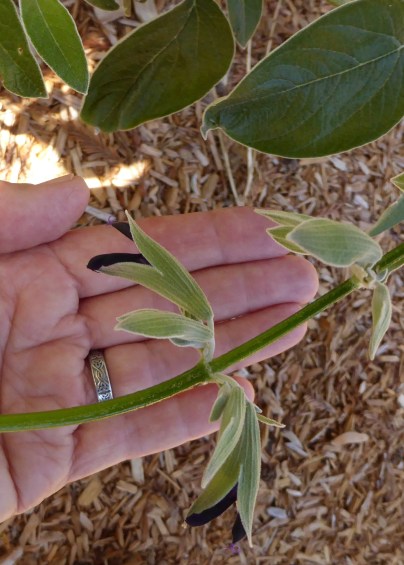
This unusual Peruvian or Andean Sage that I found at a nursery nearby has grown up and started blooming. I almost didn’t see the flowers, they are so shy and mostly hidden. I saw a website that said they were large and showy… if they become that I will be sure to take another picture.

Even without the blue-black flowers, the plant is very pretty, the way it drapes its graceful stems in the air. The stems and the backs of the leaves are silvery white, and the newer parts of the stems are very sticky.

gl-15-p1050493-crp-peruvian-sage

It makes me happy, the way it has quietly thrived and come into itself. I hope it will survive the winter and come again in the spring. It’s not listed in the Sunset Western Garden Book, but since it was propagated locally there’s a good chance it’s suited to our area.

I thought of it when I read this email from Salvo Magazine this morning. Beauty like this naturally makes us humans remember the Creator and Giver of beauty:

Is Planet Earth Trying to Tell Us Something?

You may know the standard line of evolutionary biologist-atheists like Richard Dawkins, which goes something like this:

Biology is the study of complicated things that give the appearance of having been designed for a purpose. (Dawkins, The Blind Watchmaker, 1996, p. 1)

Got that? “Have the appearance.” Don’t be fooled, warns Dawkins, for:

Natural selection is the blind watchmaker … does not see ahead, does not plan consequences, has no purpose in view. Yet the living results of natural selection overwhelmingly impress us with the illusion of design and planning. (Richard Dawkins, The Blind Watchmaker, 1996, p. 21)

It’s all an illusion of design. So ignore what your eyes and brain [and heart? -GJ] are telling you. They’re mistaken.

But apparently this habit of the mind that sees purposeful design in biology has spread beyond biology to the entire planet!

From the Daily Mail:

Sir David Attenborough and Brian Cox’s TV nature shows are ‘putting viewers off science’ because the beautiful scenes reaffirm belief in God.

* New study suggests nature programmes are putting viewers off science.
* Religious people often ‘have faith reaffirmed by the beauty on the screen.’

In the first bullet point, put “science” in quotes. They don’t mean science per se; they mean materialism or scientism.

There is no escaping it: The Planet Earth is stunningly beautiful. A wiser man wrote:

If the beatification of the world is not a work of nature but a work of art, then it involves an artist. -G. K. Chesterton

Draw your own conclusions, but don’t let someone tell you don’t see what you do see.