 If I had opened Moby-Dick even ten years ago, I wouldn’t have been able to appreciate it. Many of my peers read it in college, and I always knew that many people considered it a Must Read, the Great American Novel, etc. No one ever personally recommended it to me, though. This spring I read online two book-lovers’ brief comments on it, ideas I’d never heard before: first, that it was often funny, but also, that it was a joy to read such prose.
Possibly such prose as this:
[Speaking of the whale Moby-Dick] “He is both ponderous and profound. And I am convinced that from the heads of all ponderous profound beings, such as Plato, Pyrrho, the Devil, Jupiter, Dante, and so on, there always goes up a certain semi-visible steam, while in the act of thinking deep thoughts. While composing a little treatise on Eternity, I had the curiosity to place a mirror before me; and ere long saw reflected there, a curious involved worming and undulation in the atmosphere over my head. The invariable moisture of my hair, while plunged in deep thought, after six cups of hot tea in my thin shingled attic, of an August noon; this seems an additional  argument for the above supposition.
“And how nobly it raises our conceit of the mighty, misty monster, to behold him solemnly sailing through a calm tropical sea; his vast, mild head overhung by a canopy of vapor, engendered by his incommunicable contemplations, and that vapor—as you will sometimes see it—glorified by a rainbow, as if Heaven itself had put its seal upon his thoughts.”
Now that I think on it, it’s not surprising that I never heard such reports from my college roommates — None of them was an English major, for one thing, but I don’t recall discussing any books we were reading back then. At nineteen, most of us educated in public schools probably did not have enough exposure to great literature to have developed a literary sensibility. And  we certainly had little enough life experience to enable us to catch all the subtle humor.
Is Moby-Dick wasted on the young? Did any of you my readers read it when you were young, in school (that would be Americans, mostly), and did you ever read it again? I won’t say any book is wasted on the young, because everything we read widens our literary experience and makes us more likely to deepen our understanding of the next books we come to.
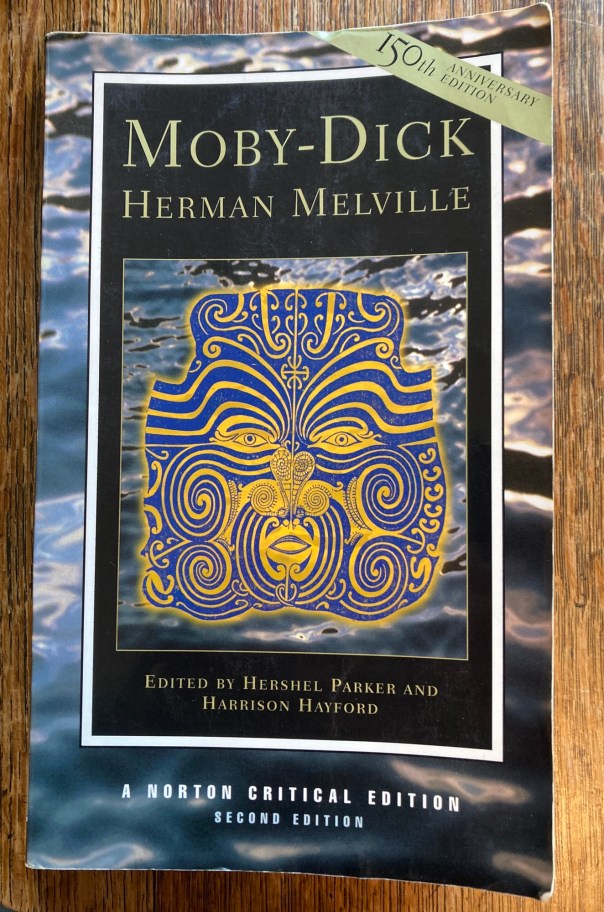
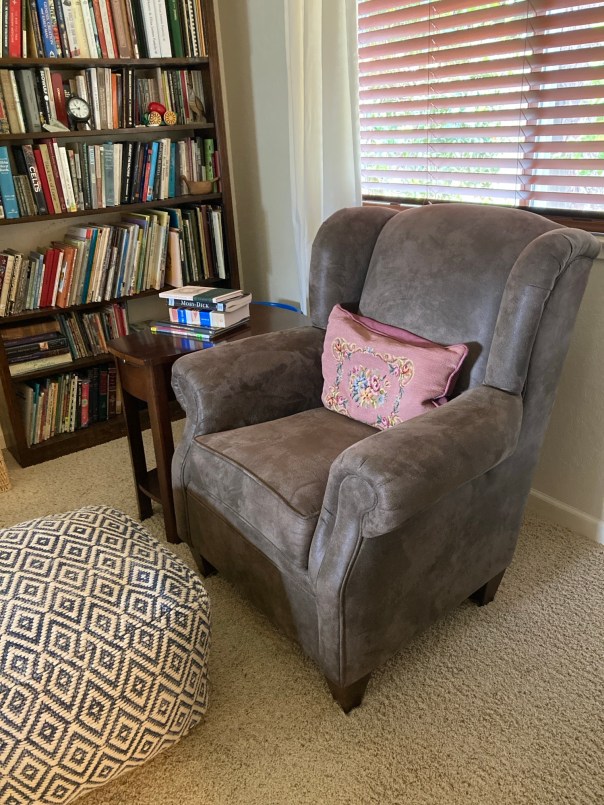
I read both a hard copy and via the audio version, though listening to this particular book on Audible often felt like skimming; I could hear those beautiful sentences passing by, but couldn’t attend to them individually or deeply. The last several chapters in the Norton Critical Edition I completed during a surprisingly leisurely evening when I was also pleased not to be mentally exhausted, and after The End, I sat in my favorite chair for a long while and leafed back through the pages, not wanting to leave the story well-told.
 I marvel at the scope of Melville’s “mental furniture,” and the way he weaves his vast knowledge into the philosophizing of Captain Ahab, and the musings of several characters. What a way he has with words — If I had read the whole thing in print the first time through, I’m afraid I’d never have finished, because I would pause at least once in every paragraph to wonder How does he do this? or to analyze the author’s worldview.
Moby-Dick is an American epic, and Harold Bloom says it may be a perfect novel. It is huge in so many ways. The length of a whaling voyage was at least three years! The character of Captain Ahab is as vast and as unknowable as any human. The Big Questions raised by him and others are supersized. The whale is gigantic. And then, there is the Ocean. The descriptions of life lived for such a protracted time in the middle of the sea made me realize that I am a landlubber for sure.

How could one bear a thousand days of being surrounded by the wide expanse, nothing but water and sky all around, and the deepest waters below? Not to mention, frequently getting thrown out of the smaller boats and being constantly at the risk of drowning in those deeps. But the whaler’s life is not without benefits:
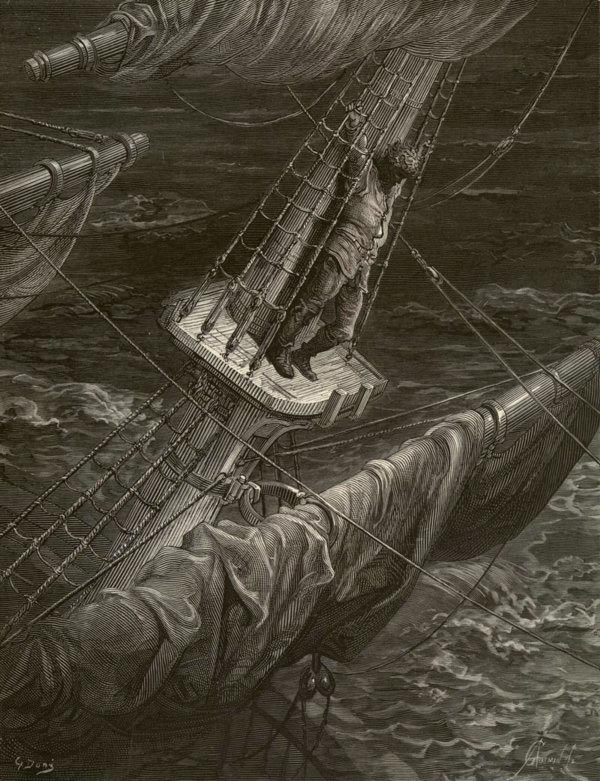 “In the serene weather of the tropics it is exceedingly pleasant the mast-head; nay, to a dreamy meditative man it is delightful. There you stand, a hundred feet above the silent decks, striding along the deep, as if the masts were gigantic stilts, while beneath you and between your legs, as it were, swim the hugest monsters of the sea, even as ships once sailed between the boots of the famous Colossus at old Rhodes. There you stand, lost in the infinite series of the sea, with nothing ruffled but the waves. The tranced ship indolently rolls; the drowsy trade winds blow; everything resolves you into languor. For the most part, in this tropic whaling life, a sublime uneventfulness invests you; you hear no news; read no gazettes; extras with startling accounts of commonplaces never delude you into unnecessary excitements; you hear of no domestic afflictions; bankrupt securities; fall of stocks; are never troubled with the thought of what you shall have for dinner—for all your meals for three years and more are snugly stowed in casks, and your bill of fare is immutable.”
And the great ocean — Melville makes me love “my own” Pacific ocean in a new way:
“To any meditative Magian rover, this serene Pacific, once beheld, must ever after be the sea of his adoption. It rolls the midmost waters of the world, the Indian ocean and Atlantic being but its arms. The same waves wash the moles of the new-built Californian towns, but yesterday planted by the recentest race of men, and lave the faded but still gorgeous skirts of Asiatic lands, older than Abraham; while all between float milky-ways of coral isles, and low-lying, endless, unknown Archipelagoes, and impenetrable Japans. Thus this mysterious, divine Pacific zones the world’s whole bulk about; makes all coasts one bay to it; seems the tide-beating heart of earth. Lifted by those eternal swells, you needs must own the seductive god, bowing your head to Pan.”

Since I’m an American, I’m glad to have read this novel that reveals a fascinating period in American history, and the kind of energy that has formed our nation. Melville knew his Bible very well, but he still seems to have missed the point, and his perspective on all those Big Questions is not really a Christian one. Moby-Dick is not important enough to me personally that I want to spend much more time and effort on it, but if I keep it by my chair, I can see dipping in again in the future just to savor the sentences. And I do hope I might run into some people who would enjoy talking about the book at least a little bit. At the end of the novel, Moby-Dick still lives.