A pair of blue jays were playing in my manzanita and pine when I came back from my walk this foggy morning. I hadn’t seen any here in many months. Oh, down by the creek I do, not far away; I don’t wonder that they prefer to hang out where there’s even more going on, more things to eat. True, there are no manzanita bushes or Canary Island Pines by the creek; maybe they came here for the the dried manzanita berries under the bush.
Anyone who has been following the Iceland poppy contest in my garden will want to see what I think is the winner of the endurance trial. It is probably an indication of how cool our summer has been, that one plant stayed alive all through August and accomplished a lonely bloom on September 7th. Surely it is the last! — and the plant does appear to be shriveling, as its companions did a few weeks ago.
In the vegetable boxes, mice, as I suppose, are eating tomatoes. I don’t seem to have energy to find a deterrent to these nightly raids; I do know that the mice probably need the fruit more than I do… but it’s an ugly mess they are making, and the solution is probably to pull out the Early Girls that are the favored item on the mouse menu. With the weather we’ve been getting, it’s not likely that the tomatoes will get as ripe as I require, anyway, and I have seen some appealing recipes for fried green tomatoes lately.
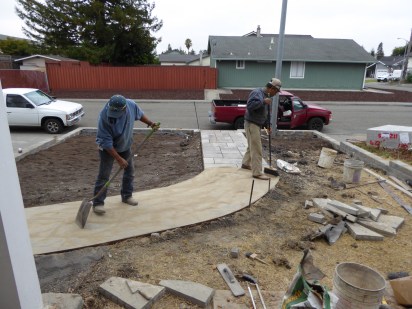
My front yard re-landscaping might be completed this month. Right now we are waiting … the hardscape is finished, these pictures showing the work of two weeks ago.
And back in the back yard, I finally bought a bench for the corner by the birdhouse, and Soldier happened to be here soon after to assemble it for me. Look how tall the native currants have grown up in that corner! As soon as the rains begin (God willing, they shall) the calla lilies will start sprouting enthusiastically and I’ll have to pull them out, eternally.
Soldier’s whole family was here for part of a day, and Liam worked in the playhouse, making a pie (so he said) out of flowers and herbs I told him he might pick for the purpose.
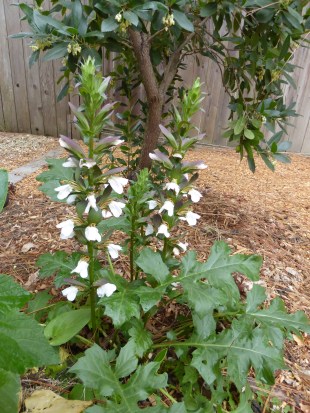
Autumn Joy sedum is still looking beautiful, as it has for at least nine months now, and the acanthus is sending out new flower stalks.
As I’ve been writing, and drinking my tea, the sun came out. Now it seems possible that I might get myself out to do some cleanup in the garden. Today I am going to soak my pea seeds, and hope to plant them tomorrow.
I have a feeling that it will always be a challenge, keeping up with all the things I want to do and need to do in the garden, not letting the housework go too neglected, reading and writing and praying, loving my friends and family, communing and working at church…. Life is very full. Today is very full. I looked for a closing quote to express something of what I’m feeling, but could find nothing more suitable than these lighthearted admonitions.
All happiness depends on a leisurely breakfast. ~John Gunther
That one I’ve already taken care of.
Spend the afternoon. You can’t take it with you. ~Annie Dillard
I’ve shared four poems by W.S. Merwin on my blog over the years. He is a poet who doesn’t use punctuation in his poems. I recently read an interview with him, given five years ago. Here I’m posting a short excerpt in which he talks about his eschewing punctuation, and about the uses and challenges of poetry generally.
If you stop using punctuation, that’s a kind of formality. I mean you have to be very conscious of the grammar and the syntax and how the sentence is put together; otherwise it’ll be just so ambiguous and confusing you just won’t be able to read it. The other thing I think it does is to make the separation between poetry and prose. I thought, punctuation is very convenient, but it was really invented in the seventeenth century for prose. Not for poetry at all. The punctuation of Shakespeare texts is whatever seemed convenient. There weren’t any particular rules that he was following that I can see. I mean it changed in the course of the plays. But above all, I thought that having no punctuation made you listen to the poem. That’s the important thing.
….
Poetry, like the imagination itself, must be limitless. And there must be other ways of expressing the inexpressible, which is what—poetry is just that. Prose is about what can be said and what is known and so on. Poetry is about what cannot be expressed. I mean, terrible grief, or intense erotic feeling, or even unspeakable anger are all inexpressible. You can’t put them in words and that’s why you try to put them in words. Because that’s all you’ve got. That’s another reason why I think that poetry is as ancient as language itself, because I think language must come out of an urge for which there was no expression, no way of doing it. I mean grief or fear or rage or whatever it was. It goes from one roar or one scream or one terrible sound of pain to starting to articulate it. It’s the articulating that becomes poetry. But it doesn’t become information at that point. It’s closer to translation. It’s translating something that’s there, that is only to a degree expressible.
One thing leads to another. I had the sudden and unusual urge to clean my shower door this morning, and ended up spending hours on the bathroom, the bedroom, the laundry area in the garage…. I made myself stop at six o’clock so I could take a walk, which was more of a chore than some evenings, because I had already been on my feet most of the day.
Even so, I didn’t want to take the shortcut, because the sight of the slant rays through the redwood trees at the park is not to be missed. This is where my children played soccer and softball, and climbed those trees, before they were trimmed of their lower branches. I like experiencing the park this way more than the former version, when we used to stand around shivering on the damp sidelines to watch an hour of soccer.
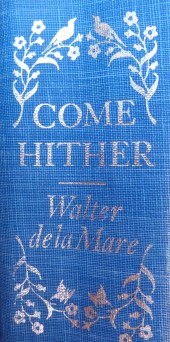
But getting back to earlier in the day: Before indulging in the flurry of vacuuming and scrubbing, I had followed other, quieter prompts, in the realm of poetry. I was reading some recommendations for anthologies, when the collection Come Hither showed up on my mental path. This was probably the first book of poetry I ever bought. We were homeschooling and I had borrowed Walter de la Mare’s anthology from the library. But I couldn’t renew it forever, and it was clearly a book that one would like to delve into forever. So I splurged on a copy of our own, and my students would leaf through its pages week by week to find an appealing poem to memorize.
Walter de la Mare
In the last months I had forgotten about this book; I knew it was in the spare bedroom on a shelf full of poetry books, and I made a note to myself to get it down and enjoy it again. After this evening’s walk I did that, but I had to limit myself to reading only the first poem, so that I will get to bed at a reasonable hour tonight. I also discovered a wonderful article by David M. Whalen, about the anthology and its editor: “Walter de la Mare’s Come Hither.”
He explains the frontispiece address to the “Young of All Ages”: “Anthologies of children’s verse usually fall into sentimentality. They reflect their editors’ attempts at indulgence in feelings that have become unreal to editors and readers both. Come Hither: A Collection of Rhymes and Poems for the Young of All Ages is markedly free of this blot as de la Mare, a Twentieth-Century British poet and author, never left behind the numinous sense of mystery that characterizes childhood.”
British author Alice Thomas Ellis is quoted in the article as saying that if she could have the Bible and Shakespeare and one other book, when stranded on a desert island, the third book would be Come Hither. The copious notes alone I find fascinating; they are obviously written with the older and even oldest Young in mind, and they lead me always to one more musing .
Here is that first poem of the collection. As the turning of the page will reveal a different offering, and another following that, I feel certain that I will have more to share with you in the future. But as Whalen points out, this one poem already contains everything.
THIS IS THE KEY
This is the Key of the Kingdom
In that Kingdom is a city;
In that city is a town;
In that town there is a street;
In that street there winds a lane;
In that lane there is a yard;
In that yard there is a house;
In that house there waits a room;
In that room an empty bed;
And on that bed a basket–
A Basket of Sweet Flowers Of Flowers, of Flowers; A Basket of Sweet Flowers.
Flowers in a Basket;
Basket on the bed;
Bed in the chamber;
Chamber in the house;
House in the weedy yard;
Yard in the winding lane;
Lane in the broad street;
Street in the high town;
Town in the city;
City in the Kingdom–
This is the Key of the Kingdom. Of the Kingdom this is the Key.
My father and my father-in-law were unusual, in that after their wives died, they each lived another nine or more years. Many men die soon after their wives, and people speculate about why. It seems that women in general do better when they lose their spouses; I have read theories about why this is… probably a lot of things contribute. Here are my ideas, largely gleaned from other people. Please forgive the over-simplification and generalities – we are all probably exceptions at least sometimes:
1) Women are used to taking care of things and people, so they know how to take care of themselves. They at least get the necessary things done for survival during the period while they are learning to live without their husbands. But if men have been used to the women cooking for them and in various ways making the house a home, they would be at risk for becoming less healthy very fast when their wives are gone, to some degree reverting to the risky behavior characteristic of unmarried men.
2) If women are, in the words of author John Gray, like “waves” whose emotions periodically roll over people around them, perhaps they know instinctively to let that tide of grief flow as long as it must. Men, on the other hand, don’t know how to deal with things they can’t control, and they want to fix problems such as emotions. If we know that we will get through this, and that there is no going around it, we are able to survive.
3) Women often have support networks with other women, and these friends help them to not feel alone. They have someone to talk to, and/or go shopping with, etc. They have a pattern of activity with other people that they can continue in some fashion as widows so they don’t start from nothing when creating their new lives. Men are notorious (at least, among most of my women friends) for not having friends in the same way. They are more likely to become depressed.
About this last point, I know that you readers of my blog have been a important part of that network for me. I have never been in the habit of going out to lunch or taking walks with friends on a regular basis, being part of a knitting group, etc. I don’t even get helped by talking about my grief, but I am without a doubt helped by writing about it, especially if at least one person is reading-listening and affirming. So I thank all of you very much – you are extending my life span!
What sparked my thinking on these things recently was finding a quote by Donald Hall, the poet who was married to poet Jane Kenyon when she died in her 40’s. He wrote:
“Poetry gives the griever not release from grief but companionship in grief. Poetry embodies the complexities of feeling at their most intense and entangled, and therefore offers (over centuries, or over no time at all) the company of tears.”
Many years ago I enjoyed in The New Yorker an article that Hall wrote about his late wife. It was the first I knew of him, but several times over the years I’ve read more of his prose. He is still alive, though she died 20+ years ago, and he was almost 20 years older than she. Now he writes only prose, but I thought that if I were going to share that quote I ought to read some of the poetry he wrote after she died. So I borrowed the collection Without from the library.
I found most of the fresh-grief poems to be too fresh and overwrought, and I don’t know if that is only because I’m past that stage myself, or because of something to do with him being a man. Perhaps he was too distracted by mourning to be able to do his best work. I never did find one I loved; I like his prose so much better. But this later one serves well:
Letter After a Year
Here’s a story I never told you.
Living in a rented house
on South University in Ann Arbor
long before we met, I found
bundled letters in the attic room
where I took myself to work.
A young woman tenant of the attic
wrote these letters to her lover,
who had died in a plane crash.
In my thirtieth year, with tenure
and a new book coming out,
I read the letters in puzzlement.
“She’s writing to somebody dead?”
There’s one good thing
about April. Every day Gus and I
take a walk in the graveyard.
I’m the one who doesn’t
piss on your stone. All winter
when ice and snow kept me away
I worried that you missed me.
“Perkins! Where the hell
are you?”
————-In hell. Every day
I play in repertory the same
script without you, without love,
without audience except for Gus,
who waits attentive
for cues: a walk, a biscuit,
bedtime. The year of days
without you and your body swept by
as quick as an afternoon;
but each afternoon took a year.
……
The poem goes on for many more stanzas – this first part was my favorite, especially the last four lines.
I have not read this.
Ten years after his wife’s death Hall published The Best Day the Worst Day: Life with Jane Kenyon. I was surprised that the majority of the book is about their life after her diagnosis of leukemia. It does include the essay The Third Thing, in which he writes about their years as a whole and how the writing life figured into it. The story of how he brought Jane, not yet 30, to New Hampshire from Ann Arbor, Michigan, to his grandmother’s house where from a child he had always wanted to live, is very touching.
She fell in love with the place at Eagle Pond, but their joint realization of the strong desire to move there came in stages. It seemed preposterous for him to quit his reliable teaching job to do it.
“It was late October when Jane made the definitive announcement: She would chain herself to the walls of the rootcellar rather than leave New Hampshire. I was terrified; I was joyous.”
I wonder at my interest in a couple whose poetry I’ve barely read, with whom I might seem to share very little in common, unless you count, as I do heavily, their love for a secluded life at home by a lake, in the garden, reading and writing much of the day. They were part of a warm church community of which Donald’s relatives were also members. Donald loves baseball, and has been a lifelong smoker (Well, no, I don’t share that with him). They lived a life that perhaps the majority of the population would not be able to endure. In fact, some people asked, “What do you do?”
From “The Third Thing”:
“What we did: we got up early in the morning. I brought Jane coffee in bed. She walked the dog as I started writing, then climbed the stairs to work at her own desk on her own poems. We had lunch. We lay down together. We rose and worked at secondary things. I read aloud to Jane; we played scoreless ping-pong; we read the mail; we worked again. We ate supper, talked, read books sitting across from each other in the living room, and went to sleep. If we were lucky the phone didn’t ring all day.”
I would probably find it easy to read about other couples also if they knew how to write as well about their everyday satisfactions – and sufferings. But I will have to move on, when I have finished this article, without learning everything that might be known about Donald and Jane, their life and their loves.
Though I might yet read more of their poetry. I have the fat Collected Poems of Jane Kenyon in the house right now, and will share with you this:
In the Grove: The Poet at Ten
She lay on her back in the timothy and gazed past the doddering auburn heads of sumac.
A cloud — huge, calm,
and dignified — covered the sun
but did not, could not, put it out.
The light surged back again.
Nothing could rouse her then
from that joy so violent
it was hard to distinguish from pain.
-Jane Kenyon
Donald Hall is 87 now. In a review of Essays After Eighty we read, “Jane Kenyon’s presence is everywhere in Essays After Eighty. The couple were married for 23 years, until her 1995 death from leukemia. Kenyon was 47 years old. Hall endured a period of intense pain, captured in two poetry collections and a memoir. Twenty years later, raw agony has become constant, aching loss: ‘I will mourn her forever.’”
Perhaps his writing is the support that has kept him going, even though he had cancer before Jane ever got sick, and last we heard, he was still smoking a pack a day.
“Give sorrow words;
the grief that does not speak
knits up the o-er wrought heart
and bids it break.”
-William Shakespeare, Macbeth
[Donald Hall died on June 23, 2018, at the age of 89.]






 One thing leads to another. I had the sudden and unusual urge to clean my shower door this morning, and ended up spending hours on the bathroom, the bedroom, the laundry area in the garage…. I made myself stop at six o’clock so I could take a walk, which was more of a chore than some evenings, because I had already been on my feet most of the day.


 is last point, I know that you readers of my blog have been a important part of that network for me. I have never been in the habit of going out to lunch or taking walks with friends on a regular basis, being part of a knitting group, etc. I don’t even get helped by talking about my grief, but I am without a doubt helped by writing about it, especially if at least one person is reading-listening and affirming. So I thank all of you very much – you are extending my life span!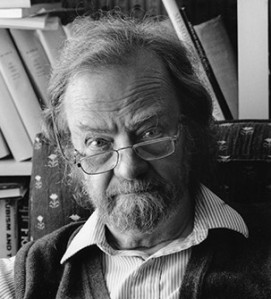


 article, without learning everything that might be known about Donald and Jane, their life and their loves.
 Gladsome Lights