 Most people, even Christians, don’t care whether the date of December 25th derives from a pagan solstice festival, but historians are interested in many aspects of this story; one of these aspects is the way in which earthly powers try to control or use popular religion to further their aims. Williaim J. Tighe is a historian and a Christian whose article “Calculating Christmas” explains how this impulse led one emperor to establish a completely new pagan festival. The last time I posted this “public service announcement” concerning the date of Christmas, I highlighted the historical evidence that Tighe cites for the early church having chosen their date before that pagan festival was ever established.
But there is the other question we might have: How did the Christians choose their date? It seems that Christ’s mother was not of a mind to be keeping a journal, but rather, Luke tells us, “Mary kept all these things and pondered them in her heart.” The author tells us in detail how the dating of Christmas is tied to the effort to figure out when it was that Christ died. It’s not easy to calculate that, either, it turns out:
“There is a seeming contradiction between the date of the Lord’s death as given in the synoptic Gospels and in John’s Gospel. The synoptics would appear to place it on Passover Day (after the Lord had celebrated the Passover Meal on the preceding evening), and John on the Eve of Passover, just when the Passover lambs were being slaughtered in the Jerusalem Temple for the feast that was to ensue after sunset on 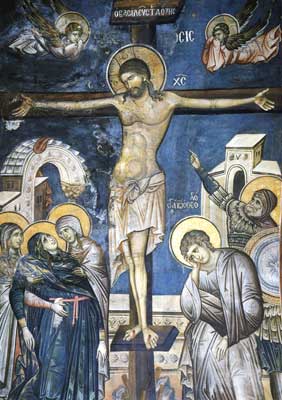 that day.
“Solving this problem involves answering the question of whether the Lord’s Last Supper was a Passover Meal, or a meal celebrated a day earlier, which we cannot enter into here. Suffice it to say that the early Church followed John rather than the synoptics, and thus believed that Christ’s death would have taken place on 14 Nisan, according to the Jewish lunar calendar. (Modern scholars agree, by the way, that the death of Christ could have taken place only in A.D. 30 or 33, as those two are the only years of that time when the eve of Passover could have fallen on a Friday, the possibilities being either 7 April 30 or 3 April 33.)
“However, as the early Church was forcibly separated from Judaism, it entered into a world with different calendars, and had to devise its own time to celebrate the Lord’s Passion, not least so as to be independent of the rabbinic calculations of the date of Passover.”
“…there is evidence from both the Greek East and the Latin West that Christians attempted to figure out the date of Christ’s birth long before they began to celebrate it liturgically, even in the second and third centuries. The evidence indicates, in fact, that the attribution of the date of December 25th was a by-product of attempts to determine when to celebrate his death and resurrection.”
I’ll leave you to decide if you want to get the rest of the story by reading the article itself. Last time I shared it, more than one of my readers said the date was not important to them, and one said this information was important. Many years ago I was briefly influenced against enjoying certain Christian festivals because of things written against them by the uninformed, so I very much appreciate those true historians who love to dig deep. Tighe points us to a longer work on the subject for those who want more details (I haven’t gone further myself). Here’s his own fairly brief summary: “Calculating Christmas.”



 opportunity — go for it!
 Gladsome Lights