“Of all tyrannies, a tyranny sincerely exercised for the good of its victims may be the most oppressive. It would be better to live under robber barons than under omnipotent moral busybodies. The robber baron’s cruelty may sometimes sleep, his cupidity may at some point be satiated; but those who torment us for our own good will torment us without end for they do so with the approval of their own conscience.”
When I woke today, a multitude of urgent tasks filled my mind and sent me off in the wrong direction. Eventually I was rescued by the Jesus Prayer, by Jesus Himself. As I calmed down I realized that a few of the tasks were not that urgent, and when I began to consolidate my lists, one task fell off altogether, being a completely unnecessary outing, and large project that would have followed. That was a drive to the apple ranch to get Gravenstein apples, a variety that I usually miss out on because they are so early. But it won’t hurt to miss out on them again — why change tradition?
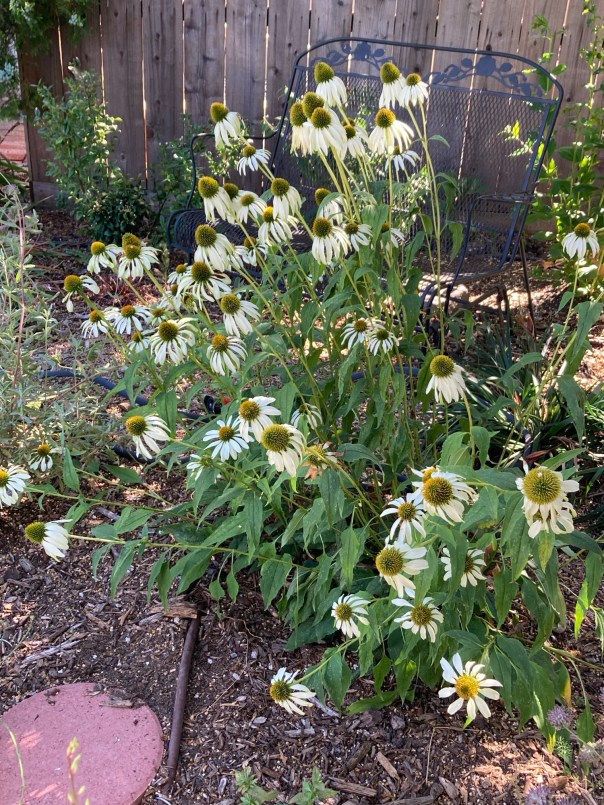
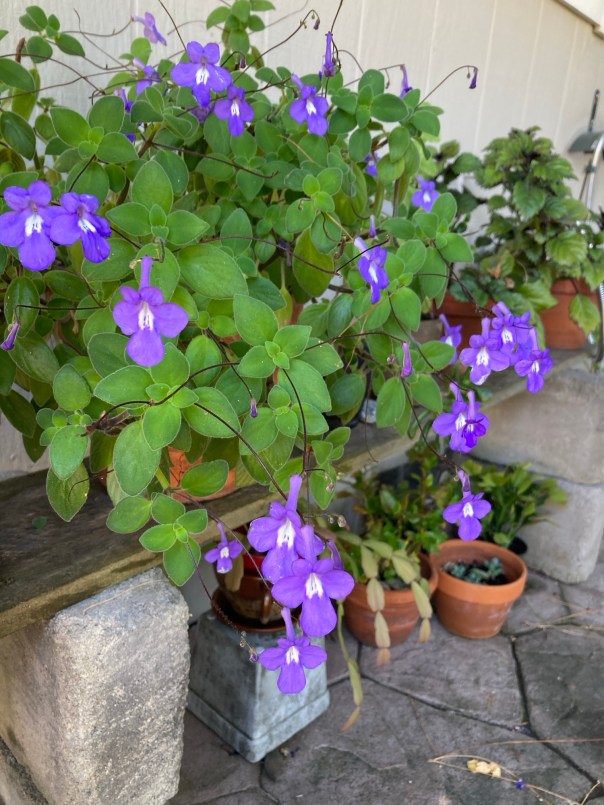
Volunteer Delta Sunflower
I’d wanted to water the garden early, but it ended up being not-so-early, and what do you know, that was not a disaster. Putting the hose on thirsty plants — or were they plants that merely look dry because it is August? — gave me so much joy, I could hardly bear it. I remember when my current garden went in, ten years ago, with its extensive automatic irrigation, my daughter Pearl was concerned and said, “But Mama, you love watering the garden!” Evidently that is true. It’s a great gift to have such work.
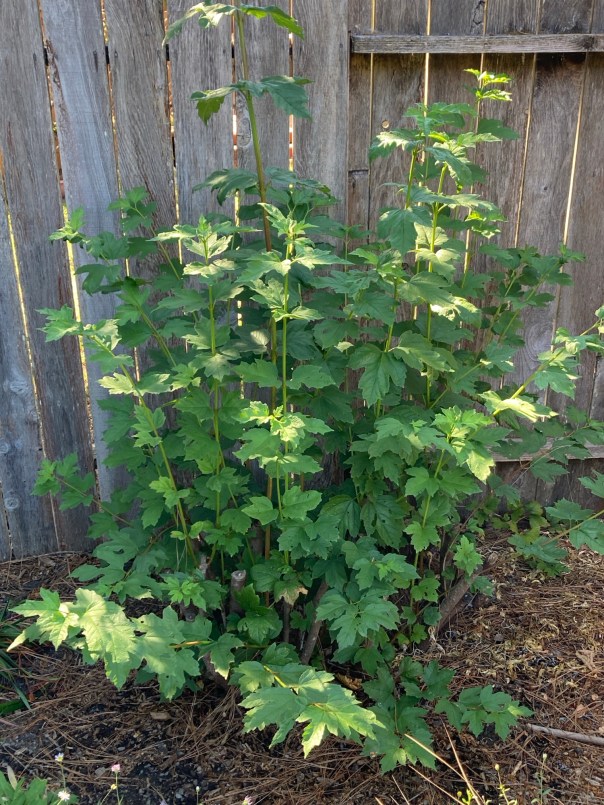
Viburnum coming along after hard pruning.
It seems to me that the irrigation system needs some adjusting; my thought is that as the plants are more in number and greater in size than when we first programmed it, and even since the last changes, I should customize it further. That job is a mental challenge for me, as there are six different valves/lines and three programs, for each of which one has to determine how many days per week and how many minutes of run time. As I have done so often, I will have to study the diagram and how to enter the settings via the dials and buttons, because it never sticks with me. If I just give some areas a little more water by hand, that will relieve my anxiety. It will be easier to tackle the problem if I am confident that nothing is dying of thirst right now.
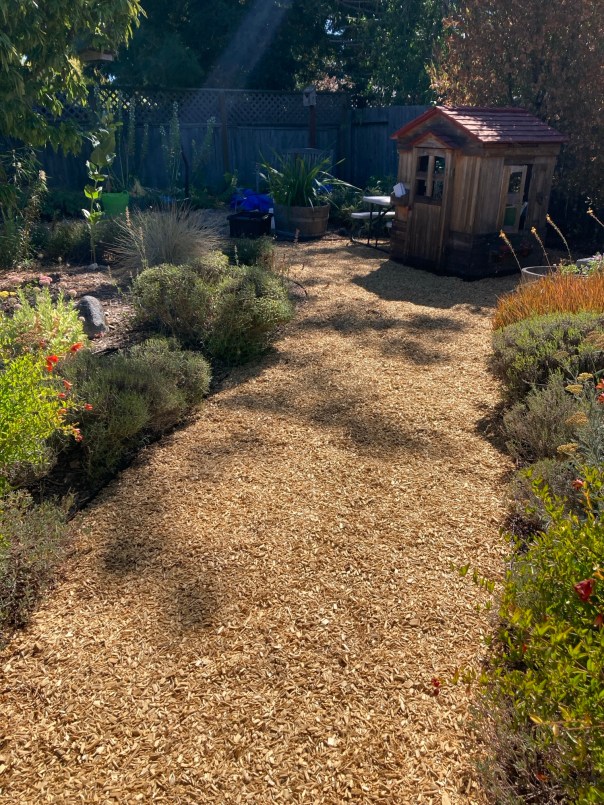
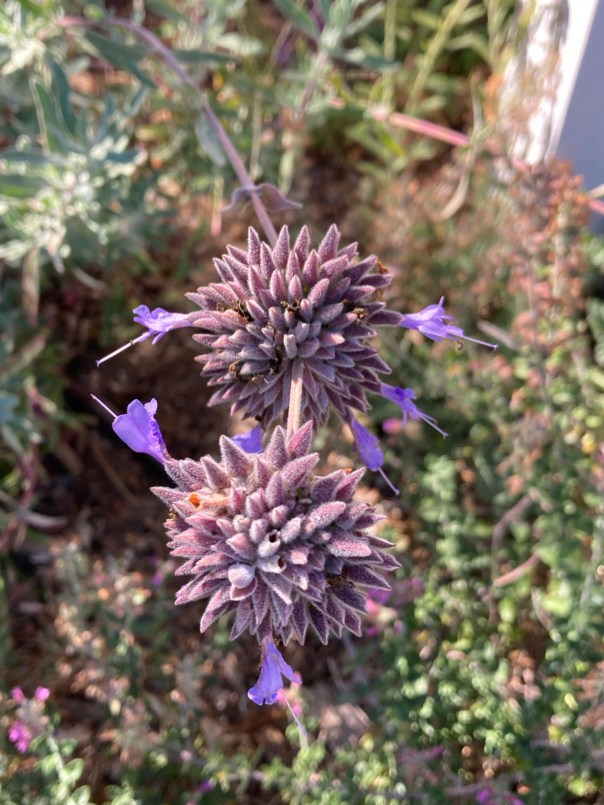
Path mulch reapplied after 9.5 years.Salvia clevelandii
As I walked around with the hose, noting how many things are alive and obviously growing, happiness filled me. The thoughts of J.R.R. Tolkien that Eugene Terekhin writes about recently in “Why Gardeners Will Save the World” make me think that my garden is helping me while I am tending it:
Quoting a letter Tolkien wrote to a friend: “I think the simple ‘rustic’ love of Sam and his Rosie (nowhere elaborated) is absolutely essential to the study of his (the chief hero’s) character, and to the theme of the relation of ordinary life (breathing, eating, working, begetting) and quests, sacrifice, causes, and the ‘longing for Elves’, and sheer beauty.”
Terekhin: “Mythically speaking, Sam [the character in Lord of the Rings] was ‘down to earth.’ He was a gardener who loved all things that grow — as all hobbits do.”
….
“The most important thing one can do in wartime is to grow a garden. Because when we grow things, they grow us. It takes a long time to grow something, and as we tend our garden we grow together with it.”
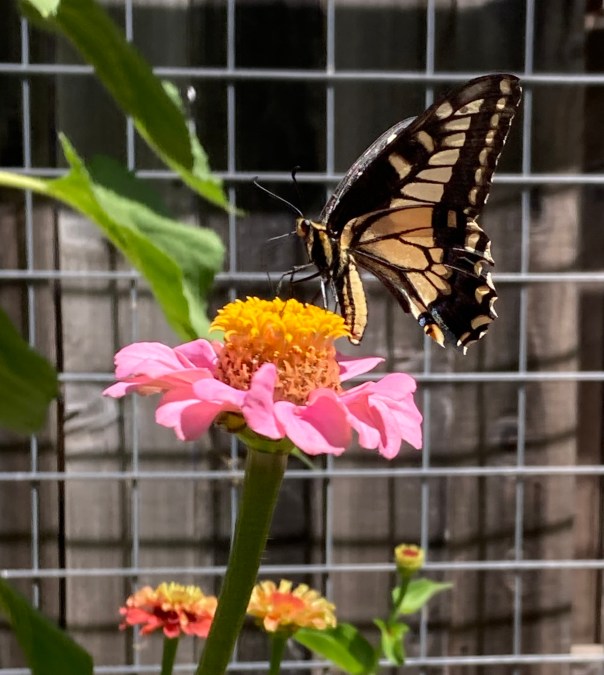
I know for sure that just being out there, soaking up the scents and the colors, watching the bees and butterflies drink from the flowers I tend on their behalf, is to me that most essential, ordinary life such as Tolkien shows us. For quite a while I followed this glorious, common swallowtail in all its glory, a creature that was drinking from just about every zinnia in the planter boxes. He and I were of the same mind about Being, and being down to earth.
Happiness is a butterfly, which, when pursued, is always just beyond your grasp, but which, if you sit down quietly, may alight upon you.
“The highest light is God, unapproachable and ineffable, neither grasped by the mind nor expressed in language. It illumines every reason-endowed nature. It is to intelligible realities what the sun is to sense-perceptible realities. To the extent that we are purified it appears, to the extent that it appears it is loved, to the extent that it is loved it is again known. It both contemplates and comprehends itself and is poured out but a little to those outside itself. I speak of the light contemplated in the Father and Son and Holy Spirit, whose wealth is the confluence and the leaping forth of this radiance.”
-St. Gregory of Nazianzus (The Theologian), Oration 40, on Baptism
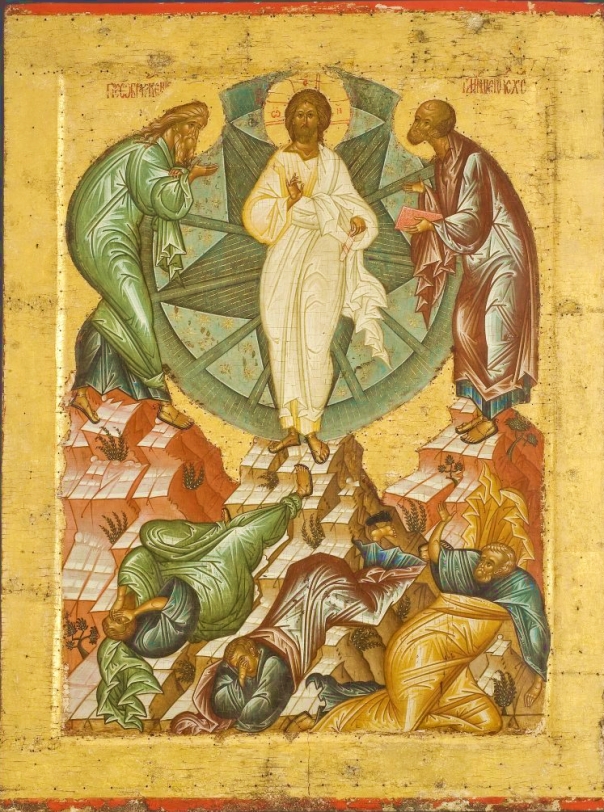
Transfiguration of Christ, Kirillo-Belozersky Monastery, Russia, 1497
I am always trying to write more letters. So I was very pleased when our sisterhood at church organized a pen-pal match-up, for anyone who wanted to exchange letters once a month with another woman in the group. I got matched up with Gwen, and she and I were thrilled about that; we somehow rarely get a chance to talk or be together outside of church services, so letter writing is perfect for us. We have been writing back and forth now for a year, though we may have fallen off a bit lately.
Because of all this, I loved reading what Donald Hall had to say to an interviewer on the subject. I am sad that people like him seem to be a “dying breed.” Do you think there is any hope of a revival of letter-writing? Even people without smart phones often use a computer to write emails instead of paper-and-ink letters.
Last Christmas I gave all my younger grandchildren ten stamped postcards each. They were of various designs, from my huge collection of postcards that remain from when I often wrote them to the (now older) grandchildren, and was for a time sending postcards all over the world as a member of Postcrossing. I included in the Christmas packages a list of their cousins’ and my addresses, and told them that postcards are fun because you only need to write a few words to fill up the page; it’s an easy way to let people know that you think of them.
Postcard from Ogden Nash
This post would not be complete without mentioning my friend Di, who has neither a computer nor a smart phone, and writes me a letter at least twice a year. She is one of the best letter-writers I have ever known, and I should write a whole post just featuring excerpts from her witty missives to me. I doubt a letter from Donald Hall could please me as much as hers do.
INTERVIEWER:
Another subject. You’re notorious for answering letters. Is your heavy correspondence related to your art? Doesn’t it get in the way?
DONALD HALL:
Sometimes I wonder, Do I write a letter because it’s easier than writing a poem? I don’t think so. Letters take less time than parties or lunches. How do people in New York get anything done? My letters are my society. I carry on a dense correspondence with poets of my generation and younger. Letters are my café, my club, my city. I am fond of my neighbors up here, but for the most part they keep as busy as I do. We meet in church, we meet at the store, we gossip a little. We don’t stand around in a living room and chat—like the parties I used to go to in Ann Arbor. I write letters instead, and mostly I write about the work of writing.