Category Archives: quotes

A beehive of comical beings.

“To be a man and live among men is miraculous, even if we know the vile deeds and crimes that people are capable of. Every day we build together an enormous beehive with our thoughts, discoveries, inventions, works, lives. Even that analogy is hardly accurate; it is too static, since our collective work is constantly changing and displaying itself in various colors, subject to time or history.

“Again, this is an insufficient description, because it ignores the most important thing: that this collective creation is given life by the most private, hidden fuel of all individual aspirations and decisions. The oddity of man’s exceptional calling rests principally on his being a comical being, forever immature, so that a group of children with their easy mood swings from laughter to crying is the best illustration of his lack of dignity.

“A few years pass, and suddenly they are adults, taking control and supposedly prepared to make pronouncements on public matters and even to take upon themselves the duties of father and mother, although it would be good if they first had an entire life of their own to prepare for this.”

― Czesław Miłosz
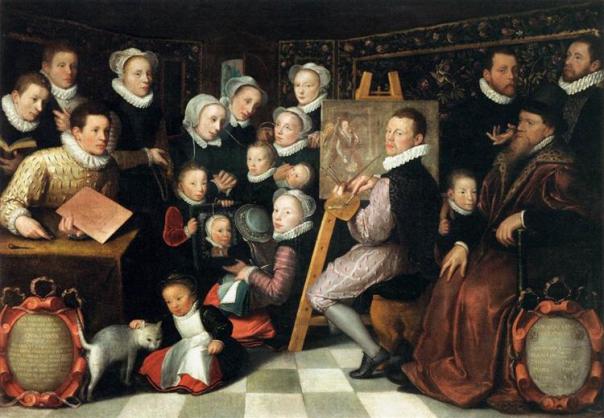
The Artist Painting, Surrounded by His Family – Otto Van Veen, 1584

Mother and daughter: boundless.

“Prayer… by its action it is the reconciliation of man with God, the mother and daughter of tears, a bridge for crossing temptations, a wall of protection from afflictions, a crushing of conflicts, boundless activity, the spring of virtues, the source of spiritual gifts, invisible progress, food of the soul, the enlightening of the mind, an axe for despair, a demonstration of hope, the release from sorrow.”

-St. Abba Agathon

“Abba Agathon was trained in the Thebaid by Abba Poemen when he was a young man. According to the Sayings of the Desert Fathers, he was highly regarded by Poemen, who called him ‘Abba’ (father) even though Agathon was still young. He was known for his exceptional meekness, accounting himself the most sinful of all men. He was a disciple of Abba Lot.

“Abba Agathon lived in Scetis with Alexander and Zoilus, who were later disciples of Arsenius. He moved after the destruction of Scetis and lived near Troe close to the Nile with his disciple Abraham. It was said of Abba Agathon that he often travelled taking nothing but his knife for making wicker-baskets. He, even in old age, provided everything he needed for himself by manual labor. The abba is said to have even lived for three consecutive years with a stone in his mouth to help himself learn silence and abstinence from speech.

“At his death, Abba Agathon remained for three days with his eyes open. The brothers asked him where he was, and he replied saying that he was at the Judgement Seat of God. When his disciples asked him if he was afraid, he said, ‘Until this moment, I have done my utmost to keep the commandments of God. But I am a man; how should I know if my deeds are acceptable to God?’ When they questioned him more, he said, ‘Truly the judgement of God is not that of man.’ Dorotheus of Gaza twice quotes the final words of Abba Agathon in his exhortations to his monks.

“Abba Agathon died c. 435 AD.”

Source

Passion-bearer Alexander

It was from watching a movie about Sophie Scholl (I think it must have been “Sophie Scholl: The Final Days”) that I first heard of The White Rose, a non-violent youth resistance group formed in Munich in 1942. Britannica says of its members:

Coupling youthful idealism with an impressive knowledge of German literature and Christian religious teachings, the students published their beliefs in a series of leaflets under the name “the White Rose” (and later as “Leaflets of the Resistance”).

In the movie we meet not only Sophie and her brother Hans, but also friends and other members of The White Rose, one of whom is named “Alex.” A couple of years ago I learned that this was Alexander Schmorell, an Orthodox Christian and co-founder of the group.

Hans and Alexander

There is a very memorable scene — one of only two that I can bring to mind from that film — in which Hans and Sophie are throwing leaflets from the upper story of a university building. They were seen by a Nazi Party member and arrested, on February 18, 1943.

The leaflets were like nothing the Gestapo had ever seen—not rigid ideological tracts aimed at the working classes, but passionate, erudite manifestos that quoted Friedrich Schiller, Plato and Laozi. “The guilt of Hitler and his accomplices goes beyond all measure,” read the group’s fifth leaflet. “Tear up the cloak of indifference you have wrapped around your hearts. Make your decision before it is too late!Smithsonian

Hans and Sophie were beheaded four days later, along with medical student Christoph Probst. In succeeding months, many other people were arrested in relation to The White Rose, and among them was Alexander Schmorell, who was executed on July 13, 1943. In 2012 he was glorified in the Orthodox Church as a saint and passion-bearer.

Memory eternal!

Weighing and measuring very carefully.

“Have no anxiety. Sometimes what’s worse than being sick is being afraid of getting sick. Leave it to God. Whatever God gives you is best for you. God never gives you a cross without first weighing and measuring it very carefully to make sure that the cross will result in your spiritual growth.”

-Elder Amilianos of Simonopetra