“…in the early twenties—before my departure to Mt. Athos in 1925, I wept and prayed to God: ‘Find a way to save the world—to save all of us, we are all defiled and cruel.’
I would pray with particular fervor for the ‘little ones,’ the poor and oppressed. Towards morning, with my strength waning, my prayer would be disturbed by the thought that if I grieve for mankind with all my heart, how is it that God can look on indifferently at the pain and torment of millions of beings whom He Himself had created? Why does He allow the innumerable instances of brute force in the world?
And I would turn to Him with the insane challenge, ‘Where art Thou?’ And in my heart I heard: ‘Was it you who was crucified for them?’ …The gentle words uttered by the Spirit shook me to the core—He Who was crucified had answered me as God.”
—Saint Sophrony, reposed July 11th, 1993
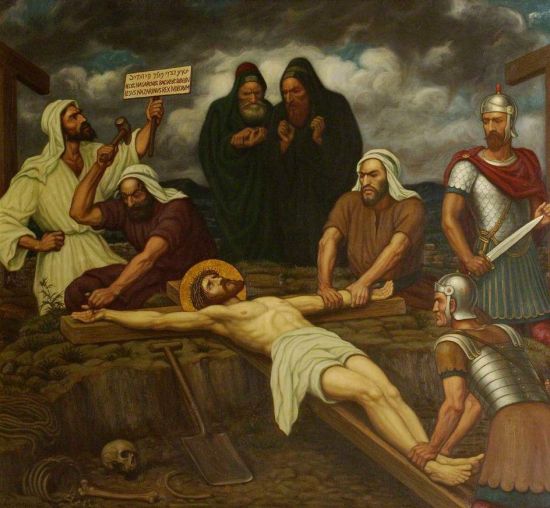
Edward Arthur Fellowes Prynne: Jesus is Nailed to the Cross
“Why do men learn through pain and suffering, and not through pleasure and happiness? Very simply, because pleasure and happiness accustom one to satisfaction with the things given in this world, whereas pain and suffering drive one to seek a more profound happiness beyond the limitations of this world. I am at this moment in some pain, and I call on the Name of Jesus — not necessarily to relieve the pain, but that Jesus, in Whom alone we may transcend this world, may be with me during it, and His will be done in me.
“But in pleasure I do not call on Him; I am content then with what I have, and I think I need no more. And why is a philosophy of pleasure untenable? — because pleasure is impermanent and unreliable, and pain is inevitable. In pain and suffering Christ speaks to us, and thus God is kind to give them to us, yes, and evil too — for in all of these we glimpse something of what must lie beyond, if there really exists what our hearts most deeply desire.”
Tessa Carman was having a conversation with Paul Kingsnorth last year, on “Following Christ in the Machine Age.” This is an overarching theme of Kingsnorth’s thinking and writing. Their conversation was leisurely and ranged over many topics, everything from books they have been reading, to Kingsnorth’s conversion, to Hollywood, to being “cancelled.” Kingsnorth lives on a “smallholding” in Ireland, so naturally the conversation turned to how we humans treat the land. I liked the point that Carman brings up, about how farmers traditionally have not been sentimental about nature, but because they “have to do” the work of caring for the land day in and day out, they develop an intimate relationship with it:
“Christians were not untouched by modernity. Especially when there’s more uprootedness — I suspect it’s easier to treat things like machines if you are used to living amongst machines. And if you’re used to taking care of a piece of land, where you have to treat it as a living thing in some sense, even if you don’t think of it as a living thing, that’s just what you have to do, because there’s a living relationship amongst the animals and the land and the people. You see that and live that, and you see the reality of it— the cycle of life and death, how manure brings life.
“If you’re in the city, you can have your image of how the natural world is instead of the reality. And there’s the danger of sentimentality, when we have disconnected ourselves from the land such that we think we can decide what’s good for the land without even knowing it, without knowing the people, let alone this specific piece of land, these animals and these plants.”
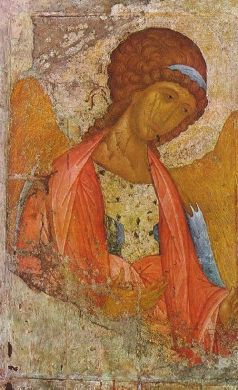
When the Holy Trinity said, “Let there be heaven and earth,” Thou, O Christ, didst serve as a Thought and a Tongue of the divine Trinity. Choirs of angels formed themselves on Thy voice, receiving their form from the multi-colored light; thereupon many armies, as multi-colored clouds, cried out as an echo of the divine glory and divine blessedness, and stood in ranks around Thee, their Leader, singing the triumphal hymn: Alleluia.
The long poem, Akathist to Jesus Conqueror of Death, by St. Nikolai Velimirovich, contains songs of the nine ranks of angels, of which that above is titled, “The Choir of Angels.” Today in the Orthodox Church we commemorate the Archangel Michael and All Angels, so I will share the second of those songs as well, “The Choir of Archangels”:
Thou hast made us Thy vessels and filled us completely with Thy might and Thy wisdom; of ourselves we are nothing, but in Thy mercy Thou hast made us Thy friends. Lucifer fell from our archangelic rank and dragged all mankind into perdition, but Thou, so as to remove that disgrace from our countenance, hast allowed us to share in Thy victory, the victory over Lucifer, by sending the Archangel Gabriel as herald of Thy descent into battle and Thy victory; thus in gratitude we praise and glorify Thee, singing: Alleluia.
Last year at this time I was trying to learn a prayer song to the Archangel Michael, to teach the little children at church. I had forgotten about the most traditional and easy one that they might already have been introduced to in the past, and spent a long time in finding a hymn (text below) that was really a bit much for the class. But it is my own favorite so far, and I think this is where I learned it:
Father Stephen has written about the legitimacy of praying to angels. About the scripture that says, “There is only one mediator between God and man, the Man Christ Jesus,”he explains:
“…that sense of mediation is a meaning of the word that Christ alone could perform. No angel, no other creature can unite me to God. Only God become man is able to unite man to God.
“But we’re talking about prayer, not union, per se. Can someone else pray for me? I hope so …. Can angels pray for me? (yes they can and they do). Is it wrong to ask them to do so or thank them for it (certainly not)….
“God is the ‘Lord of Hosts.’ He is always surrounded by such a cloud of Angels, saints, etc. He cannot be approached ‘alone.’ This great company of witnesses, as the book of Hebrews calls them, bears witness to my prayers before God, and hopefully improves greatly upon them. They see so much more clearly than what I see. I see and know so little. Thank God someone is praying who knows. God knows, but it is His delight, in the utter humility of His nature, to share that knowledge and to invite us to pray.”
St. Michael the Archangel, Defend us in battle. Be our protection against the wickedness and snares of the devil. May God rebuke him we humbly pray; and do thou, O Prince of the heavenly host, by the power of God, cast into hell Satan and all the evil spirits who roam throughout the world, seeking the ruin of souls.


 When the Holy Trinity said, “Let there be heaven and earth,” Thou, O Christ, didst serve as a Thought and a Tongue of the divine Trinity. Choirs of angels formed themselves on Thy voice, receiving their form from the multi-colored light; thereupon many armies, as multi-colored clouds, cried out as an echo of the divine glory and divine blessedness, and stood in ranks around Thee, their Leader, singing the triumphal hymn: Alleluia.

 Gladsome Lights