Bed-making duplicates the cosmic order, because you make order out of chaos, and that’s a good thing to do when you first awaken, because you’re reenacting the creation of the world in a symbolic manner. It’s a good way to get your day going.
“Lord Jesus Christ, Son of God, Who is coming to judge the living and the dead, have mercy upon us sinners, forgive our sinful falls throughout our lives, and by ways known to Thee alone, hide us from the face of antichrist within the secret desert of Thy salvation.”
When I am reading any sort of literature I often think of what fellow blogger M.K. has said, (forgive me, M.K., if I am distorting this) that when she finds someone whose writer’s voice she particularly appreciates, it doesn’t matter the topic of the writing, she enjoys reading everything he or she produces.
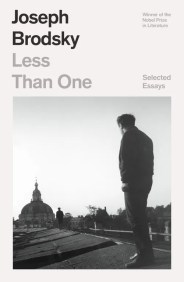
For me, the poet Joseph Brodsky is one of those writers. His intellect, his experience, his abilities, are so far removed from my own, it seems strange that I would feel the connection with him that I do. The attraction is there, but my time is limited, so I’ve actually read very little of his work. But this particular book, Less than One, got my attention recently, calling out from the mobile bookshelf that sits along the short path I often traverse, from the kitchen to the computer. I took it in hand and saw that it is a book of essays, but I didn’t remember why I had bought it.
Maybe it was after reading something like this, from the publisher:
This collection of essays thrusts Joseph Brodsky—previously known more for his poetry and translations—into the forefront of the “Third Wave” of Russian émigré writers. Originally published the year before Brodsky received the Nobel Prize in Literature, Less Than One includes intimate literary essays and autobiographical pieces that evoke the daily discomfort of living under tyranny. His insights into the works of Dostoevsky, Mandelstam, and Platonov, as well as the non-Russian poets Auden, Cavafy and Montale are brilliant; Seamus Heaney said of Brodsky’s treatment of one of Auden’s most famous poems, “There will be no greater paean to poetry as the breath and finer spirit of all human knowledge than Brodsky’s line-by-line commentary on ‘September 1, 1939.’”
Joseph Brodsky
That paragraph also made me interested to delve into Auden. But the first thing I read about the poem Heaney references, “September 1, 1939,” gave me pause. It was a blog post by Dr. Oliver Tearle, in which he points out that Auden disowned the poem and was “ashamed to have written” it.
When Brodsky was made unwelcome in the Soviet Union in 1972, W.H. Auden was one of the people who helped him to settle in the U.S. But long before that, as a young student, he was learning Polish and English with the goal of being able to translate poets like Czeslaw Milosz and John Donne. He said of his Jewish parentage, “While I am related to the Old Testament perhaps by ancestry, and certainly the spirit of justice, I consider myself a Christian. Not a good one but I try to be.”
When he was denounced and stood trial before a judge, the examination went like this:
Judge: And what is your occupation in general? Brodsky: Poet, poet-translator. Judge: And who recognized you to be a poet? Who put you in the ranks of poet? Brodsky: No one. And who put me in the ranks of humanity? Judge: Did you study it?…How to be a poet? Did you attempt to finish an institute of higher learning…where they prepare…teach… Brodsky: I did not think that it is given to one by education. Judge: By what then? Brodsky: I think that it is from God.
I immediately thought of Milosz and in particular his book The Captive Mind, when I read this paragraph from Brodsky, quoted on The Poetry Foundation website:
“Language and, presumably, literature are things that are more ancient and inevitable, more durable than any form of social organization. The revulsion, irony, or indifference often expressed by literature toward the state is essentially the reaction of the permanent—better yet, the infinite—against the temporary, against the finite. … The real danger for a writer is not so much the possibility (and often the certainty) of persecution on the part of the state, as it is the possibility of finding oneself mesmerized by the state’s features which, whether monstrous or undergoing changes for the better, are always temporary.”
No doubt one aspect of the poet’s voice I find compelling is this unwillingness to be captivated by things lesser than the infinite — anything less than the full expression of the human soul.
Czeslaw Milosz became an admirer, writing: “Behind Brodsky’s poetry is the experience of political terror, the experience of the debasement of man and the growth of the totalitarian empire. … I find it fascinating to read his poems as part of his larger enterprise, which is no less than an attempt to fortify the place of man in a threatening world.”
I enjoyed seeing the poet on video in this very short clip of an interview, in which he is speaking about how he personally strives against this debasement, not just of his own person, but of his fellow humans. Even without knowing the context of his words, we get another glimpse of his own soul when he tells about his efforts not to reduce people in his mind to simple categories, but to see their complexity, and their bravery. He says this is how you “winnow their essence.”
My minimal encounters with Joseph Brodsky encourage me to resist my own reductionist, categorizing tendencies. His is a voice I will continue to listen to.
“By failing to read or listen to poets,
society dooms itself to inferior modes of articulation,
those of the politician, the salesman or the charlatan.”
“If people must not be taught religion, they might be taught reason, philosophy. If the State must not teach them to pray it might teach them to think. And when I say that children should be taught to think I do not mean (like many moderns) that they should be taught to doubt; for the two processes are not only not the same, but are in many ways opposite. To doubt is only to destroy; to think is to create.”


 When I am reading any sort of literature I often think of what fellow blogger M.K. has said, (forgive me, M.K., if I am distorting this) that when she finds someone whose writer’s voice she particularly appreciates, it doesn’t matter the topic of the writing, she enjoys reading everything he or she produces.

 Gladsome Lights