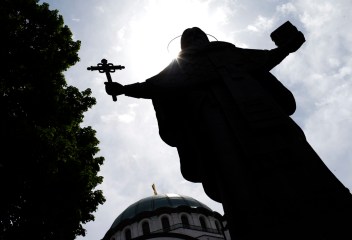
But God forbid that I should glory, save in the cross of our Lord Jesus Christ. -Galatians 6:14
Thy Cross is for all men a well of blessings
and a cause of thanksgiving. Thereby for them that believe in thee,
weakness is turned into strength, shame into glory, and death into life. -St. Leo the Pope (d. 461)
Feast of the Exaltation of the Cross — September 14
“Our modern poetry is in pieces…. This makes a defense of poetry difficult. But defend it we must, for poetic knowledge is an essential kind of knowledge. Without it, our understanding of the world suffers a severe distortion. It is as if we have grown up in an age of one-eyed men who have heard rumors that people could once judge distances, depths, and colors by the use of two eyes, but are now reduced by this flat, prosaic information age that relies on scientific analysis as virtually our only source of knowledge. We are a century of Cyclops.”
Though Faulkner wrote that in the 20th century, I doubt whether he would think the situation has improved in the 21st. In the same year as the Touchstone article, Czeslaw Milosz published this offering that is a form of therapy for our distorted vision: In the introduction to the anthology of poetry that he compiled, The Book of Luminous Things, he writes:
“Many poems that I like or admire are not in this anthology because they do not correspond to my criteria of size and accessibility to the reader.”
“My proposition consists in presenting poems, whether contemporary or a thousand years old, that are, with few exceptions, short, clear, readable and, to use a compromised term, realist, that is, loyal toward reality and attempting to describe it as concisely as possible. I act like an art collector who, to spite the devotees of abstract art, arranges an exhibition of figurative painting….”
He also thinks we moderns are missing something essential to our soul’s health. Whereas Faulkner writes metaphorically of a problem with our eyes, Milosz says, also metaphorically but more generally, “We seem to be missing some vital organs…”
“I have written elsewhere of this deprivation as one of the consequences brought about by science and technology that pollutes not only the natural environment but also the human imagination. The world deprived of clear-cut outlines, of the up and the down, of good and evil, succumbs to a peculiar nihilization, that is, it loses its colors, so that grayness covers not only things of this earth and of space, but also the very flow of time, its minutes, days, and years. Abstract considerations will be of little help, even if they are intended to bring relief.
“Poetry is quite different…. Since poetry deals with the singular, not the general, it cannot — if it is good poetry — look at things of this earth other than as colorful, variegated, and exciting; and so, it cannot reduce life, with all its pain, horror, suffering and ecstasy, to a unified tonality of boredom or complaint. By necessity poetry is therefore on the side of being and against nothingness.”
Almost all of the poems are introduced with a line or two about what he likes about that one, as an example of good poetry. None of his own poems is included. Here is one from the collection with a teacherly comment from Milosz to introduce it:
Walt Whitman
“The strong presence of a thing described means that the poet believes in its real existence. That is the meaning of a programmatic and unfinished poem by Walt Whitman, ‘I Am the Poet,’ which rehabilitates a ‘naïve’ approach and rejects philosophy’s unfavorable opinion on the direct testimony of our senses.”
I AM THE POET
I am the poet of reality I say the earth is not an echo Nor man an apparition; But that all the things seen are real, The witness and albic dawn of things equally real I have split the earth and the hard coal and rocks and the solid bed of the sea And went down to reconnoitre there a long time, And bring back a report, And I understand that those are positive and dense every one And that what they seem to the child they are [And that the world is not a joke, Nor any part of it a sham].
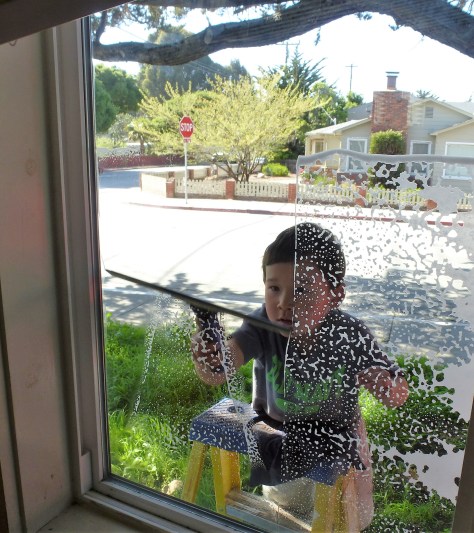
Toil is man’s allotment; toil of brain, or toil of hands, or a grief that’s more than either, the grief and sin of idleness.
-Herman Melville
In addition to that pithy quote, I found an old blog post of mine on the topic of work, in which my stories illustrate to some degree what I think Chesterton was saying, quoted in this post last week. It’s almost ten years old: “Art and happiness flow from love and work.” It was a good reminder to me of things that haven’t changed.
Let me amend Melville’s statement, too, because the categories he mentions don’t seem to include a place for prayer, which is also work, of the most essential sort. We pray from our hearts, or our spirit, with the help of our bodies.
I wish you all the joy of good work, strengthening prayer, and satisfied rest. ❤
 Though Faulkner wrote that in the 20th century, I doubt whether he would think the situation has improved in the 21st. In the same year as the Touchstone article, Czeslaw Milosz published this offering that is a form of therapy for our distorted vision: In the introduction to the anthology of poetry that he compiled, The Book of Luminous Things, he writes:

 Gladsome Lights