 Jean-Claude Larchet is a contemporary French patristics scholar and theologian who has written on diverse subjects such as the Theology of Illness, life after death, and mental disorders. (I’m currently reading his The New Media Epidemic.) Several years ago our parish did a study of his book, Theology of the Body, and last week when I was thinking on that topic I was glad to find it still on my shelf.
In the chapter on “The Body in Spiritual Life,” Larchet discusses the physical aspects of our worship, beginning with the tradition of standing in church, “… a posture that symbolizes the resurrection, that key point of the Christian faith and hope.”
“In addition, mention may also be made of the ‘passive’ liturgical participation of the body in the setting that is so characteristic of the Orthodox Church, where the splendor of the celebration, so often misunderstood by those who have no experience of its meaning, has an important spiritual role to play – the beauty of the architecture and the ‘decoration’ of the churches whose walls are covered with frescoes and icons; the solemn character of the services; the richness of the celebrants’ vestments; the magnificence of the chants; the incense; the lights of the lamps and candles; and so on. All these things – which never cease to awaken a sense of wonder in the faithful – have a fourfold meaning.”
 Two of those “folds” are 1) “symbolizing the kingdom of heaven, and 2) “giving the faithful, in a symbolic way, a taste of the riches and glory of the kingdom of heaven, and also of the new conditions of existence there, when the body is transfigured along with all the senses….”
The next and last paragraph I will share here struck me as alluding to realities so holistic and fundamental that they must constitute the very business of our life. The story we can read in the specific details tells who we are and what we are made for, and includes many mystical, or hidden, elements, no less real for their hiddenness. It is the true story of humanity:
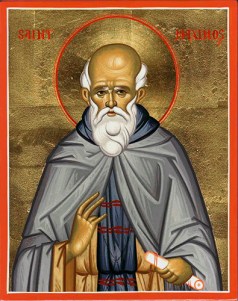
“The very interior of an Orthodox church introduces the body into a space that is different from the ordinary; it is a space transfigured and sacred, whose profound symbolism is superbly analyzed by St. Maximus the Confessor in his Mystagogia. He stresses in particular that the church’s spatial structure symbolizes the human being: the altar representing the spirit, the sanctuary the soul, and the nave the body. Conversely, the human being symbolizes the church: his spirit is, as it were, an altar; his soul, a sanctuary; and his body, a nave. And this is not simply by their nature but by their own specific functions in spiritual life: the body represents in particular the practical or ethical dimensions; the soul stands for the contemplative dimension; and the spirit its pinnacle, theologia, in which the believer receives from the Holy Spirit supernatural knowledge of the divine mysteries.”

 “I realized that a crisis of limits is a crisis of culture, and a crisis of culture is a crisis of spirit. Every living culture in history, from the smallest tribe to the largest civilization, has been built around a spiritual core: a central claim about the relationship between human culture, nonhuman nature, and divinity. Every culture that lasts, I suspect, understands that living within limits—limits set by natural law, by cultural tradition, by ecological boundaries—is a cultural necessity and a spiritual imperative. There seems to be only one culture in history that has held none of this to be true, and it happens to be the one we’re living in.”
 It was a drippy and drizzly morning when I drove to the post office to ship Christmas presents to a few of my family. I thought there would be a long line, so I gave myself plenty of time, because I wanted to go directly from there to the cemetery in time to pray with a friend at her husband’s interment.
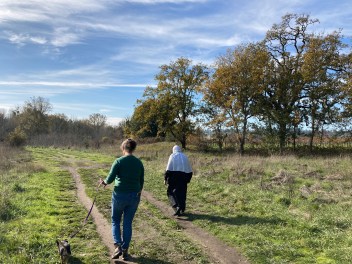
 I had another visit with friends yesterday, for which I made a big pot of chili beans; this afternoon a little tea time with a sister from church when I got back from the cemetery; and last week, a walk with two friends. It’s still fall here, but the colors are all turning to browns and grays, so I was surprised to see this mushroom, the brightest I’ve ever encountered. It was one of several of its kind popping up under bushes.
 “Keeping the commandments of Christ is not doing nothing. It is, however, the refusal to use violence to force the world into ever-changing imaginary versions of the good.”

 Gladsome Lights