Category Archives: quotes

There is no lesson plan for it.

The desire to be beautiful seems to be common to mankind, but the very atmosphere of this age is toxic with something that feeds a disease, making us obsessed with our image. One part of the toxic mix is the overwhelming abundance of pictures of faces and bodies in magazines and on every electronic device, forming a kind of lesson plan on How to Look. I was happy for a respite this morning when I read St. Nikolai’s homily for the day in The Prologue of Ohrid.

HOMILY
on the beauty of Christ above all other beauty
Thou art fairer than the sons of men (Psalm 45:2).
 

Holy Scripture does not ascribe any particular value to physical beauty, and in general to anything transient. That is why everyone who reads Holy Scripture should take care to be sufficiently attentive and wise to transfer the praise of physical beauty to the soul and to spiritual values. Without a doubt, spiritual beauty gives a wondrous attractiveness to the most unattractive body, just as an ugly soul makes even the most attractive body repulsive. The Prophet David, pouring forth good words (Psalm 45:1), says to his King, the Lord Jesus Christ: Thou art fairer than the sons of men. 

The Lord Himself created His bodily cloak as He wanted. Had He wanted to appear in the world as the physically fairest of men, He could have done so. But there is nothing in the Gospel to indicate that He drew followers to Himself or influenced men by His appearance. He Himself said: the flesh profiteth nothing (John 6:63). Therefore, it is clear that David was not speaking of the physical beauty of Christ, but of His spiritual, divine beauty. This is clearly seen in the following words of the Psalmist: Grace is poured forth upon thy lips (Psalm 45:2). So it is that the unsurpassed beauty of the Son of God is not in the form and shape of His lips, but rather in the stream of grace that flows from His mouth. 

Again, the Prophet Isaiah speaks of Christ: He had no form or comeliness; and when we shall see Him, there is no beauty that we should desire Him (Isaiah 53:2-3). Do Isaiah and David agree? Perfectly well. David speaks of Christ’s inward beauty, and Isaiah speaks of Christ’s external abasement. Isaiah said that He would not be seen as a king or a rich man, but as a servant and sufferer.

O Lord Jesus Christ, Thou art fairer to us than all men and angels: glory to Thine immortal and unending beauty. O gracious Lord, correct the ugliness of our souls, which are disfigured by sin, we pray Thee.

To Thee be glory and praise forever. Amen.

From the archives

The challenges of reality.

“There is something which unites magic and applied science while separating both from the wisdom of earlier ages. For the wise men of old the cardinal problem had been how to conform the soul to reality, and the solution had been knowledge, self-discipline, and virtue. For magic and applied science alike the problem is how to subdue reality to the wishes of men: the solution is a technique; and both, in the practice of this technique, are ready to do things hitherto regarded as disgusting and impious—such as digging up and mutilating the dead.”

-C.S. Lewis in The Abolition of Man

The mountains rise up and startle you.

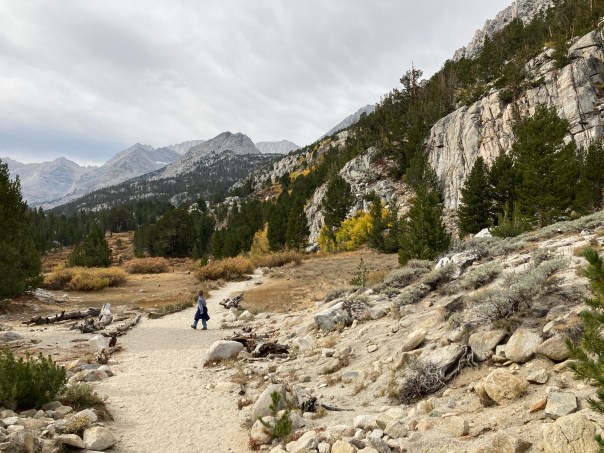
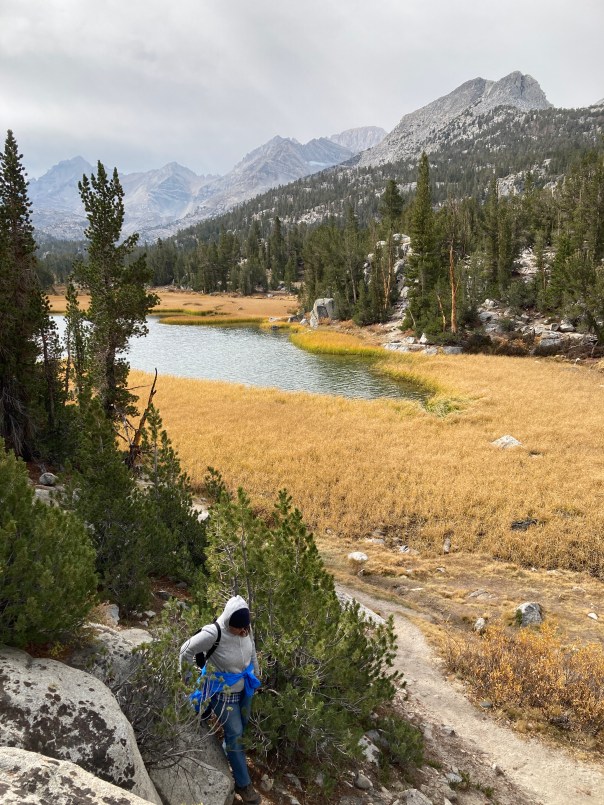
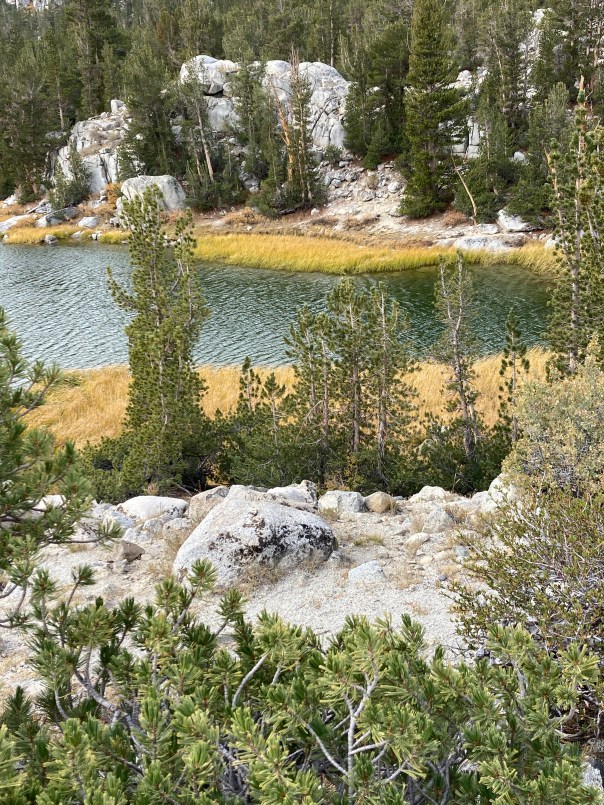
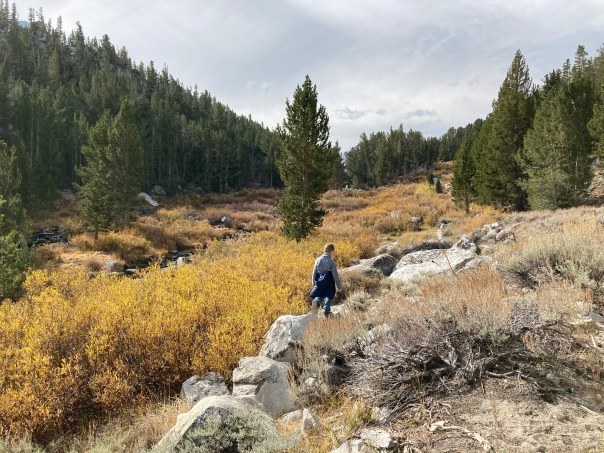
We arrived in California and settled in our lodging (together) in Mammoth Lakes, on the east side of the Sierra Nevada. The next morning was pretty cold, requiring several layers of clothing as we set off for a hike in the Little Lakes Basin, along Rock Creek and to Marsh Lake. The trailhead was already over 10,000 ft in elevation, which meant that we were enjoying a very high mountain experience with minimal effort.

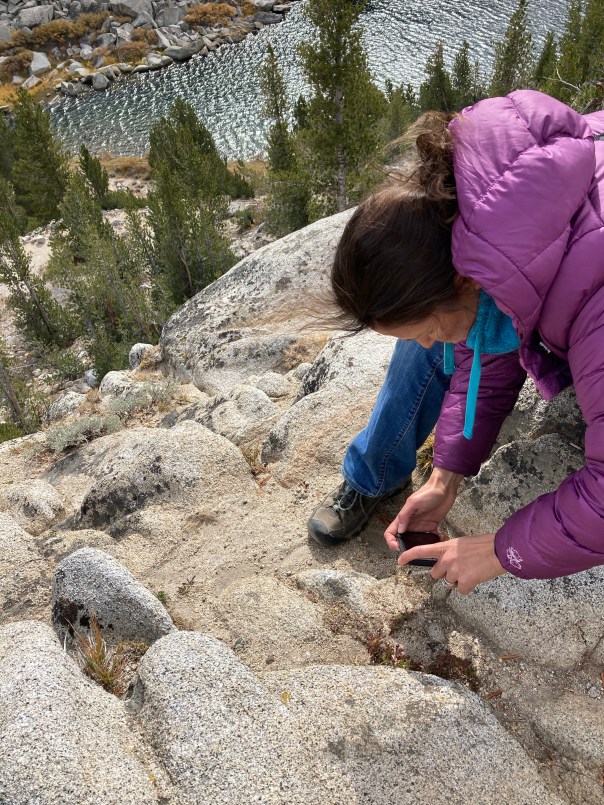
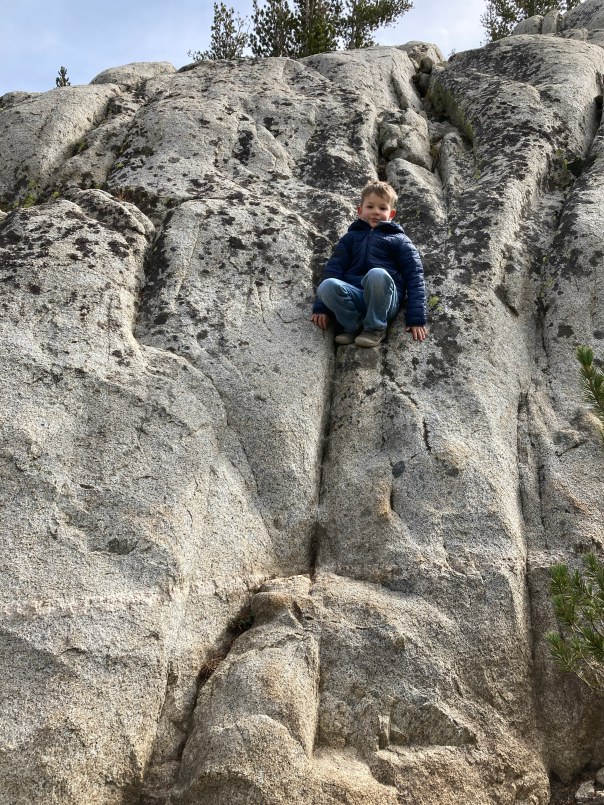
There was ice in several places along Rock Creek, which just made for more fun for Jamie. Three of us reveled in expansive or micro views in our camera viewfinders, and the youngest ones scampered like goats up and down boulders and cliffs.

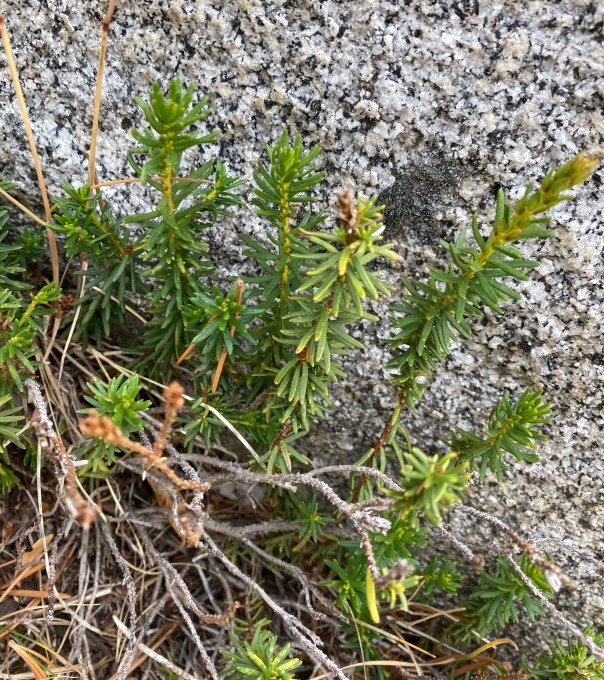
Purple Mountain Heath

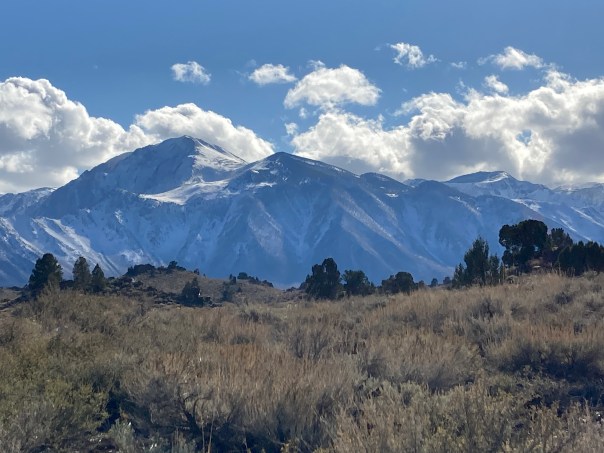
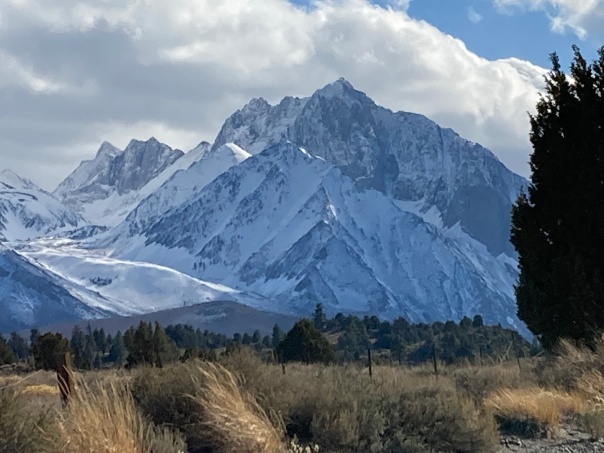
On the western side of the Sierras, you start from the Central Valley, nearly at sea level, and have to climb through foothills and lower ranges before you get to the high elevations. But on the east side, the valley is already at 4,000 feet elevation, and from there the mountains rise up immediately, and startle you.

Me

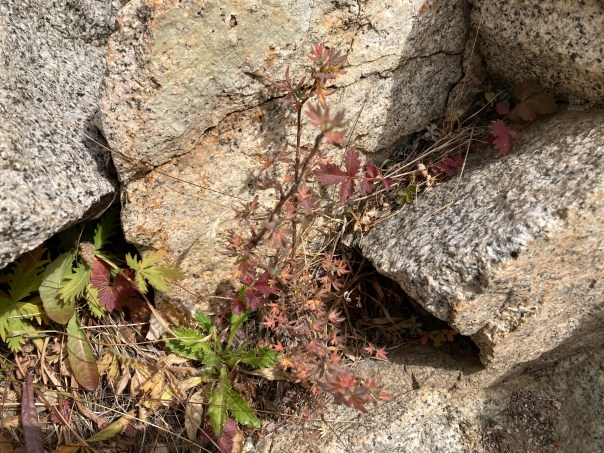
Above, you can see three species of cinquefoil that Pippin and I encountered all along the trail. In this spot they were all in close proximity to one another, though one is ihard to see back there n the shade. They are Slender Cinquefoil, Sticky Cinquefoil, and Shrubby Cinquefoil, not necessarily in that order. I actually gave up on keeping them straight.

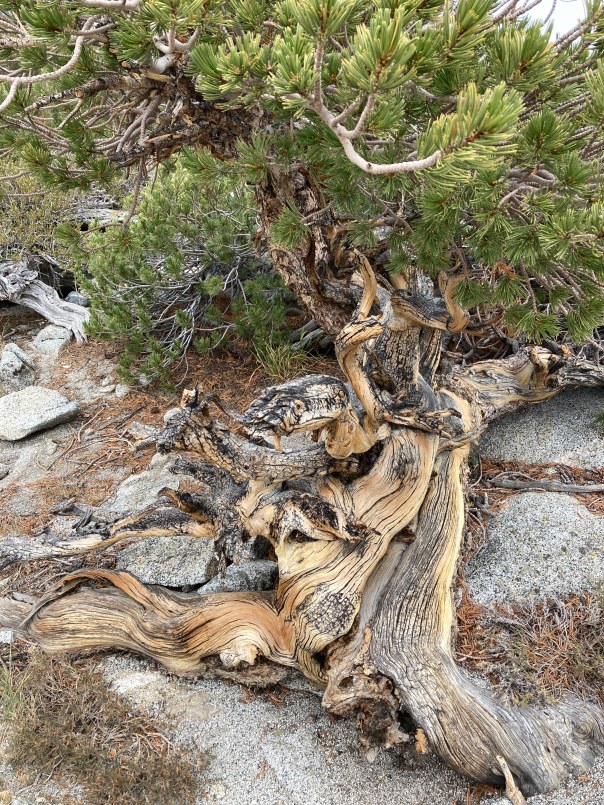
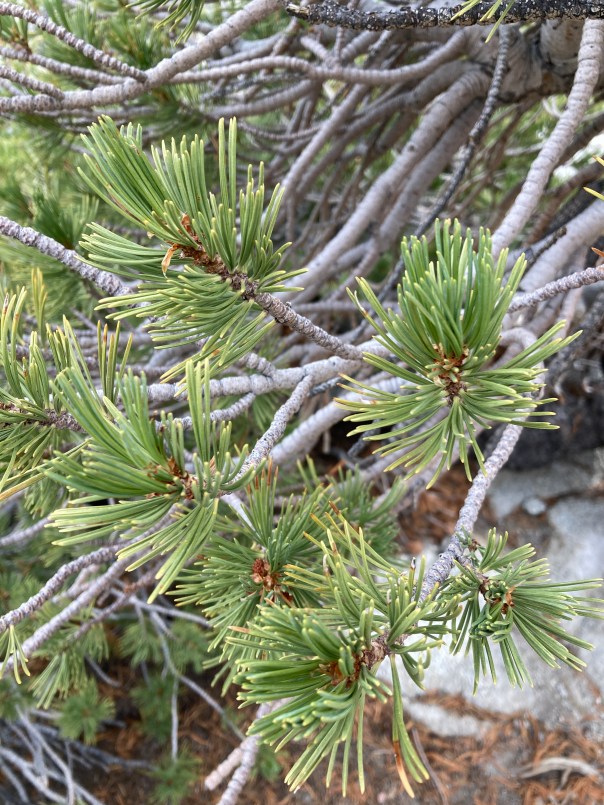
This weathered Whitebark Pine got my attention; the Professor identified it for me:

We had arrived in town just before a snowstorm, we could see it coming on our phones’ weather app, and anticipated having to stay mostly indoors the next morning at least, because we have no snow gear with us.

And that’s how it turned out. While the snow was falling thickly for a few hours, we ate rice pudding for breakfast, built a fire in the woodstove (fires hadn’t been allowed in the campgrounds) and read or did creative projects. I tried sketching one of the images from the day before, in a tiny notebook I had brought, using Jamie’s and Ivy’s colored pencils. Both Jamie and Ivy got into writing stories, picking out the words on my laptop, their first time at a keyboard.

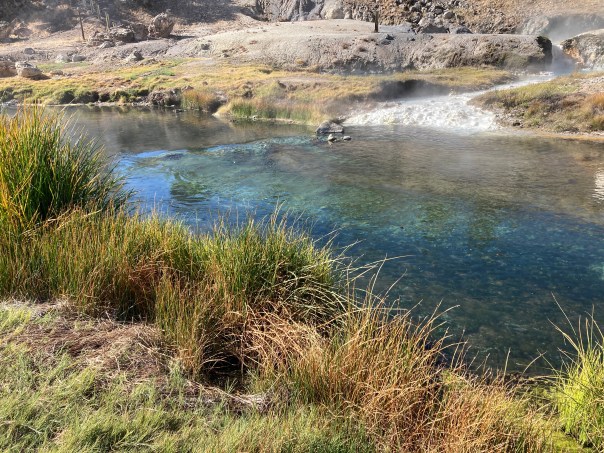
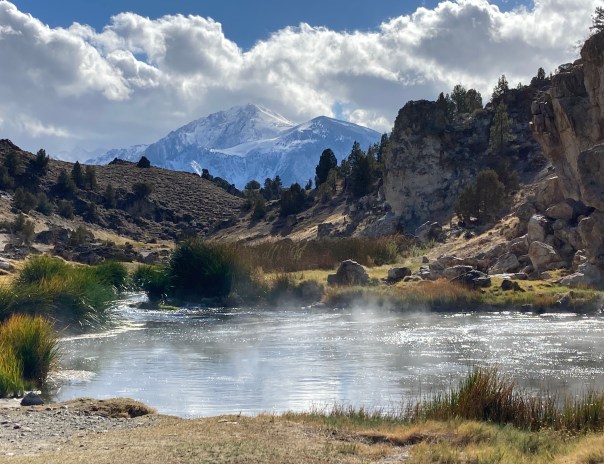
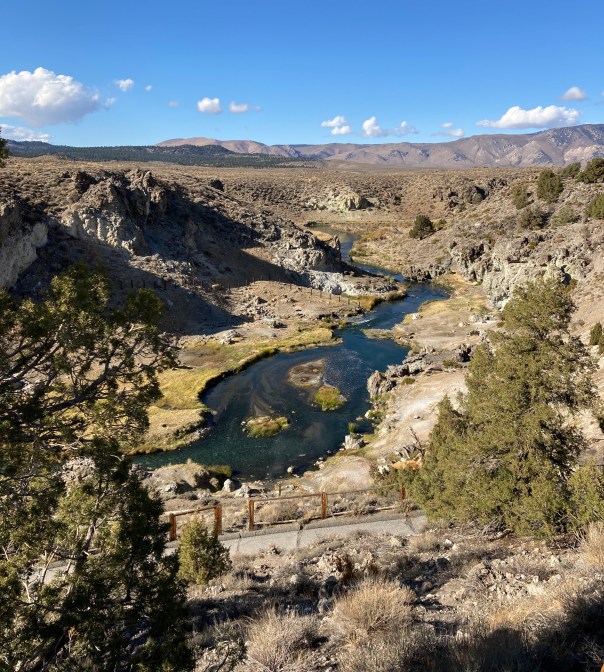
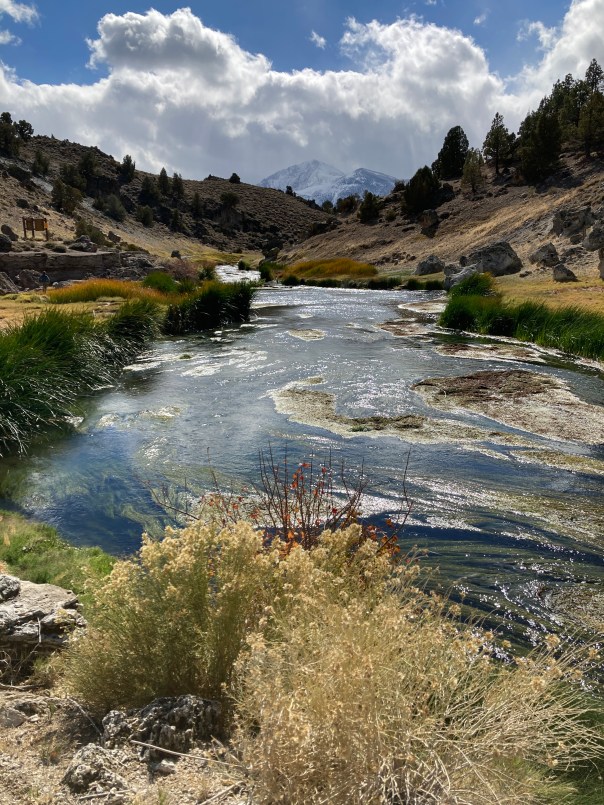
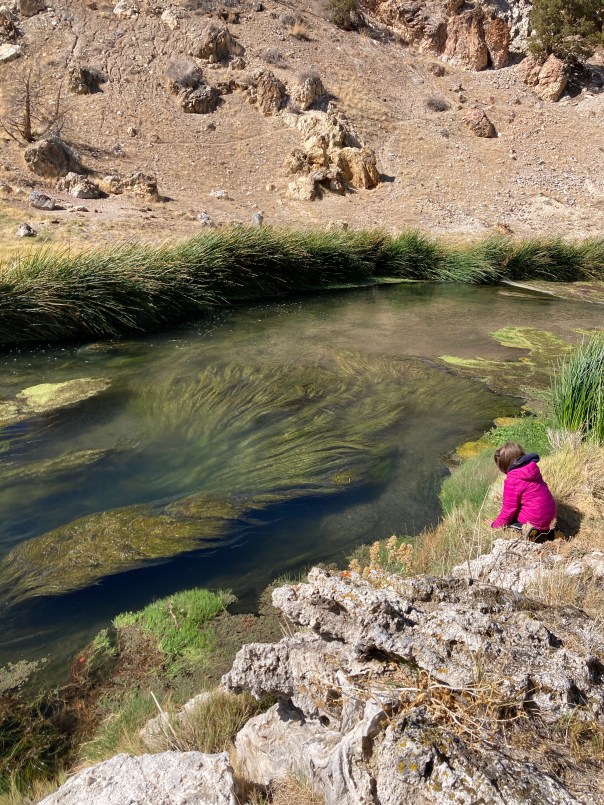
Then the snow stopped, and after lunch we drove to Hot Creek to ramble and explore. This is a place in the lower part of Mammoth Creek where the water spurts from hot springs under the surface of the creek, and its name is changed. We all found so much to look at, and Scout fished.

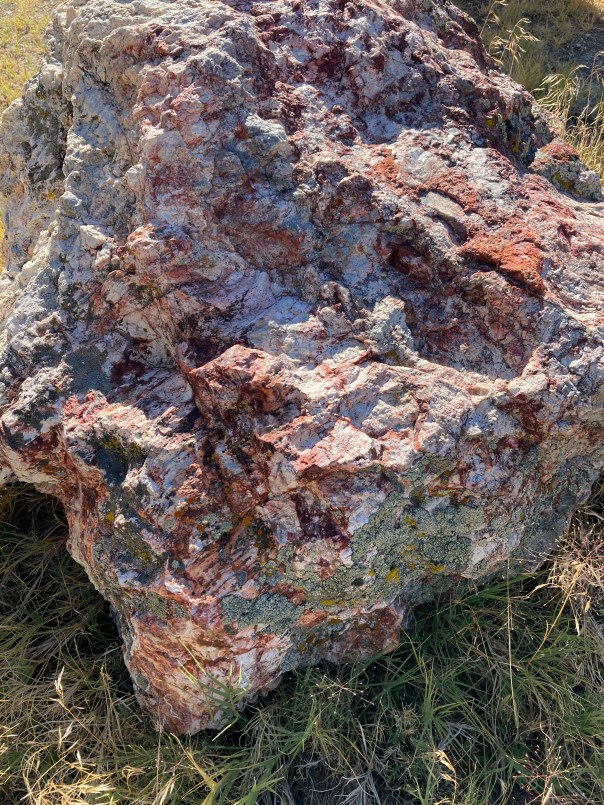
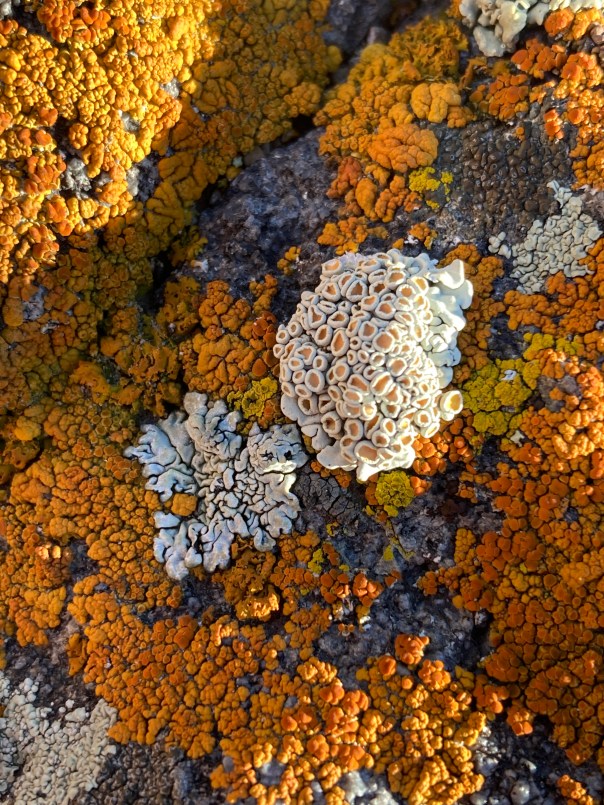
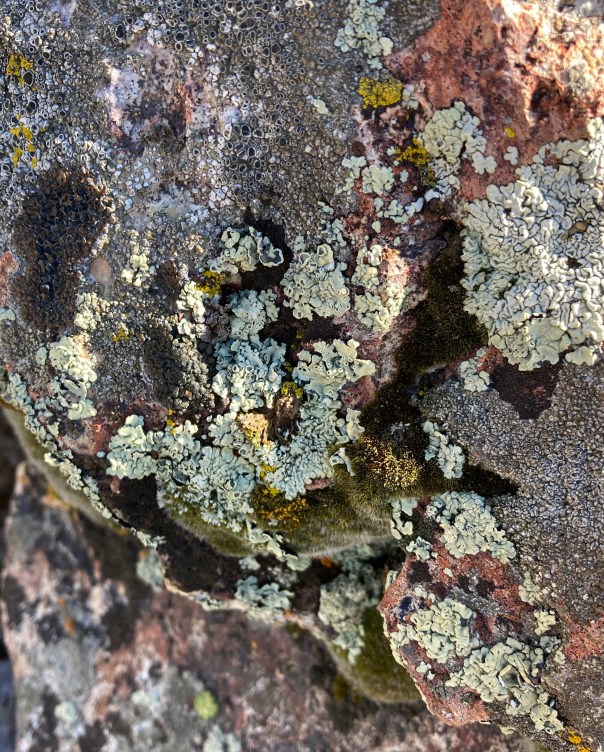
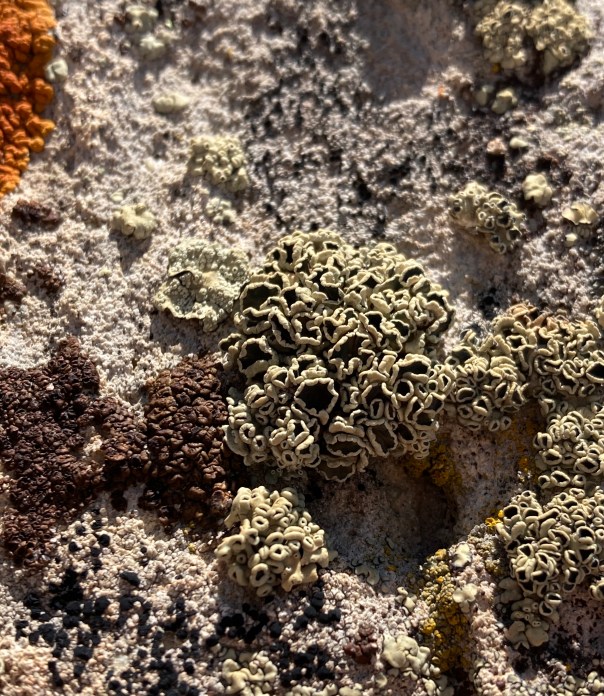
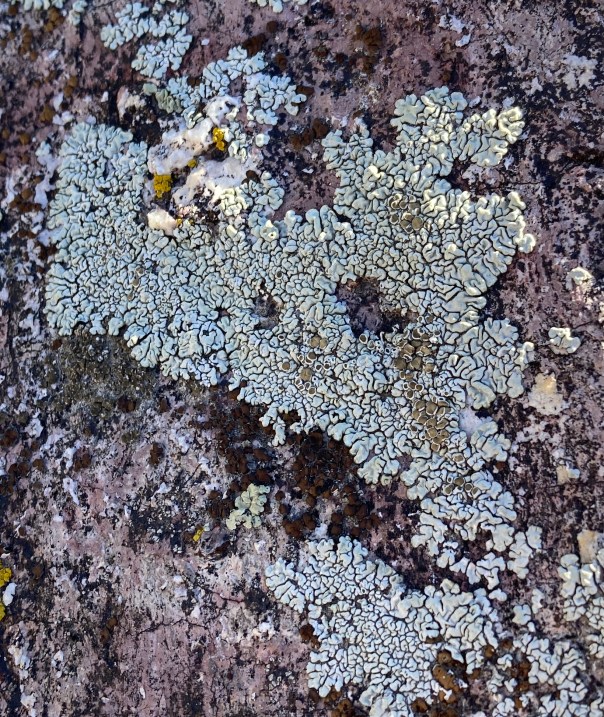
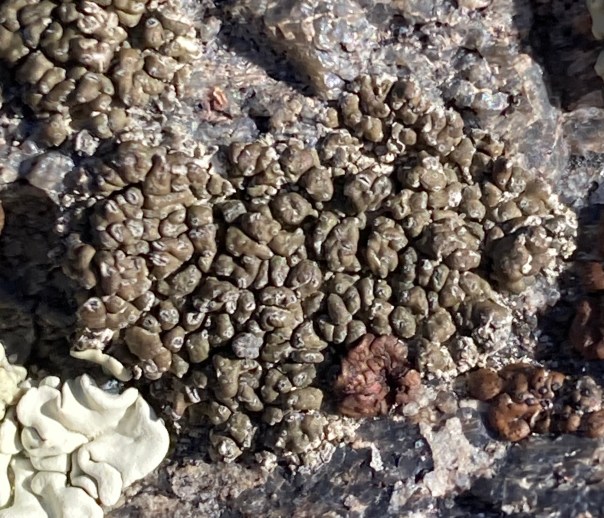
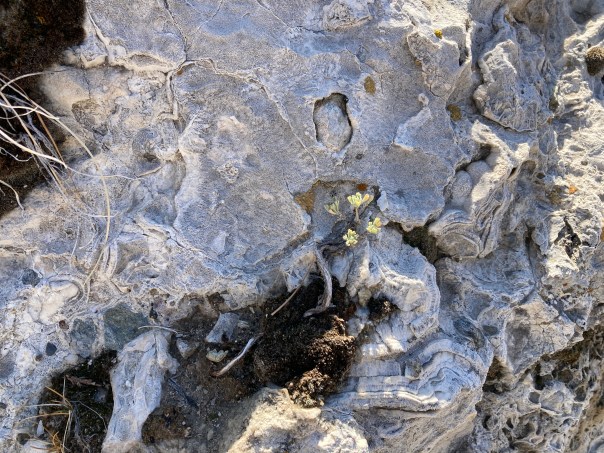
Lots of types of lichens grow on the “moonscape” rocks. Two of my favorites were growing together in this group captured by Pippin:

Elegant Sunburst Lichen with a mound of Orange Rock Posy Lichen

And more:

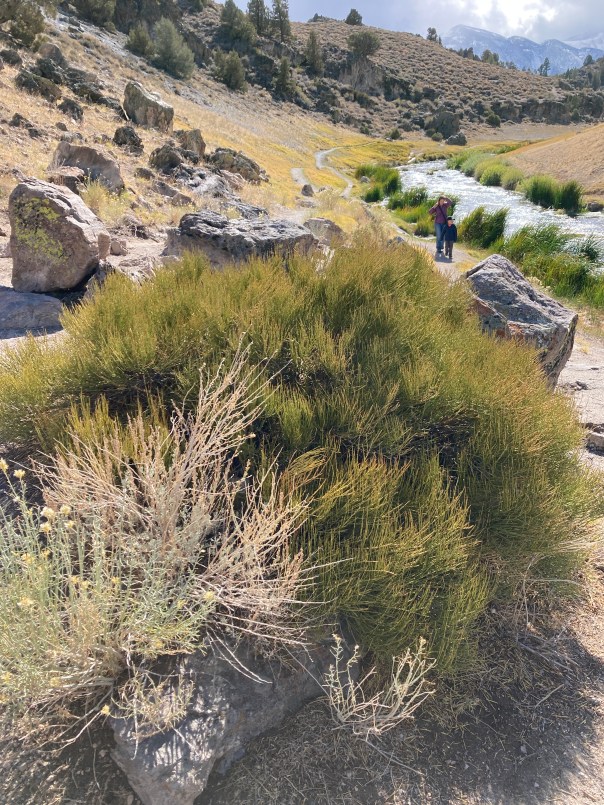
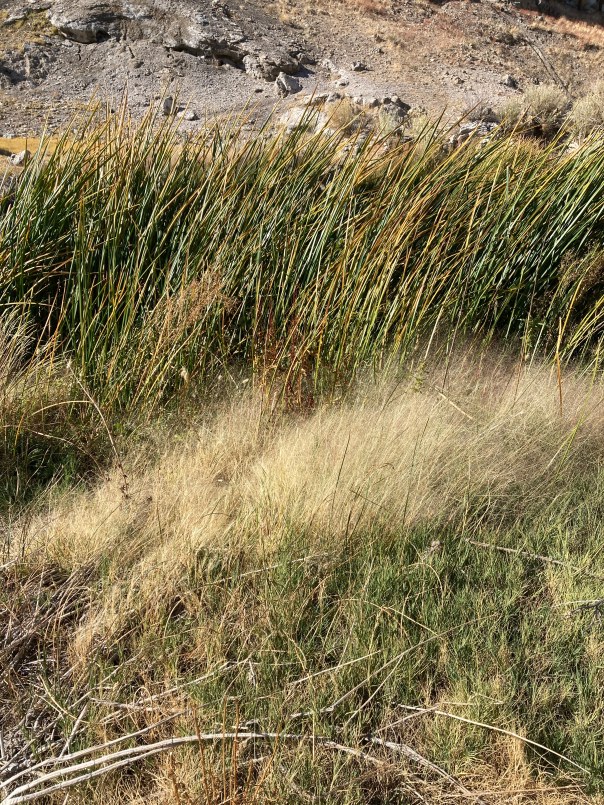
I was pleased to discover many bushes of ephedra or Mormon Tea growing near the creek.

The green bush is ephedra.

We dipped our fingers in the water in several places, and were surprised that tiny fish were swimming in it, it was so like bath water. In many places along the bank just above you could put your hand in a hole or crack and feel the warm and humid air. The smell of sulfur was strong in places, too.

Ivy had an encounter with nettles. She said with great feeling, “I thought it was lemon balm but it was a baby nettle!” Her mother managed to find some purslane leaves which she reluctantly chewed, and put the poultice on her skin. Either the poultice worked, or the taste of it distracted her; in any case, she was not frowning for long.

When we walked back up out of the creek channel, there the mountains stood, like gods.

Considering these mountains, and all the wonders that have surrounded me in the last week, Isabella Bird well expresses my feeling:

“I have found a dream of beauty at which one might look all one’s life and sigh.”

Doing sensible and human things.

Not only is my mind typically scattered to the four winds, but it is also buffeted and pushed down and downright dominated by currents of thought — and current events — that somehow turn into raging hurricanes. But in my daily life, they are only passing and mental hurricanes, so when I read this quote from my daughter Pearl, I was freshly encouraged to call frequent moratoriums on the practice of wondering whether it might be a Viking or a bomb or a car wreck that will eventually make my loved ones suffer.
“In one way we think a great deal too much of the atomic bomb. ‘How are we to live in an atomic age?’ I am tempted to reply: ‘Why, as you would have lived in the sixteenth century when the plague visited London almost every year, or as you would have lived in a Viking age when raiders from Scandinavia might land and cut your throat any night; or indeed, as you are already living in an age of cancer, an age of syphilis, an age of paralysis, an age of air raids, an age of railway accidents, an age of motor accidents.’

“In other words, do not let us begin by exaggerating the novelty of our situation. Believe me, dear sir or madam, you and all whom you love were already sentenced to death before the atomic bomb was invented: and quite a high percentage of us were going to die in unpleasant ways. We had, indeed, one very great advantage over our ancestors—anesthetics; but we have that still. It is perfectly ridiculous to go about whimpering and drawing long faces because the scientists have added one more chance of painful and premature death to a world which already bristled with such chances and in which death itself was not a chance at all, but a certainty.

“This is the first point to be made: and the first action to be taken is to pull ourselves together. If we are all going to be destroyed by an atomic bomb, let that bomb when it comes find us doing sensible and human things—praying, working, teaching, reading, listening to music, bathing the children, playing tennis, chatting to our friends over a pint and a game of darts—not huddled together like frightened sheep and thinking about bombs. They may break our bodies (a microbe can do that) but they need not dominate our minds.”

—C.S. Lewis, “On Living in an Atomic Age” (1948)

I also don’t need to spend (all my) time researching how bombs are made, or why the Vikings are so ruthless. Which is great, because it leaves more time for writing a chatty blog post to my friends, which is a very human thing to do, and I hope sensible as well.
September 1st really felt like the first day of fall! It hasn’t warmed up much since, but I’m sure we will get some hot days in the next weeks. My fig tree is absolutely loaded, and one of the four winds that my mind goes to is Preparation for Preserving. Get out the dehydrator, and gear up for the harvest: pushing through the perennials and bushes that surround my tree, and stooping under the low-hanging branches to extract the plump fruits, which are revealed by contrast with the big green layers when one by one they turn black.

I went to a nursery the other day to lay in a supply of echinacea purpurea plants to set out this month. Some areas of my “new” landscaping need reinvigorating after six years, and I have been longing for the standard echinacea species that I used to have. The white ones in my front garden are thriving, the multicolored ones in the back are not.

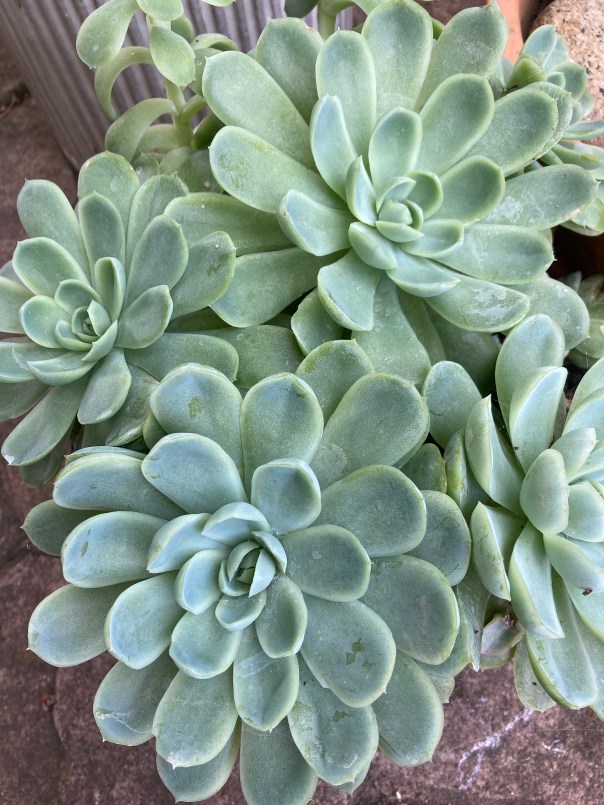
A friend who was moving across the country asked if I would like any of the potted plants he’d kept on his small patio. I evidently hadn’t paid much attention to them when I’d visited his duplex, because I said I’d take them all, and was quite surprised to end up with 37 pots of plants. Three of them are quite large, and two of those are gorgeous jade plants.

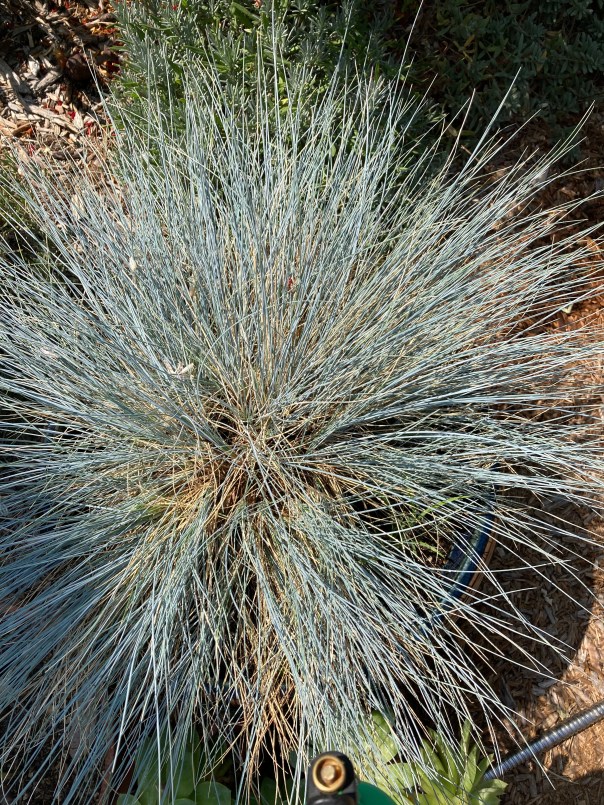
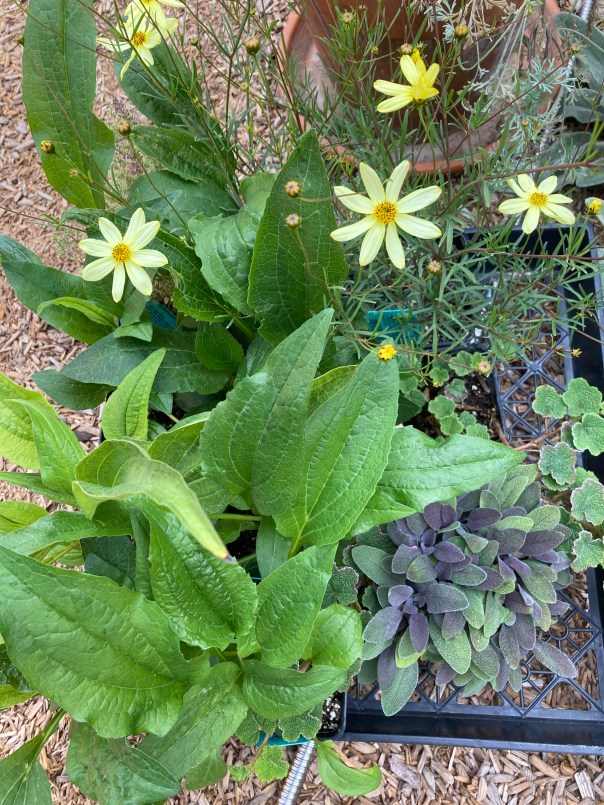
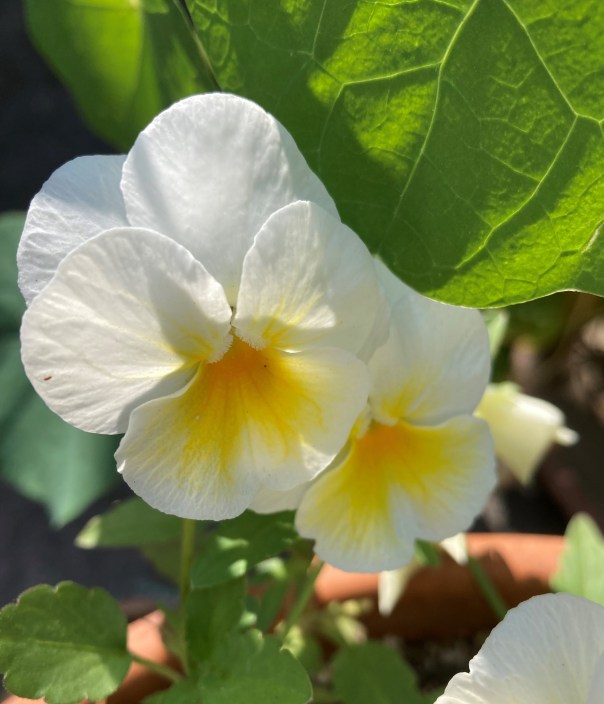
So — I have more lovelies in my garden to keep me company and give me good work to do. This morning I  went out to take pictures of a couple of them to post here, and ended up watering. Not one but two blue jays were visiting my property, and adding to the ambiance with their scratchy voices that make me feel for a moment that I am in the mountains. I noticed a ripe fig, and ate that as a fast-food breakfast. Then… a few ground cherries for dessert! Ah… September.