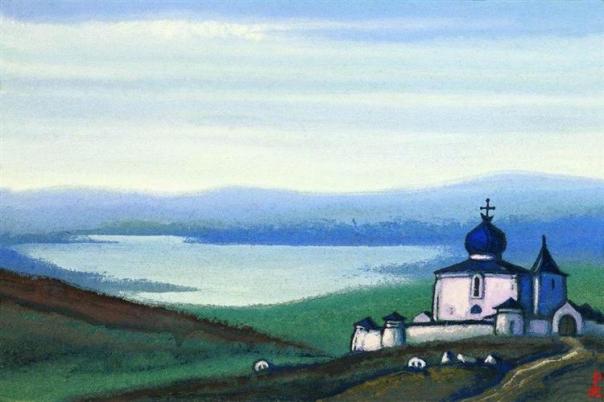
“In the traditional theology of the Eastern Church this world and the ‘next’ are not two worlds. We use the language of place (heaven and earth) for lack of language not for accuracy. There is more to the created order than we see (‘all things visible and invisible’). But that which is not seen is not inherently separate from that which is. Sacrament (mystery in the East) is a way of describing the relationship between what is seen and what is unseen. Everything is sacrament, icon and symbol.”
Thou tellest my wanderings: put thou my tears into thy bottle: are they not in thy book?
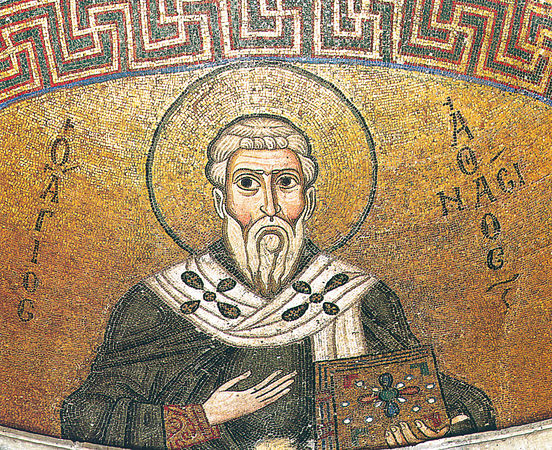
The more one researches current events, historical accounts, and the tangled web of cultures and civilizations going back to the foundation of the world, the more likely is a fall into worry and even despair. We fear especially for children who have to grow up in a violent era, as many have done. That’s why I take courage from the life of St. Athanasius, and pray that my children, grandchildren, godchildren, and all of us, might learn deep in our souls what he knew. The following is an excerpt from a post I wrote several years ago in a time of sorrow. I have shared the quote from his treatise more recently than that, but I hope you might agree with me that it’s worth rereading:
I learned in the short account of the life of Athanasius at the beginning of his On the Incarnation, that the last and worst persecution of Christians ended in Egypt in 311 A.D., when Athanasius was about fourteen. From the age of five he had lived with the constant threat of death, and with the ever-present reality of persecution of his friends and family. The behavior of the ungodly is irrational and inhuman, and tends to cause great pain and suffering, often unto death, not only of the innocent but also of the most Christ-like. As an adult the scenes and events of his childhood seem to be fresh in his mind when he writes:
“A very strong proof of this destruction of death and its conquest by the cross is supplied by the present fact, namely this. All the disciples of Christ despise death; they take the offensive against it and instead of fearing it, by the sign of the cross and by faith in Christ trample on it as on something dead. Before the divine sojourn of the Saviour, even the holiest of men were afraid of death, and mourned the dead as those who perish. But now that the Saviour has raised his body, death is no longer terrible, but all those who believe in Christ tread it underfoot as nothing, knowing full well that when they die they do not perish, but live indeed, and become incorruptible through the resurrection. But that devil who of old wickedly exulted in death, now that the pains of death are loosed, he alone it is who remains truly dead.”
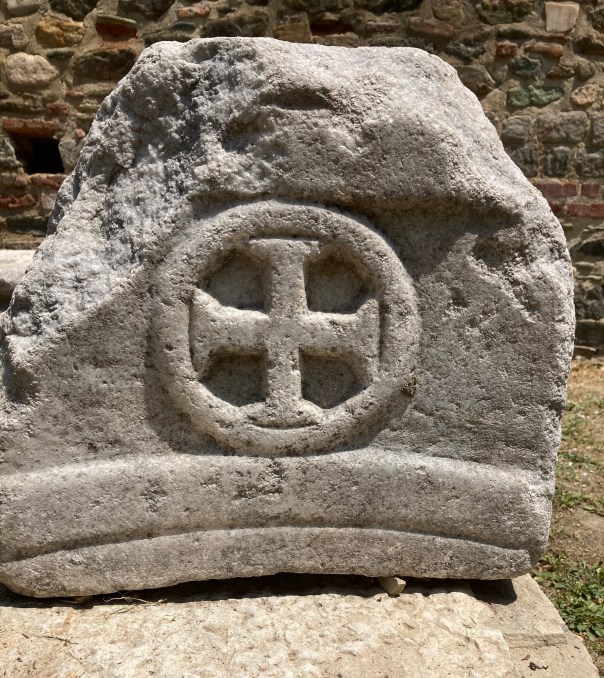
Thessaloniki – Rubble at Church of the Acheiropoietos
Early fall rain has told me confidently about the arrival of the season. And there’s nothing so evocative, familiar but startling, as that particular scent that is carried in the droplets, and in the mist rising from the ground.
“Is not this a true autumn day? Just the still melancholy that I love – that makes life and nature harmonise. The birds are consulting about their migrations, the trees are putting on the hectic or the pallid hues of decay, and begin to strew the ground, that one’s very footsteps may not disturb the repose of earth and air, while they give us a scent that is a perfect anodyne to the restless spirit. Delicious autumn! My very soul is wedded to it, and if I were a bird I would fly about the earth seeking the successive autumns.”
― George Eliot, George Eliot’s Life, as Related in her Letters and Journals
…If you cannot be still within your heart, then at least make still your tongue. If you cannot give right ordering to your thoughts, at least give right ordering to your senses. If you cannot be solitary in your mind, at least be solitary in body. If you cannot labor with your body, at least be afflicted in mind. If you cannot keep your vigil standing, keep vigil sitting on your pallet, or lying down. If you cannot fast for two days at a time, at least fast till evening. And if you cannot fast until evening, then at least keep yourself from satiety.
If you are not holy in your heart, at least be holy in body. If you do not mourn in your heart, at least cover your face with mourning. If you cannot be merciful, at least speak as though you are a sinner. If you are not a peacemaker, at least do not be a troublemaker. If you cannot be assiduous, at least consider yourself lazy. If you are not victorious, do not exalt yourself over the vanquished. If you cannot close the mouth of a man who disparages his companion, at least refrain from joining him in this.
Know that if fire goes forth from you and consumes other men, God will demand from your hands the souls which your fire has burned. And if you yourself do not put forth the fire, but are in agreement with him who does, and are pleased by it, in the judgment you will be reckoned as his accomplice. If you love gentleness, be peaceful, if you are deemed worthy of peace, you will rejoice at all times. Seek understanding, not gold. Clothe yourself with humility, not fine linen. Gain peace, not a kingdom.
 and civilizations going back to the foundation of the world, the more likely is a fall into worry and even despair. We fear especially for children who have to grow up in a violent era, as many have done. That’s why I take courage from the life of St. Athanasius, and pray that my children, grandchildren, godchildren, and all of us, might learn deep in our souls what he knew. The following is an excerpt from a post I wrote several years ago in a time of sorrow. I have shared the quote from his treatise more recently than that, but I hope you might agree with me that it’s worth rereading:

 …If you cannot be still within your heart, then at least make still your tongue. If you cannot give right ordering to your thoughts, at least give right ordering to your senses. If you cannot be solitary in your mind, at least be solitary in body. If you cannot labor with your body, at least be afflicted in mind. If you cannot keep your vigil standing, keep vigil sitting on your pallet, or lying down. If you cannot fast for two days at a time, at least fast till evening. And if you cannot fast until evening, then at least keep yourself from satiety.
 Gladsome Lights