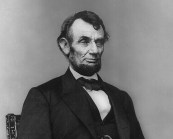
 President Abraham Lincoln’s heartfelt message below came to my attention last week, by way of J. Douglas Johnson, an editor of Touchstone Magazine. Here is a piece of history of the best sort, which it comforts and encourages me to read. I’m always thankful for our founding fathers and more recent statesmen who have gone before us and been taken from us, but no matter how wise and good the best of them were, their perspective will no doubt have been adjusted at least somewhat since they have departed.
But if Abraham Lincoln is praying for us today, I suspect that his supplication might include the essence of what he thought important back then. Johnson remarks: “What I find so remarkable about the speech is that Lincoln at no point attempts to persuade the Southern states (or to inspire the Northern ones) about the rightness of the Union cause or the evils of slavery. Instead, he goes right to the core, echoing the words of our Lord spoken through the prophet Hosea:
“‘When I fed them, they were satisfied;
when they were satisfied, they became proud;
then they forgot me. (Hosea 13:6)'”
PROCLAMATION APPOINTING
A NATIONAL DAY OF PRAYER AND FASTING
March 30, 1863
Whereas, the Senate of the United States, devoutly recognizing the supreme authority and just government of the Almighty God in all the affairs of men and of nations has by a resolution requested the president to designate and set apart a day for national prayer and humiliation:
And whereas, it is the duty of nations as well as of men to own their dependence upon the overruling power of God: to confess their sins and transgressions in humble sorrow, yet with assured hope that genuine repentance will lead to mercy and pardon: and to recognize the sublime truth, announced in the Holy Scriptures and proven by all history that those nations only are blessed whose God is the Lord:
And inasmuch as we know that by His divine law nations, like individuals, are subjected to punishments and chastisements in this world, may we not justly fear that the awful calamity of civil war which now desolates the land may be but a punishment inflicted upon us for our presumptuous sins, to the needful end of our national reformation as a whole people? We have been the recipients of the choicest bounties of Heaven. We have been preserved, these many years, in peace and prosperity. We have grown in numbers, wealth, and power as no other nation has ever grown; but we have forgotten God.
We have forgotten the gracious land, which preserved us in peace, and multiplied and enriched and strengthened us; and we have vainly imagined in the deceitfulness of our hearts, that all these blessings were produced by some superior wisdom and virtue of our own. Intoxicated with unbroken success, we have become too self-sufficient to feel the necessity of redeeming and preserving grace, too proud to pray to the God who made us:
It behooves us then, to humble ourselves before the offended Power, to confess our national sins, and to pray for clemency and forgiveness.
All this being done in sincerity and truth, let us then rest humbly in the hope authorized by the divine teachings, that the united cry of the nation will be heard on high, and answered with blessings no less than the pardon of our national sins, and the restoration of our now divided and suffering country to its former happy condition of unity and peace.
—Abraham Lincoln



 have demanded divine honour from all rational creatures and absolute temporal power over the whole world.”
 Gladsome Lights