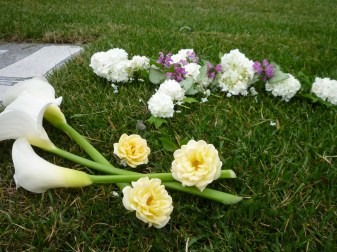
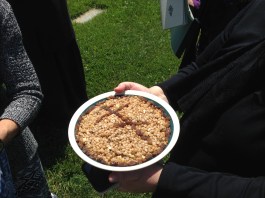
 I almost broke out of my “cage” last week to visit my husband’s grave. My priest would meet me there, and we would pray on the memorial of my beloved’s repose, five years ago. But we changed our plan and had a virtual gathering with him praying in the church and more of us praying along via Zoom than would ever have been able to come to the cemetery. Before we had conceived the graveside plan and given it up, we had planned for me to bring a koliva to church to serve after a service there. I know people everywhere have been accomplishing many and various quick-change feats lately.
The Zoom meeting/service was a little odd; I’m certain it was the first prayer service ever held that way in my parish, but under the circumstances it was the best, and I was really glad we did it. More than 21 people were able to be with me that way, and some of you were among them. I could see that 21 devices were tuned in, and some of them represented couples or families.

Most of us had our microphones turned off, but even having two or three people singing or praying together on Zoom confuses the audio stream. I was thankful to all of those who were willing to listen above the superficial distortion to the beauty of the memorial, for the sake of praying with me and for my husband. It was sweet to see their names and/or faces, and after the hymn “Memory Eternal” more people turned on their mics to say it individually. 
That was a blessing of the current version of normal, and a good alternative to standing in the rain six feet away from my priest. But when I do eventually feel free to visit the cemetery, that real and physical resting place (I will choose a sunny day), I can see me with my face in the grass, smelling the earth, feeling the breeze blowing over me and over all those waiting for the Resurrection of the Dead. Until then I am sharing a few pictures of events featuring more concrete, material remembrances, the sorts of gatherings which we will be less likely to take for granted in the future — I hope!
Today as I write, it is Saturday, which is the Sabbath, as we were reminded in our (streamed) morning prayers from church. The day of rest. But most of us don’t rest ourselves on this day. Rather, the church remembers those who are resting in death, waiting for the Resurrection, Resurrection Day, which we both celebrate and look forward to on Sundays, as Sunday is the Eighth Day.
When I “came home,” which meant coming downstairs, I read the passage from I Corinthians appointed for the day, and it is on the same theme, a topic on the minds of many in these days of a world pandemic, a time when death statistics are in nearly every news article one comes across. I keep thinking about Ivan in Tolstoy’s story, and how it was only in suffering that he began to get understanding. I will quote from my own blog post, written only a month ago, so soon pertinent to our moment:
 “It is the disruption of Ivan Ilyich’s pleasant life, the pain of his illness, and the growing realization that he is dying, that make him pay attention, and even pray. His prayer is along the lines of, ‘What did I do to deserve this?’ but nevertheless: ‘Then he was still, ceased weeping, held his breath, and was all attention; he listened, as it were, not to a voice uttering sounds, but to the voice of his soul, to the current of thoughts that rose up within him.'”
It is always a good thing to realize that one is dying. Those of us who will survive this recent threat and go on to live many more happy decades are no less under the sentence of death than those who will die from Covid-19. The realization can lead to repentance, and that in turn, to life. Here is the epistle reading for today:
Now this I say, brethren, that flesh and blood cannot inherit the kingdom of God; nor does corruption inherit incorruption. Behold, I tell you a mystery: We shall not all sleep, but we shall all be changed— in a moment, in the twinkling of an eye, at the last trumpet. For the trumpet will sound, and the dead will be raised incorruptible, and we shall be changed. For this corruptible must put on incorruption, and this mortal must put on immortality. So when this corruptible has put on incorruption, and this mortal has put on immortality, then shall be brought to pass the saying that is written: “Death is swallowed up in victory.”
 “O Death, where is your sting?
O Hades, where is your victory?”
The sting of death is sin, and the strength of sin is the law. But thanks be to God, who gives us the victory through our Lord Jesus Christ. -I Corinthians 15:50-57
Let’s not only pray that we and the people we love be delivered from physical suffering and death, but also that when suffering and death come, as they will, we all will be able to hear the voice of God in our hearts. As it was for Ivan, for some it will be the beginning of true life.
For Thou art the Resurrection, the Life, and the Repose of Thy servants who have fallen asleep, O Christ our God, and unto Thee we ascribe glory, together with Thy Father, who is from everlasting, and Thine all-holy, good, and life-creating Spirit, now and ever unto ages of ages. Amen.
-From Prayer for the Departed


 Søren Kierkegaard published the first edition of this work in 1849, but he continued to think about the subject and to write about it in his journals. The translator Bruce H. Krimmse tells us this in the introduction, and quotes from the journals, reflections that I rather wish I hadn’t read, because what’s in the first half of the book itself is quite adequate for stripping away any sentimentality I might have about birds and flowers. As Krimmse says, “[Kierkegaard] never permits the reader to ease up on the oars and drift in an intellectual, ethical, or spiritual sense.” Also, these further explanations were confusing to me, whereas most of the first discourse was more accessible. Maybe this was one of the introductions one should read after.

 ade institution, but the Harbour of Life that is Christ’s Body. We are fed the food not of men but of angels; we are inspired by the truth, not of this world, but of God Himself; and we are ruled, not by worldly fear which grows and begets more fear, but by the peace of Christ which surpasseth all understanding (Philippians 4.7) and brings unfailing comfort, whether in times of peace or peril. In the present moment, therefore, I urge you to be not afraid (Isaiah 43.1) nor let the concerns of the moment shake you from the firm foundation that is unhindered faith in the living God, Who heals the sick and restores the broken-hearted. The present situation may be a cause of great upset in the world around us, but in the Church, and in our Christian lives, we continue unhindered and undeterred in all that God has delivered into our hands for the salvation of our souls.
 Mysteries might bring or be the source of sickness or ill-health: by no means! The Mysteries of Christ are the true medicine of our souls and bodies, and bring nothing but life—and life eternal. Any whose hearts are troubled by present matters should pray fervently for an increase of faith so that fear can be cast aside; and the Church will continue her ancient witness to the love that is beyond fear, bringing the Holy Mysteries to the world, and to each of us, in a time when it needs them profoundly. Do not be afraid! As we sing so frequently in these Lenten days, God is with us! And He is merciful and loving, quick to hear and heal and save.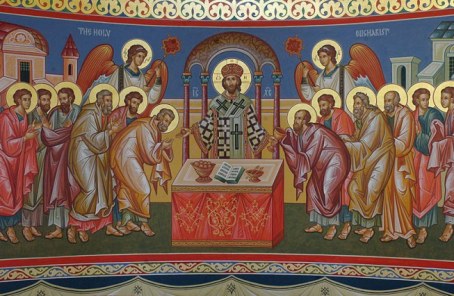

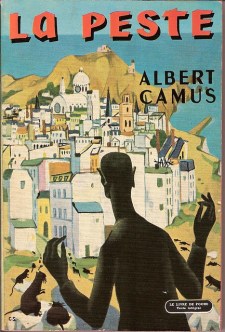 I ran into my dear homeschooling friend Debbie in the store and told her I was starting The Plague; she laughed her delightful laugh and said, “Oh, Gretchen, you are reading that right now??”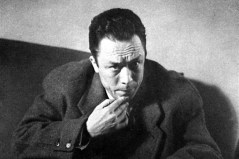
 Gladsome Lights