“A thread of sweet sound was spun into the night.” Rose and Richard Quin attend a party at which he charms the hostess in many ways, not least by playing his flute in the summer-house.
“Above us the sweet hollow voice rose and fell, doubled back on itself and glided forward, ubiquitous, tracing a pattern among the stars and another within us, behind our breast-bones,” and Rose finds herself thinking about the boy standing next to her, that if he wished she would marry him, though she had planned up to this point never to marry. “There was no need for an exceptional destiny.”
“My brother’s music was proclaiming that there would be a huge vacuum in the universe, a hole that would swallow all, if we did not fill it with something that the notes defined with a clarity forbidden to words.”
But then she begins to listen to Richard Quin, “with the special knowledge that came of being his sister, and I was astonished by the simplicity of the strangers. They were melting under the influence of a tenderness which they believed to be in his performance, but was not there. They were inventing it because they needed it. The music promised sweetness which was for himself alone. He ached with a desire to be in another place than this, where he would find that sweetness. If he felt concern whether they found this same delight for themselves, it left no trace in the sounds he made. And he felt no such concern; from this and that, over the years, I knew he did not.
“There was this excuse for his indifference, he had already discharged whatever debt he owed to them. He could speak of what they desired and they could not. Without him they would have been voiceless. With him their need pierced the night like the reply to the ray of a star.
“Yet surely that was not quite right, surely one never discharges one’s full debt to other people. But again that cannot be true, if the payment one makes is large enough. I could not work it out.”
-Rebecca West, This Real Night


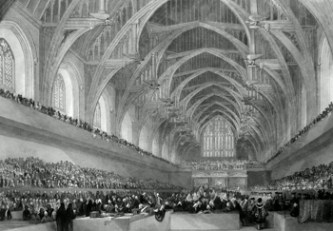 When in the novel The Fountain Overflows Rose Aubrey accompanies her father to the House of Commons to persuade a particular MP to help his current cause, we find out just how wily a politician he is. We also get a glimpse of the glory of the architecture:
 “It was like sitting in the midst of a tureen full of gravy soup. I was growing up at the end of an age which, partly by necessity and partly by choice, was very brown. In the towns chimneys poured out smoke from open fires and kitchen ranges, and light itself was permanently stained; and town-dwellers, who then so largely set the way of thinking, romanticized the obscurity to which they grew accustomed. Such sights as a narrow shaft of light struggling over a broad dark passage aroused none of the impatience we would feel today, but rather a sense that here was something as acceptable as a succession of major chords or a properly scanned line of verse.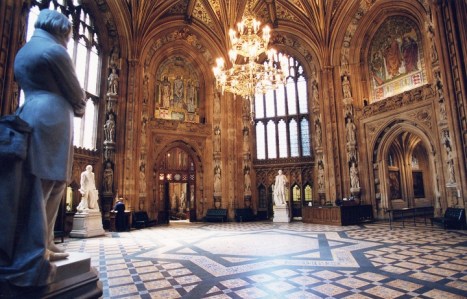
 Gladsome Lights