Category Archives: quotes

Let Evening Come

To me, this is the most famous of Jane Kenyon’s poems, my first acquaintance with her, which made me so happy, I immediately copied it by hand into a notebook. I think it was in a collection of writings lent to me by an acquaintance, Sabbath: Restoring the Sacred Rhythm of Rest, by Wayne Muller. In my notes I called this book a “syncretistic” gathering, but said that it still contained “lots of tidbits I wanted to record.”

In a review of a new book about poetry for those who “don’t see the point,” titled The Point of Poetry, by Joe Nutt, the reviewer Dr. Oliver Tearle says this about one use of poetry: “Many claim it has saved their life, or at least made them feel a little less low during dark times (Stephen Fry once picked Philip Larkin’s depressing poem ‘Aubade’ as one of the poems he turns to when feeling down, because simply seeing your own grim feelings expressed so deftly and movingly lifts the spirits by showing you what human beings can achieve with words).”

He well expresses one reason that I find some poems very nourishing. I’m surprised that I haven’t posted this favorite before; probably because one blogger or another over the years was sharing it already. But I found it again this evening in Poem a Day Volume 2, and I’ll just let my happiness spill over this time.

LET EVENING COME

Let the light of late afternoon
shine through chinks in the barn, moving
up the bales as the sun moves down.
Let the cricket take up chafing
as a woman takes up her needles
and her yarn. Let evening come.
Let dew collect on the hoe abandoned
in long grass. Let the stars appear
and the moon disclose her silver horn.
Let the fox go back to its sandy den.
Let the wind die down. Let the shed
go black inside. Let evening come.
To the bottle in the ditch, to the scoop
in the oats, to air in the lung
let evening come.
Let it come, as it will, and don’t
be afraid. God does not leave us

comfortless, so let evening come.

-Jane Kenyon

Love for an instant.

“It is true enough, of course, that a pungent happiness comes chiefly in certain passing moments; but it is not true that we should think of them as passing. . . To do this is to rationalize happiness, and therefore to destroy it. Happiness is a mystery like religion, and should never be rationalized. . .

“A man may have, for instance, a moment of ecstasy in first love, or a moment of victory in battle. . . The cause which the flag stands for may be foolish and fleeting; the love may be calf-love, and last a week. But the patriot thinks of the flag as eternal; the love thinks of his love as something that cannot end. These moments are filled with eternity; these moments are joyful because they do not seem momentary. . .  Man cannot love mortal things. He can only love immortal things for an instant.”

–G.K. Chesterton in Heretics (1905)

From G.K. Weekly

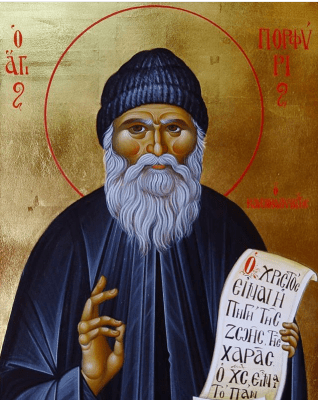
People will gather around us like bees.

Let us scatter our love selflessly to all, without regard to the way they act towards us. When the grace of God enters us, we will not be concerned about whether they love us or not or whether they speak to us politely or not. We will feel the need to love all people. It’s egotism on our part to wish for others to speak to us politely. If they don’t, we shouldn’t be upset. Let them speak to us as they wish. We needn’t become beggars for love.

Our aim should be to love them and pray for them with all our soul. Then we will become aware that all people love us without our seeking it and without our begging for their love. They will love us freely and sincerely from the depths of their heart without our blackmailing them. When we love without seeking to be loved, people will gather around us like bees. This is true for everyone.

—Elder Porphyrios, Wounded by Love

Lifting the eyes without horror.

In White Road, Olga Ilyin writes her memoirs of the years 1919-1923 in Russia. I am not very far into the book, but I want to share a short passage describing one Siberian winter morning as she was fleeing eastward with the White Army and some members of their families. Each night they would billet with sympathetic peasants, and move on the next day.

“It was one of those windless mornings…when the air is frozen to the crispness of glass and every sound engraves itself on the darkness with such precision that you can trace its outline with a pencil.

“I had just come on the porch of our cottage. I loved to be the first one to come outside with Bibik [her baby] to steal a moment of quiet before the noise and movement of departing troops, to gaze at the stars overhead, and listen to my footsteps on hard-packed snow fall into silence like notes of music.

“And yet, how could I? For these were the same stars I had watched with horrified eyes on the night when I fled from home; the same stars at which my father had looked from an open truck just a week later when a firing squad drove him to where he was shot. Never again, I had felt, could I lift my eyes without horror to this unyielding gulf between God and man, hammered in by myriads of frightful metallic nails. So, why should I come out to catch a moment to be alone with them? How was it possible that again the stars should reassure me of the wonder of life, telling me that nothing great could really be broken or vanquished? At least within us.”