Category Archives: quotes

As the soul, so the education…

Five years ago I posted this quote and comments as part of a blog-along about the author. Today as I read it I am half terrified at the tone of Chesterton’s statement, how he makes education sound like the most natural and effortless, even unstoppable thing. The health of the sub-cultures we nurture is more critical than ever, so that the “soul” of these little societies may continue to nurture us and to educate our grandchildren and great grandchildren.

Education is simply the soul of a society
as it passes from one generation to another.

–G.K. Chesterton

People who aren’t used to thinking in a Chestertonian way may think this statement extravagant, or overly poetic and ephemeral. I forgive them, because they likely are recipients of a societal soul that lacks perspective and understanding. It takes time and tradition to build a healthy society, and the modernists who taught many of us have lost the moorings of our Christian past. Many people don’t have a concept of passing something on to their children; they just want them to have a college degree so they can get a Good Job.

I have done most of my growing up in the little society of the family my husband and I created many decades ago, and the culture and nourishment has been good. The word soul didn’t come to mind as a descriptor of what we were trying to impart to our children, while we were trying to give them the best nurturing, the best culture for healthy growth, but now that I have for so long been focused on cultivating life in my children and my self, Chesterton’s way of describing it seems perfect.

Of course, it’s frighteningly full of possibilities. How would you characterize the soul of American society? Or the society of your extended family? Are you in a church that is unified and close-knit enough to constitute a society, and is it one that you can feel good about the next generation continuing? The process that GKC hints at brings to mind images of some ghost-like being floating over the globe, and I wonder how much control I can have over that?

At any rate, this thought makes me gladder than ever that my husband and I were able to homeschool our children for many years, and pass on to them thousands of small bites of hearty soul food. We can’t even know for sure which were superfoods and which were maybe just as nourishing, but harder to digest, seeing how God redeems and uses even our failures. But we cooked up the recipe ourselves, in our home kitchen, so to speak, and after all this time, it is still tasting very good.

 

Like tintacks clustering.

From G.K. Chesterton:

“It is a very remarkable thing that none of us are really Copernicans in our actual outlook upon things. We are convinced intellectually that we inhabit a small provincial planet, but we do not feel in the least suburban. Men of science have quarreled with the Bible because it is not based upon the true astronomical system, but it is certainly open to the orthodox to say that if it had been it would never have convinced anybody.

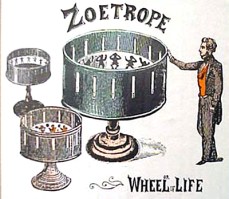
“If a single poem or a single story were really transfused with the Copernican idea, the thing would be a nightmare. Can we think of a solemn scene of mountain stillness in which some prophet is standing in a trance, and then realize that the whole scene is whizzing round like a zoetrope at the rate of nineteen miles a second? Could we tolerate the notion of a mighty King delivering a sublime fiat and then remember that for all practical purposes he is hanging head downwards in space? A strange fable might be written of a man who was blessed or cursed with the Copernican eye, and saw all men on the earth like tintacks clustering round a magnet. It would be singular to imagine how very different the speech of an aggressive egoist, announcing the independence and divinity of man, would sound if he were seen hanging on to the planet by his boot soles.”


— The Defendant (1901)

In us the dead still belong.

Today, about a week before our Orthodox beginning of Lent, is Saturday of Souls, or Memorial Saturday. In Divine Liturgy we commemorate all those who have “fallen asleep in the hope of the resurrection and life eternal.” Father Alexander Schmemann writes in Great Lent:

“To understand the meaning of this connection between Lent and the prayer for the dead, one must remember that Christianity is the religion of love. Christ left with his disciples not a doctrine of individual salvation but a new commandment ‘that they love one another,’ and he added: ‘By this shall all men know that you are my disciples, if you love one another.’ Love is thus the foundation, the very life of the Church which is, in the words of St. Ignatius of Antioch, the ‘unity of faith and love.'”

I was able to attend Liturgy this morning, and many things contributed to my great joy in participating. Saturday morning is not an “easy” day to make it to church, and I probably could count on one hand the number of these memorial Saturdays that I have attended over the years. They are celebrated often during Lent, and other dates on the church calendar.

Today many of us had offered our contributions to the list of names of the departed that were read aloud as we all prayed. My dear godmother was present with me this morning, which made me feel more complete 🙂 and it happened to be the exact date that my uncle was killed in a plane crash long before I was born — the uncle I wrote about once here.

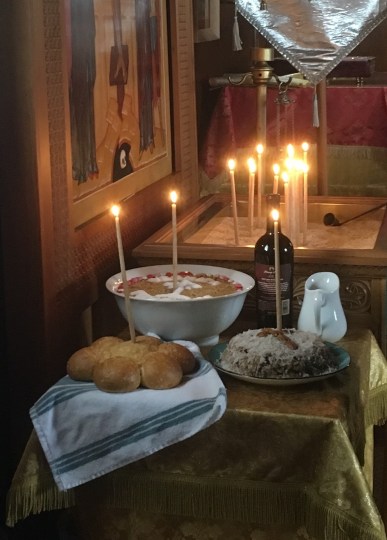
Today we were also praying especially for two men who more recently fell asleep in Christ, one just 40 days previous. George and Nikolai, memory eternal! Romanian women brought koliva, one made of barley instead of wheat, and other commemorative foods.

Just to stand in church, to stand in Christ, to stand with my departed loved ones — it was awfully sweet. Because of this reality that Metropolitan Anthony speaks of in Courage to Pray:

“The life of each one of us does not end at death on this earth and birth into heaven. We place a seal on everyone we meet. This responsibility continues after death, and the living are related to the dead for whom they pray. In the dead we no longer belong completely to the world; in us the dead still belong to history. Prayer for the dead is vital; it expresses the totality of our common life.”

Things that have no true existence.

St. John the Forerunner

“The sweet work of repentance
that is set before us as followers of Christ,
is nothing other than the return to reality.”

“How we feel about many things has this same make-believe quality. We find certain styles of clothing and certain products (cars, houses, etc.) attractive and desirable, but often with little more than subjective reasons for our desires. The power of this make-believe is so great that it is well-known that many people “go shopping” to battle depression. It is a strange therapy.”

Read the rest of the article by Father Stephen Freeman here: “The Unreal Land” — about the real cause of so much of our grief and misery in everyday life, “a ceaseless struggle with things that have no true existence.”

When I look around his blog I always find plenty to provoke my thoughts in a good direction. His book Everywhere Present puts a lot of this food for the soul together in one nourishing bowl.

(re-post from 2011)