Category Archives: Robert Farrar Capon

Baklava is various – here is one recipe.

Ten years ago, when I was reading The Supper of the Lamb by Robert Farrar Capon, and writing multiple blog posts about that delicious book, I promised to share here the recipe for baklava that our parish uses. The idea came to me when reading Capon’s words on butter and pastry, and I warned my readers not to use his recipe for baklava. Since then I’ve learned more about the many and various ways that people prepare that confection in different cultures, and am no longer closed-minded about it at all. If you have a different recipe you like, I hope you will share it in the comments.
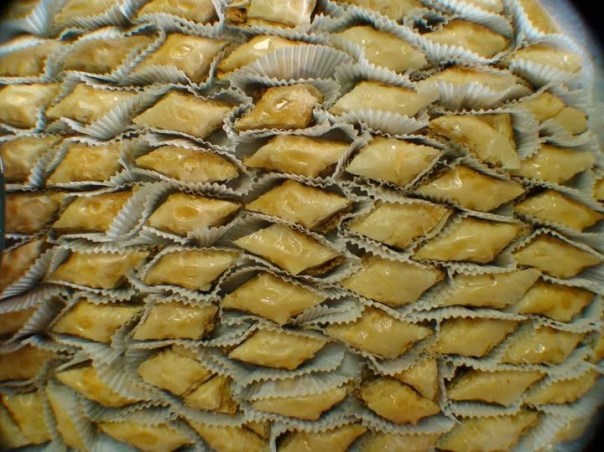
Though I love honey, I prefer baklava without it, because in the examples I have eaten, the honey overpowers the flavors of nuts and butter, and makes a heavy piece of dessert — honey is in fact a heavy and dense food. This version that we learned to make from a long-time member of the parish is somehow “lighter” in flavor, while losing none of the richness that is essential.

BAKLAVA

About 30 pieces

SYRUP:

3/4 cup water
1 1/2 cups sugar
1 tablespoon fresh lemon juice

FILLING:

1 pound walnuts
1/2 cup sugar

PASTRY:

1 pound filo dough, thawed
1 pound unsalted butter, clarified (instructions below).

1. Preheat oven to 350°.

2. Prepare the syrup: Combine water and sugar; bring to a boil and cook over moderately high heat, stirring, until thickened. Stir in lemon juice, cook 3 more minutes and set aside to cool.

2. Grind nuts in a food processor. Transfer to a bowl, add sugar and mix thoroughly.

3. Spread half the filo dough flat on a buttered 9” X 13” jellyroll pan. Cut and piece as necessary. Spread nut-and-sugar mix evenly over dough; then lay the remaining dough over the top.

4. Cut pastry, either into 2” squares, or for traditional diamond-shaped pieces, make lengthwise cuts 1 1/2” apart, and cuts at a 45 degree angle 1 1/2” apart. This will yield diamonds about 4 1/2” long, with sides about 2 1/2” long.

5. Pour 1 cup of the melted butter evenly over the top. Place the pan in the oven and reduce heat to 300°. Bake for 40 minutes, turning the pan after 20 minutes for even browning. Repeat, using remaining butter and baking again for 20 minutes, turning after 10 minutes.

7. Remove pan from oven and immediately pour cooled syrup over the hot pastry. Let stand and cool approximately 24 hours.

Clarified Butter

Melt butter in a heavy saucepan over low heat. After it has melted, some of the milk solids will drop to the bottom of the pan while others will rise as foam. Skim off the foam and pour the clarified butter out of the pan, leaving the milk solids at the bottom, or strain it through a double layer of cheesecloth.

If you are interested in what the book The Supper of the Lamb is about, you can find all the posts in which I wrote anything about it here: Robert Farrar Capon.

(Father) Robert Farrar Capon

RFC makes one of nature’s marvels.

In the chapter titled “Living Water” in The Supper of the Lamb, in which we learn how to make Brown Stock and White Stock, Robert Farrar Capon continues, “…you are now ready for the really astonishing part of the exercise.” It’s the lead-in to another of the recipes that are scattered throughout the first two-thirds of The Supper of the Lamb, with more of them concentrated in the recipe section at the back.

Many of the recipes seem a little outdated now, but I doubt I’d have taken to the foods featured in Supper even in 1969 when it was first published, because I was just learning to live on my own and to eat rice and vegetables. Our ferial eating in those days was sparser of meat and wine than RFC could have imagined, and Diet for a Small Planet was the go-to cookbook. It would be another ten or fifteen years before I bought my first leg of lamb.

Nowadays I am well supplied with recipes for most everything I could possibly want to cook, but Capon’s next suggestion sounds so strange and appealing that I think I will have to try it eventually. If I had to choose between meat and butter, two foods at the top of my list of culinary loves, I guess I’m just sensible enough to choose meat, and when RFC tells me I can capture its “heart and soul” in my kitchen, I can’t resist his encouragement to create something of which he also claims, “…you will find yourself whittling off little pieces to dissolve on your tongue at odd times of the day.”

I’ll just give you the whole recipe here, because though we no doubt can find a version online, I naturally like the style of this one. It will be my last “meaty” post on this book, because in my church we are beginning our Lenten fast from meat very soon, and it’s time for me to turn the page.

HOMEMADE MEAT GLAZE
(Meat Extract)

Take the strainerful of bones and scraps [from which you have made the stock] and put them back into the stockpot. Add any scraps of meat you have around: poultry, pork, veal — even leftover hamburger — just stay away from lamb and ham. Meat extract can, of course, be made from the used bones alone, but anything that brings more natural gelatin to the pot is welcome. Cover everything deeply with cold water, adding no salt at all, and boil for two or three hours more.

That done, strain once again, this time into a large saucepan. Discard the bones. (They have been worked to death. Even the dog will look down his nose at them now.)

Boil the contents of the pan hard, skimming the froth from the top now and then, until the liquid is drastically reduced. When it is down to about a pint, transfer it to a smaller pan and boil on, over slightly reduced heat. Continue boiling until it reaches the consistency of a thick, blackish-brown syrup (half a cup, give or take a little). Pour this into a heatproof jar, cool, and refrigerate.

You now have, perhaps for the first time in your life, real meat extract — one of nature’s marvels. It is, of course, highly concentrated gelatin, but it has been imbued with the heart and soul of meat. Its taste is beautiful. Moreover, in spite of the fact that no speck of salt went into all those quarts of water the second time around, it is salted to perfection. Its consistency is, admittedly, a little forbidding; It is not unlike a young and tender shoe heel. Refrigerated, it will keep in this state for weeks; but, obligingly enough, it melts at the temperature of the mouth. If you are any lover of food at all, you will find yourself whittling off little pieces to dissolve on your tongue at odd times of the day.

Use it ad lib. Its general effect is to give a sauce soul and substance without overpowering the proper flavor of the dish. Experiment. It improves almost anything. A tablespoonful melted in warm Hollandaise imparts a certain roundness and resonance to what is sometimes an excessively light and lemony sauce. A piece dropped on top of a hot fried egg (plus a dash of Tabasco, if you are up to it) is delightful. And in the form of Colbert Butter, it is the perfect accompaniment to steaks, chops, fish, or poultry — not to mention a piece of matzoh at three in the afternoon.