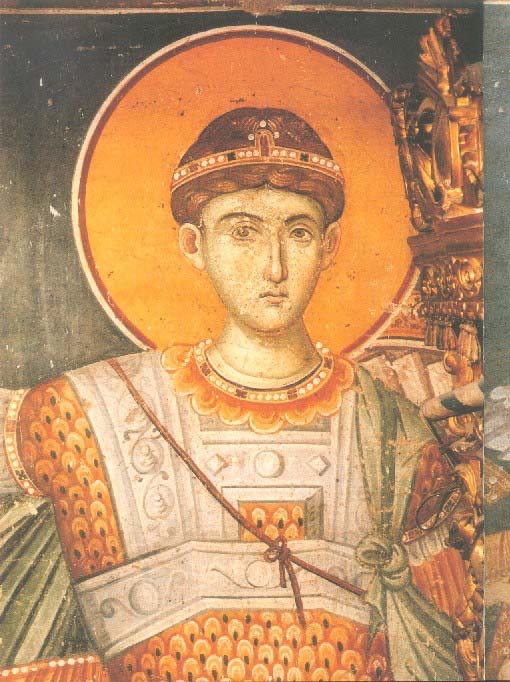
Holy, Glorious Demetrios the Myrrh-gusher of Thessaloniki
Holy, Glorious Demetrios the Myrrh-gusher of Thessaloniki
Psalm 58:8
Thou tellest my wanderings:
put thou my tears into thy bottle:
are they not in thy book?
The more one researches current events, historical accounts, and the tangled web of cultures 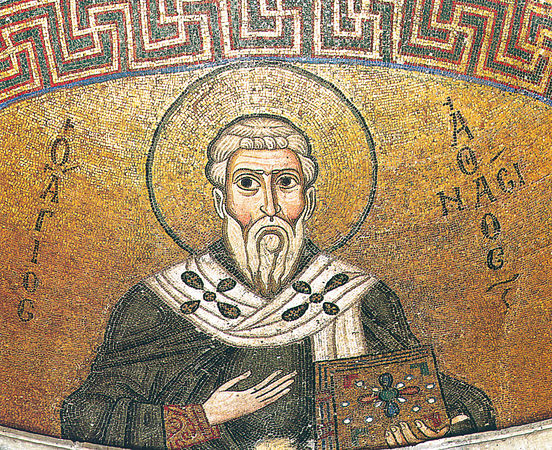 and civilizations going back to the foundation of the world, the more likely is a fall into worry and even despair. We fear especially for children who have to grow up in a violent era, as many have done. That’s why I take courage from the life of St. Athanasius, and pray that my children, grandchildren, godchildren, and all of us, might learn deep in our souls what he knew. The following is an excerpt from a post I wrote several years ago in a time of sorrow. I have shared the quote from his treatise more recently than that, but I hope you might agree with me that it’s worth rereading:

I learned in the short account of the life of Athanasius at the beginning of his On the Incarnation, that the last and worst persecution of Christians ended in Egypt in 311 A.D., when Athanasius was about fourteen. From the age of five he had lived with the constant threat of death, and with the ever-present reality of persecution of his friends and family. The behavior of the ungodly is irrational and inhuman, and tends to cause great pain and suffering, often unto death, not only of the innocent but also of the most Christ-like. As an adult the scenes and events of his childhood seem to be fresh in his mind when he writes:
“A very strong proof of this destruction of death and its conquest by the cross is supplied by the present fact, namely this. All the disciples of Christ despise death; they take the offensive against it and instead of fearing it, by the sign of the cross and by faith in Christ trample on it as on something dead. Before the divine sojourn of the Saviour, even the holiest of men were afraid of death, and mourned the dead as those who perish. But now that the Saviour has raised his body, death is no longer terrible, but all those who believe in Christ tread it underfoot as nothing, knowing full well that when they die they do not perish, but live indeed, and become incorruptible through the resurrection. But that devil who of old wickedly exulted in death, now that the pains of death are loosed, he alone it is who remains truly dead.”
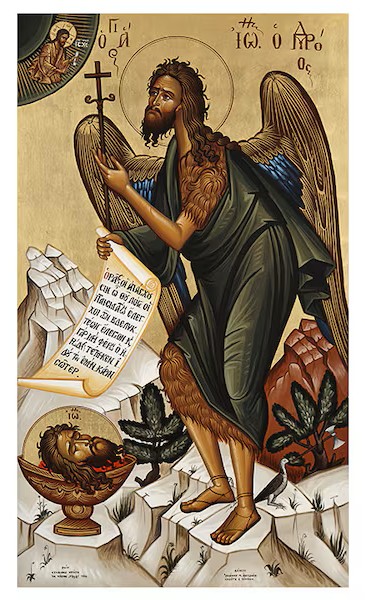
The glorious beheading of the Forerunner,
became an act of divine dispensation,
for he preached to those in hell the coming of the Savior.
Let Herodias lament, for she entreated lawless murder,
loving not the law of God, nor eternal life,
but that which is false and temporal.
-Hymn for the Feast, of The Beheading of the Glorious Prophet, Forerunner and Baptist John.

St. Poimen (or Pimen, or Poemen) the Great was born in Egypt in about 340. He and his two brothers joined themselves to a monastery in Scetis. After raids on Scetis caused the monastics to disperse, they began to assemble the Sayings of the Desert Fathers (the Apophthegmata Patrum), in which St. Poimen is the abba or poemen (“shepherd”) most often quoted.
“For many of the monks, Saint Pimen was a spiritual guide and instructor. They wrote down his answers to serve for the edification of others besides themselves. A certain monk asked, ‘If I see my brother sinning, should I conceal his fault?’ The Elder answered, ‘If we reproach the sins of brothers, then God will reproach our sins. If you see a brother sinning, do not believe your eyes. Know that your own sin is like a beam of wood, but the sin of your brother is like a splinter (Mt. 7:3-5), and then you will not enter into distress or temptation.'”
“Once, a monk from another country came to the saint to receive his guidance. He began to speak about sublime matters difficult to grasp. The saint turned away from him and was silent. They explained to the bewildered monk that the saint did not like to speak of lofty matters. Then the monk began to ask him about the struggle with passions of soul. The saint turned to him with a joyful face, ‘Now you have spoken well, and I will answer.’ For a long while he provided instruction on how one ought to struggle with the passions and conquer them.
“Saint Pimen died at age 110, about the year 450. Soon after his death, he was acknowledged as a saint pleasing to God. He was called ‘the Great’ as a sign of his great humility, uprightness, ascetic struggles, and self-denying service to God.” oca


