Category Archives: saints

How to become fresh and youthful.

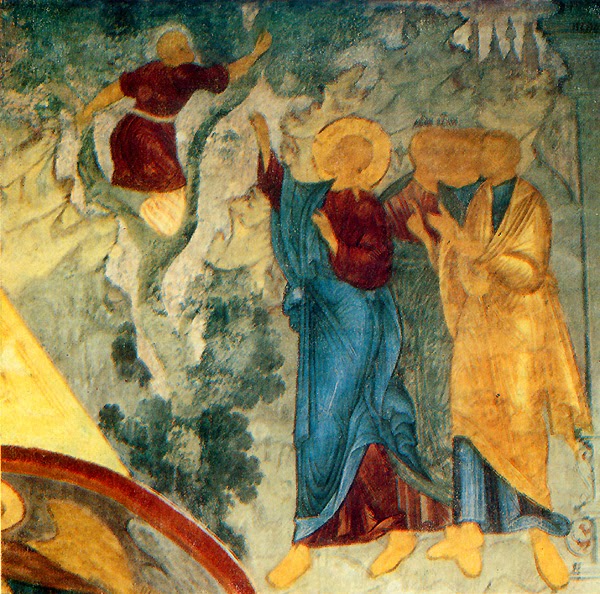
“The Paschal season of the Church is preceded by the season of Great Lent, which is also preceded by its own liturgical preparation. The first sign of the approach of Great Lent comes five Sundays before its beginning. On this Sunday the Gospel reading is about Zacchaeus the tax-collector. It tells how Christ brought salvation to the sinful man, and how his life was changed simply because he “sought to see who Jesus was” (Luke 19:3). The desire and effort to see Jesus begins the entire movement through Lent towards Pascha. It is the first movement of salvation.”

This excerpt from our church bulletin explains why this date on the church calendar is a good one for someone to become a catechumen, as two people did on Sunday in my parish, and as I did seven years ago. It was not my first introduction to life in Christ, but it was definitely the time when I climbed up to the best vantage point to see Christ and His Church in all its fullness.

When I was a little child in Sunday School I learned some details of the story by way of a song:

“Zacchaeus was a wee little man, a wee little man was he.
He climbed up in a sycamore tree for the Lord he wanted to see.
And when the Savior passed that way He looked up in the tree;
And He said, ‘Zacchaeus, you come down, for I’m going to your house today.'”

In his Gospel homily Sunday our rector pointed out that the Lord also said, “Make haste.” In other words, “Get down here, man! Don’t be dilly-dallying about, but begin right now to mean business with God.” And this week St. Nikolai explains how this man and his experience are meaningful to each of us:

“Today, salvation has come to this house.”
(St. Luke 19:9).

“Thus it was spoken by the One Whose word is life and joy and restoration of the righteous. Just as the bleak forest clothes itself into greenery and flowers from the breath of spring, so does every man, regardless of how arid and darkened by sin, become fresh and youthful from the nearness of Christ. For the nearness of Christ is as the nearness of some life-giving and fragrant balsam which restores health, increases life, give fragrance to the soul, to the thoughts and to the words of man. In other words, distance from Christ means decay and death and His nearness means salvation and life.”
….
“Draw near to us O Lord, draw near and bring to us Your eternal salvation.”
What dust can do.

St. Paul

Father Stephen writes about how we don’t often follow the Apostle Paul’s example of glorying in our weakness. The title of his blog post is “Your Weakness Saves You.” We need to pray out of our weakness and not when we are feeling strong; but Fr. Stephen observes that many of us would prefer to glory in our strength:

At some level, we believe that we are not saved through our weakness, but will be saved through our strength, and that the whole life of grace is God’s effort to make us stronger – never suspecting that God’s grace may actually be purposefully developing our weaknesses.
….
I often tell people who say they are struggling with prayer to quit trying to pray like a Pharisee and learn to pray like a Publican. We often want to pray from strength – to approach God when we at least feel spiritually alive. The Publican refuses to lift his eyes to heaven. The contradiction of his life and the goodness of God are more than he can bear. And yet he prays. And, ironically, it is he who goes down to his house justified rather than the Pharisee.

I find that the Orthodox prayer book cultivates this awareness of my weakness with its many cries of “Lord, have mercy.” Sometimes I am engaged in some activity that doesn’t allow me to give my full attention to prayer, but I am still burdened over a difficult situation or the need of a friend. I can express my helplessness to do anything by human strength, my inability to even think about what a solution might be, by praying “Lord, have mercy,” as many times as necessary to reach a place of quietness of heart.

As Psalm 103 reminds us weekly, “He remembers that we are dust.” When I pray that, I feel the love and tenderness of the Lord. He knows our weakness, and when we know it too, and pray with that understanding, we are near to Him.

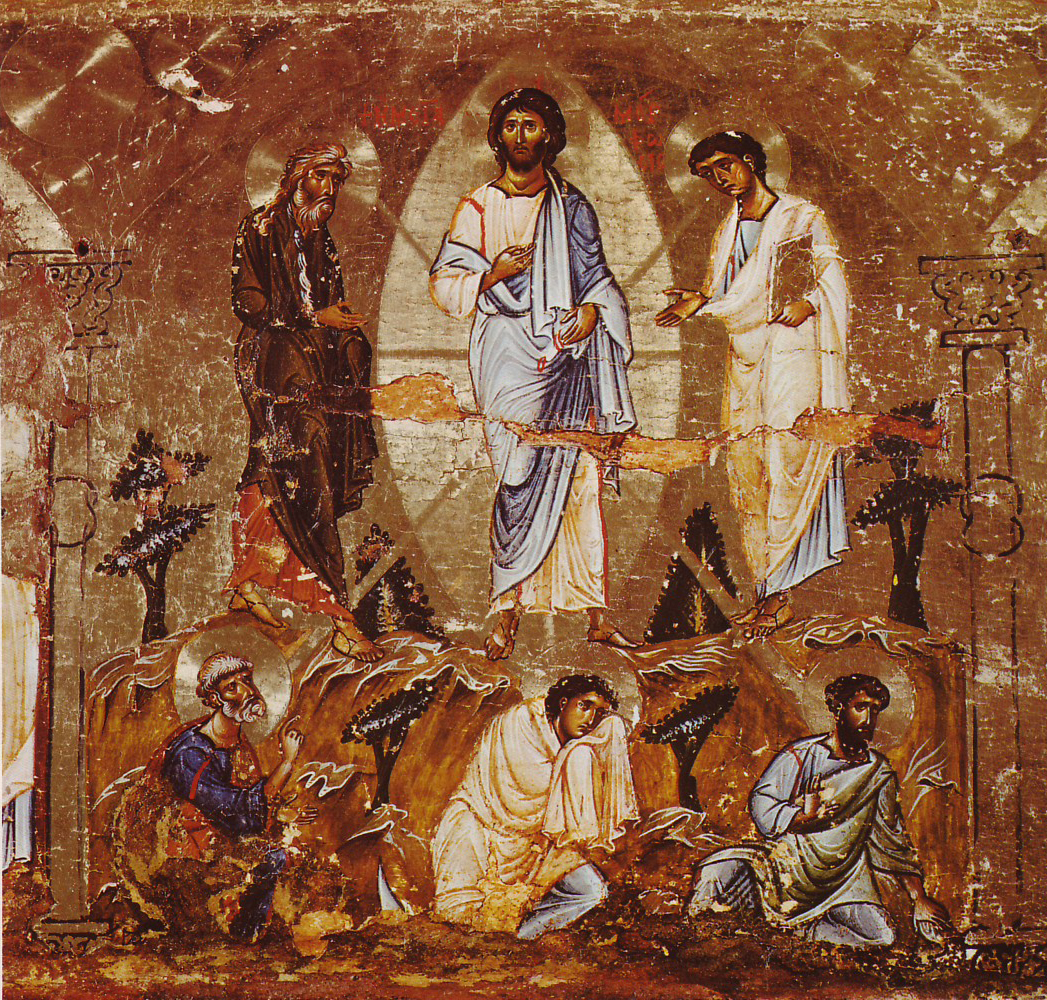
He is the Radiance of the Father.

Icon of the Transfiguration, Sinai, 12th century

It’s been four years since I first posted these thoughts on the Feast of the Transfiguration, and I’m finding them worth considering afresh. May He Who is the Radiance of the Father shine on and in us.

Light and Love

This quote was brought to my attention today, on the eve of the Feast of the Transfiguration.
St. Macarius of Optina:
None of your suffering has come by chance. Nothing can happen to us without our Lord’s consent; and His consent is not only wise but always dictated by His love of us. Carefully examine your conscience and your life, and I am sure you will understand what I mean. Sorrow weighs you down? Never mind. The grateful heart, humble and wise – the heart which has become grateful, humble, and wise – will be greatly consoled and blessed with serene joy.

As I was looking for an icon of this feast, I ran across a phrase “transfiguration of suffering,” and I realized that–of course–these thoughts are connected. As I have heard regarding Orthodox theology from the beginning, it’s difficult to put it into a systematic theology, because “everything is connected to everything else.” God won’t be boxed into our human and finite categories.

Just as Christ was revealed in all his glory, as much as the disciples could bear, that is, so every Christian has the potential to shine with the light of the Holy Spirit. Suffering can be used as a tool to accomplish this, as we see in the lives of many of God’s people. One person who comes to mind is Father Arseny, whose life of suffering in the last century one can read in two books of firsthand accounts. Reading about him, I caught a vision of what it might mean to be truly a Christian, a “little Christ.” There is a short review of the books about him here.

I have little suffering to bear, but if I do accept it with thanksgiving and patience, it might make me more able to show forth His light and love. This is a good thing to keep in mind and heart for the Feast.

St. Panteleimon

St. Panteleimon had studied medicine, but it was by the miraculous powers of Christ that he healed many people whom the doctors had not been able to help. He was martyred in 304 after the jealous doctors denounced him as a Christian.

We remembered him with hymns in church today, the same morning that the gospel passage recounted Christ’s healing of the Gadarene maniacs. In both cases the earthly powers did not rejoice that the sick had been made whole, or that God was present and active in their midst. Their spiritual eyes were so clouded over that they completely missed the blessing. Lord, have mercy!

I love this painting of St. Panteleimon that Leah posted last week.


St Panteleimon the Healer by Nikolay Roerich