Category Archives: saints

St. Nicholas most simply put

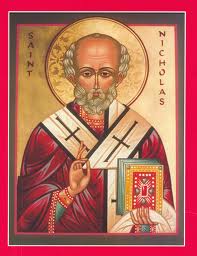
The feast of St. Nicholas begins with a vigil service this evening and continues with liturgy in the morning. Happy Feast Day! I read the following in The Winter Pascha by Thomas Hopko:

The extraordinary thing about the image of St. Nicholas in the Church is that he is not known for anything extraordinary. He was not a theologian and never wrote a word, yet he is famous in the memory of believers as a zealot for orthodoxy, allegedly accosting the heretic Arius at the first ecumenical council in Nicaea for denying the divinity of God’s son. He was not an ascetic and did no outstanding feats of fasting and vigils, yet he is praised for his possession of the “fruit of the Holy Spirit…love, joy, peace, patience, kindness, goodness, faithfulness, gentleness, self-control” (Gal. 5:22-23). He was not a mystic in our present meaning of the term but he lived daily with the Lord and was godly in all his words and deeds. He was not a prophet in the technical sense, yet he proclaimed the Word of God, exposed the sins of the wicked, defended the rights of the oppressed and afflicted, and battled against every form of injustice with supernatural compassion and mercy. In a word, he was a good pastor, father, and bishop to his flock, known especially for his love and care for the poor. Most simply put, he was a divinely good person.

St. Andrew and His Cross

Where we sang this morning

Happy St. Andrew’s Day! I had the honor and joy of celebrating the feast in church this morning. Added to the usual liturgy and communion were prayers and song lifting up one of our dear elderly parishioners who died in the Lord early today. Now the memory of his repose will always be tied to this feast.

Andrew was the first of Jesus’s disciples, and centuries ago became the patron saint of Scotland and other countries. I wore my tartan plaid skirt as I always do on November 30th, and this year I had a new purple Celtic scarf to wear, recently brought from Scotland by Pearl.

Some of you might remember that I wrote about this years ago; I’m sorry to say that while trying to repost those thoughts this morning I deleted them instead. Ah, well, it turns out to be a blessing, because the accident caused me to find that just today John Sanidopoulos has written a thorough history of how it happened that the Scots chose this saint for their patron, and his cross for their official national flag.


This form of cross is called a saltire and is linked to St. Andrew because he was crucified on a diagonal cross in the first century. I learned that the first use of the X-shaped symbol was on medieval soldiers’ clothing, probably a white image on a black background. And today there are many Scottish nationalistic garments and items that hearken back to this design, like this belt buckle.


It was only in the last decade that Scotland made St. Andrew’s Day an official bank holiday. The nation also has another flag you might be more familiar with, the Lion Rampant, the unofficial national flag that belongs to the kings and queens of Scottish history. And there is the Union Flag of the entire U.K. Time was, Scotland could not legally fly its official satire on its national holiday of St. Andrew, but that sorry situation has been rectified of late.

These national days and flags have been part of the cultural consciousness since the 14th century, a consciousness that naturally changes from generation to generation. The original and deeper meanings of this cross are probably lost in the background fog of the mind of the nation.  It is encouraging to think that even if they have largely forgotten him and their Christian heritage, St. Andrew continues to pray for the people of Scotland.

The Glory of Thy People Israel

This morning I’m putting up my post of two years ago today, 
essentially unchanged but maybe slightly improved. 
A blessed feast to all!
 

My Favorite Neglected Feast

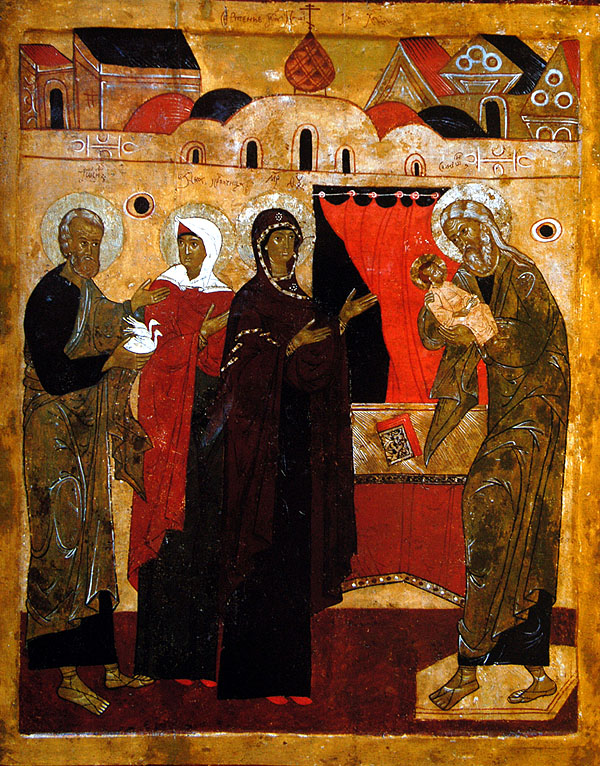
Today is one of the Twelve Great Feasts of the Orthodox calendar, The Presentation of Christ in the Temple; therefore I think it excusable if I postpone tackling many pressing mundane tasks and meditate a little longer on one of my favorite celebrations.

As long as I can remember, the story of Christ being presented in the temple as an infant has brought tears to my eyes, because of the constancy and joy of Simeon, a “just and devout man” who had throughout a long life been waiting and praying for the Messiah. His words express a single-minded heart — his purpose in faithfully waiting had been fulfilled. What a sweet reward, to be the one to receive and hold the Christ!

When Jesus was brought to the temple at 40 days old, according to the law, Simeon (Luke Chapter 2) “… took he him up in his arms, and blessed God, and said, ‘Lord, now lettest Thou thy servant depart in peace, according to Thy word: For mine eyes have seen Thy salvation, which Thou hast prepared before the face of all peoples, a light to enlighten the Gentiles, and the glory of Thy people Israel.’ ”

Thanks to Deb, I found this series of very informative postings that Matt wrote, linking all the events of this day through history, including Groundhog Day, which I will now always remember, in the background. (I did love that movie, whose lesson of humility is applicable throughout the secular or church year.) It is a neglected feast, our priest noted this morning, though our numbers weren’t too small this morning for Divine Liturgy.

The festivities spill over to February 3rd when we give a whole day to commemorating Simeon and the Prophetess Anna. It’s been a happy thing to find that Orthodoxy takes plenty of time for rejoicing in an event that has long been a resting place to me along the path that we call our salvation history.

Candlemas is another name for the holy day, and the church East and West has traditionally blessed candles on this day. I love candles as much as anyone, and I left the church with a handful to burn at home and in that way to stretch out the joy for a good while, brightening and lightening up these winter days.

Saint Seraphim of Sarov

January 2nd is the feast of St. Seraphim of Sarov, the patron saint of my parish. It is the day he reposed (died) in the Lord in 1833. It’s lovely how our celebration of his bright life comes right in the middle between Nativity and Theophany festivities, and in the dead of winter. Some pictures of Father Seraphim show him in a snowy forest, and many sayings of and about him talk about the warmth of prayer and of the Holy Spirit.

Here in the Northern Hemisphere we need all the heat we can get right about now. Most of us have been extra elated and/or exhausted by our holidays, leaving us vulnerable to emotional ups and downs. I know that in the last couple of years, the doldrums of January got a hold on me, but this year I intend to fortify myself and resist the downward pull by various means. When the earth is dark and cold it’s clear how earthly, not heavenly, is my own self. But the Light of the World has come, and with some effort I hope to rest more constantly in the sphere of His brilliance.

I’ve been hunting around the Internet for more quotes from St. Seraphim to add to my treasures, and found on this blog a list of “Ten Counsels of St. Seraphim,” of which the quotes on Despondency seem to the point:

Just as the Lord cares for our salvation, so the devil, the killer of men, strives to lead man to despondency.

When despondency seizes us, let us not give in to it. Rather, fortified and protected by the light of faith, let us with great courage say to the spirit of evil: “What are you to us, you who are cut off from God, a fugitive from Heaven, and a slave of evil? You dare not do anything to us: Christ, the Son of God, has dominion over us and over all. Leave us, you thing of bane. We are made steadfast by the uprightness of His Cross. Serpent, we trample on your head.”

Father Seraphim spent many years alone in the forest, learning to pray and acquiring the Holy Spirit, after which he returned to the monastery where he spent many more years counseling and healing the crowds who lined up to see him every day. He “gave them the Lord” as I’ve heard people put it.
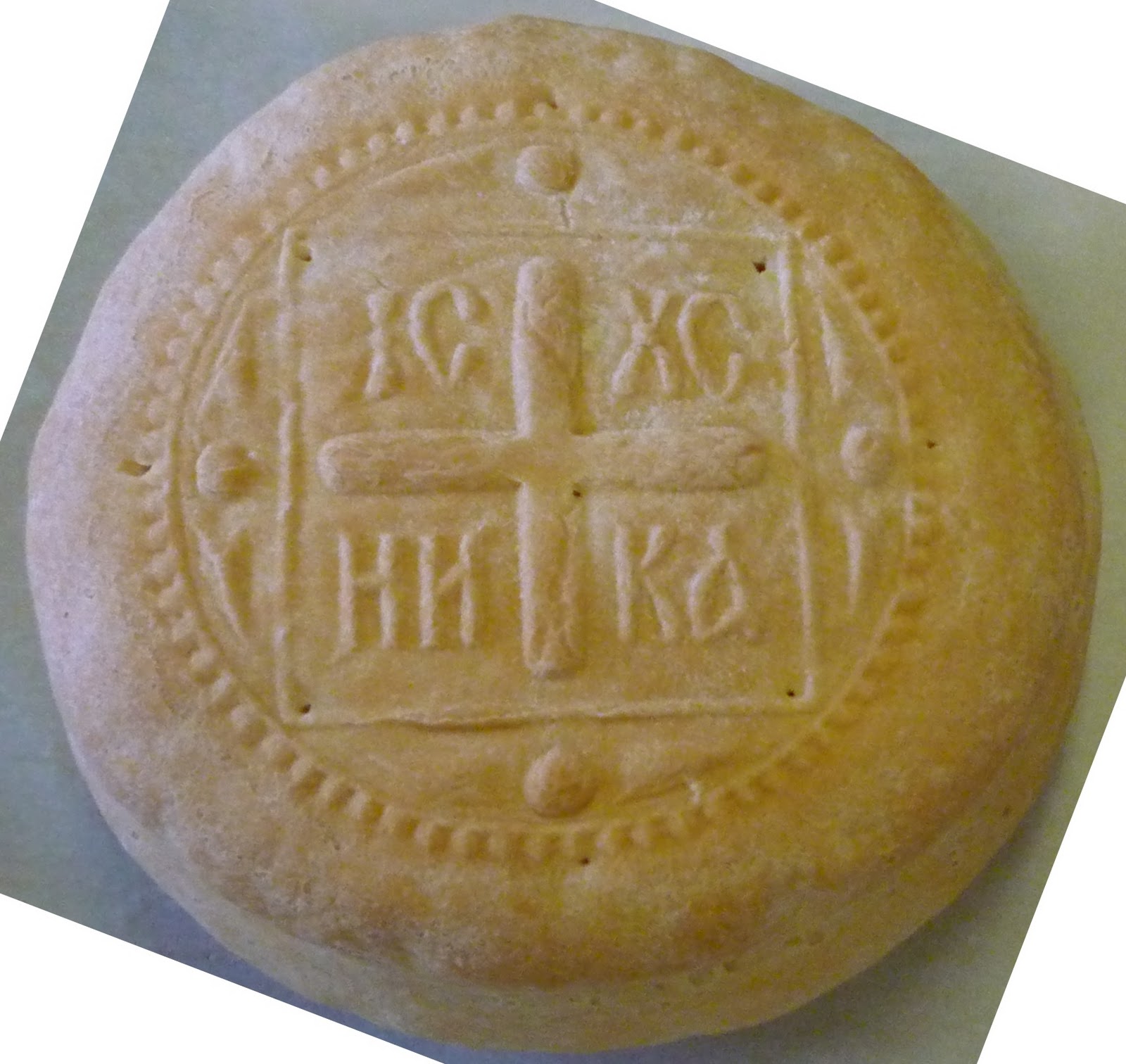
Communion bread

One meeting and conversation that Father Seraphim had with his friend N.A. Motovilov tells us quite a bit about him and is quoted at length here. Father Seraphim talked much about our need to “acquire the Holy Spirit Who acts within us and establishes in us the Kingdom of God.”

That is certainly what I need. Even now, after much excitement and little sleep just in the last few days, I feel that earthy heaviness mocking my faith. But with God’s help, and by the prayers of Saint Seraphim and all the saints, I hope to get the blood moving in my lazy soul, trample more often on that ugly head, and keep putting one foot in front of the other until I reach Springtime.