Category Archives: saints

St. Paul preached here.

The Apostle Paul visited Thessaloniki on his second missionary journey, when it was called Thessalonica. He stayed in the city teaching in the synagogue and encouraging the Christians for at least three Saturdays/Sabbaths.

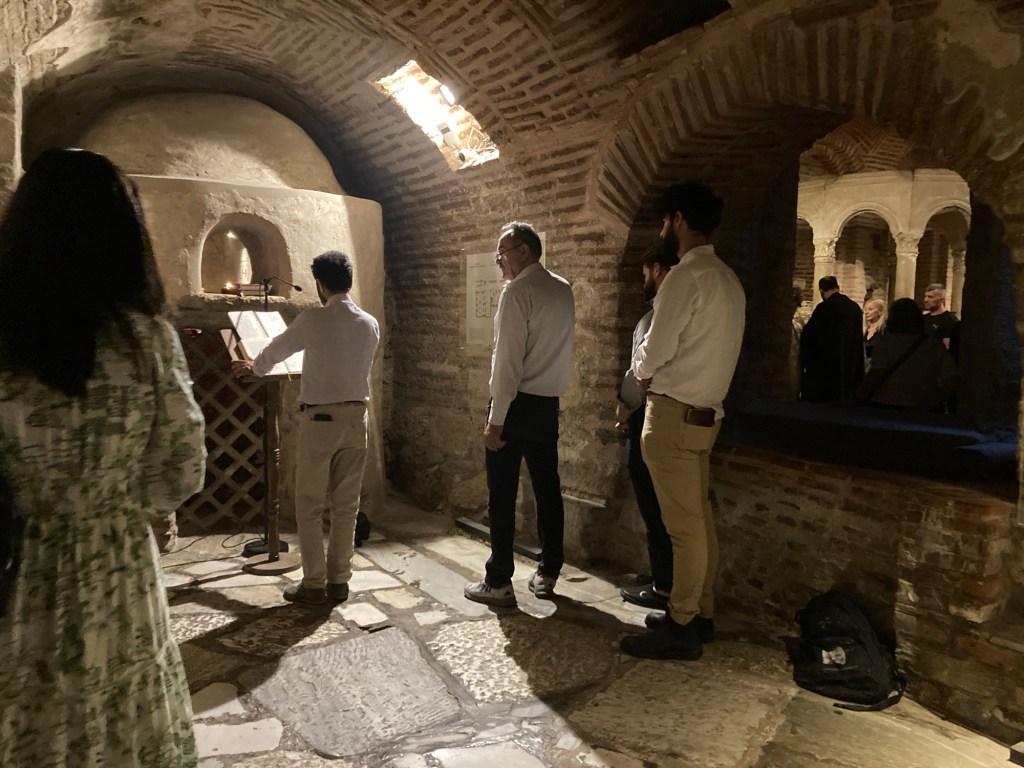
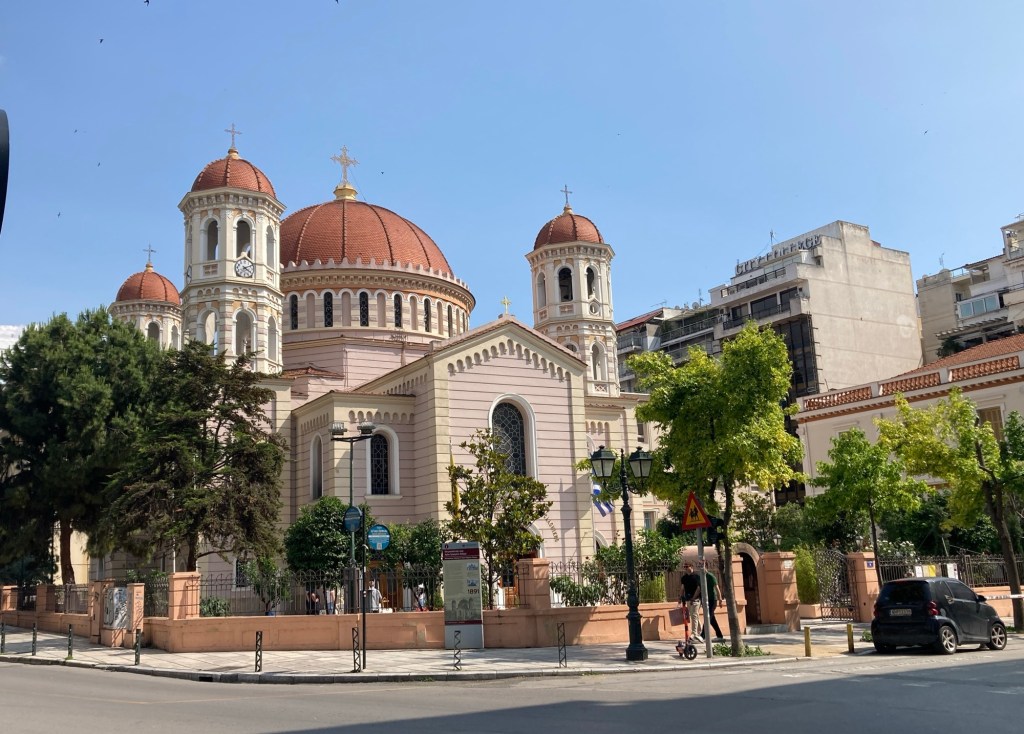
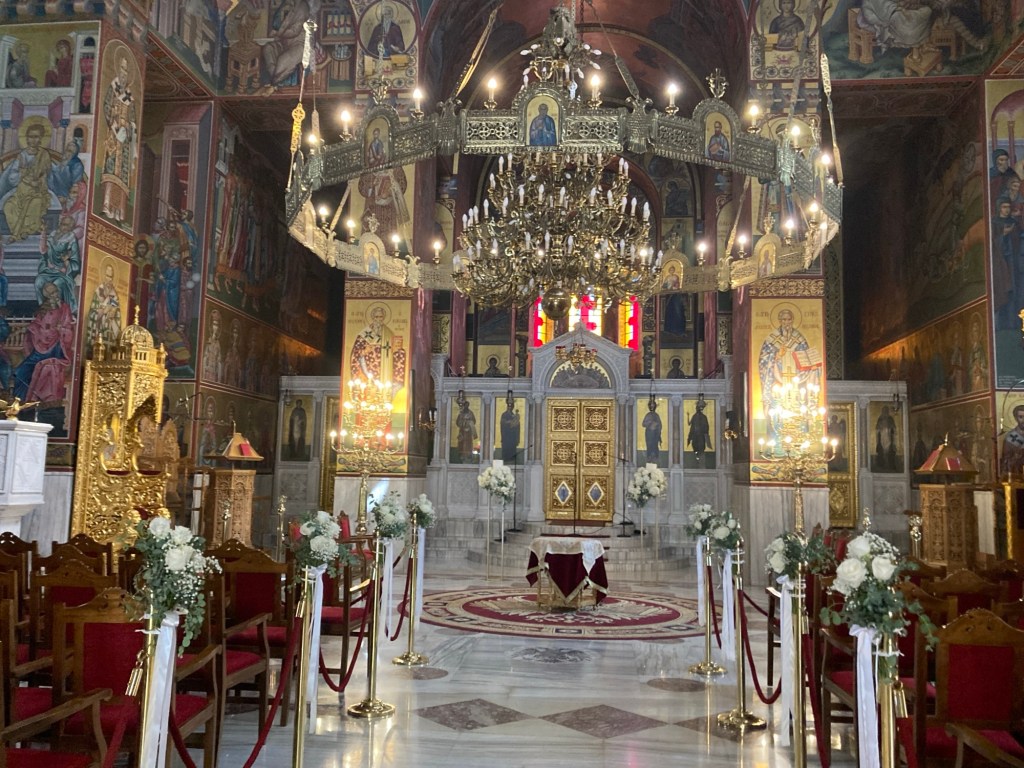
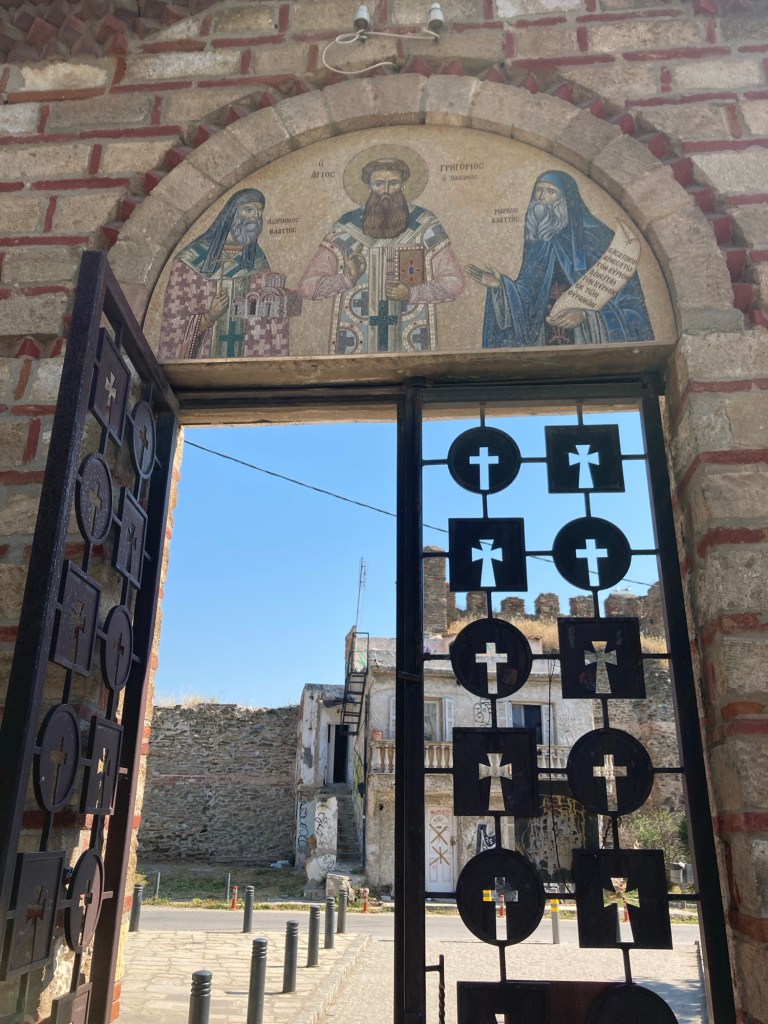
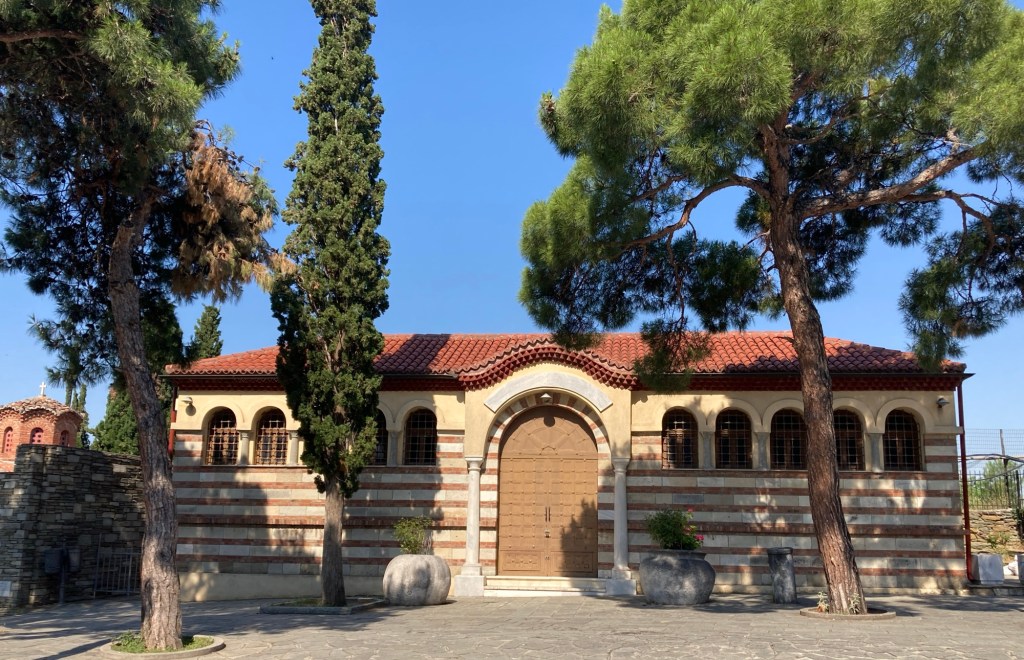
Maria and I visited the place where tradition has it that he preached, on which site Vlatadon Monastery was founded in the 14th century. Of all the monasteries in the city, is the only one still active, though there are many newer ones in surrounding more rural areas.

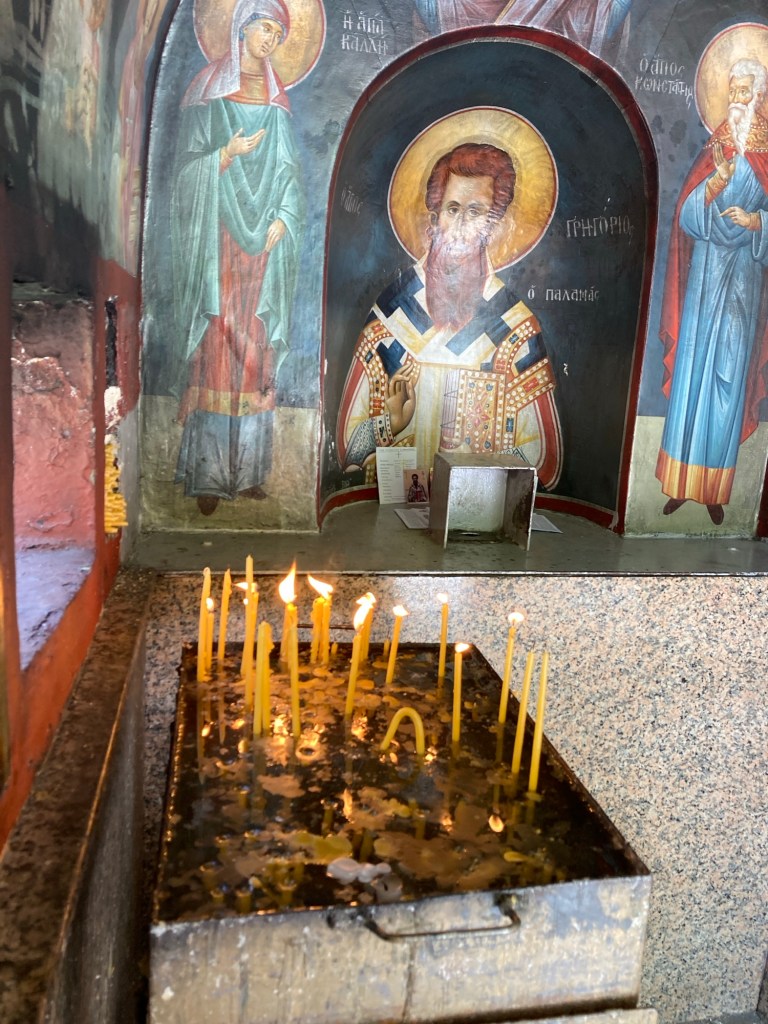
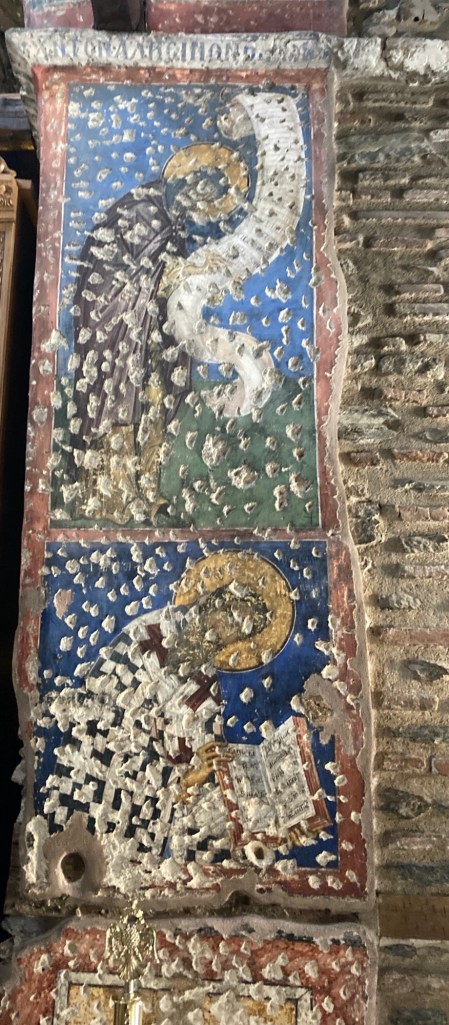
When Thessaloniki fell to the Ottomans in 1430, and the majority of churches were turned into mosques, the wall frescoes were punctured to facilitate plastering over them.

After we toured the monastery church and shady, peaceful gardens, Maria suggested we sit on a bench and read from one of St. Paul’s letters. It was not one he’d written to the Thessalonians, but the famous Love Chapter, I Corinthians 13:

Ormylia and Souroti

The relics of Elder Aimilianos of Simonopetra are kept at the Holy Monastery of the Annunciation in Ormylia, and the grave of Saint Paisios of Mount Athos is in Souroti, at the Holy Monastery of St. John the Theologian.

Today my friend and sister in Christ who is also a tour guide drove us to both of these holy sites, where I received great blessings that I don’t feel capable of a expressing in a worthy way.

I’d been looking forward to this visit for nearly a year, and praying that God would make it happen, that He would prevent all the things that could go wrong and change my plans. And He did.

For now I’m only going to post a few photos from the monasteries; if ever you are interested when I get a chance to talk to you in person, I will try to tell you specifics about things that happened, people I talked to, and what I learned. Until then, I mostly wanted you to know that I made my pilgrimage there, glory to God.

What springs from unity.

St. Gregory Nazianzus (or Nazianzen), also known as St. Gregory the Theologian, is one of the Three Holy Hierarchs of the Orthodox Church, along with St. Basil the Great and St. John Chrysostom; and one of The Cappadocian Fathers, along with St. Gregory of Nyssa and St. Basil the Great (of Caesarea). He has been called The Trinitarian Theologian, and you can read a snippet of such theology below. I was intrigued by his also being called The Minstrel of the Holy Trinity, evidently because of his poetic style, and spiritual poetry. I will be looking more into that.

“The opinions about deity that hold pride of place are in number: atheism, polytheism and monotheism. With the first two the children of Greece amused themselves. Let the game go on! Atheism with its lack of a governing principle involves disorder. Polytheism with a plurality of such principles, involves faction and hence the absence of a governing principle, and this involves disorder again. Both lead to an identical result — lack of order, which, in turn, leads to disintegration.

“Monotheism, with its single governing principle, is what we value — not monotheism defined as the sovereignty of a single person (after all, self-discordant unity can become a plurality) but the single rule produced by equality of nature, harmony of will, identity of action and the convergence towards their source of what springs from unity — none of which is possible in the case of created nature.

“The result is that though there is numerical distinction, there is no division, there is no division of the substance. For this reason, a one eternally changes into a two and stops at three — meaning the Father, the Son and the Holy Spirit. In a serene, non-temporal, incorporeal way the Father is parent of the ‘offspring’.”

―St. Gregory of Nazianzus, d. 390, The Five Theological Orations

I’ve been plugging away at reading The Mystical Theology of the Eastern Church, in which Vladimir Lossky gives a history of Christian understanding of God as He has revealed Himself, in which story St. Gregory’s doctrine plays a major role. It’s a stretch for my untrained mind to follow the thoughts of these venerable fathers of antiquity, who who were not only extraordinary scholars, but holy men: St. Gregory often emphasizes that even to begin to think well about God it is most necessary to have a repentant heart. So I will close with his exhortation to those who might think more highly of their theologizing than they ought (from Oration 20), which I find heartening right now:

“If you trust me, then — and I am no rash theologian! — grasp what you can, and pray to grasp the rest. Love what already abides within you, and let the rest await you in the treasury above. Approach it by the way you live: what is pure can only be acquired through purification… Keep the commandments, make your way forward through observing the precepts: for the practical life is the launching-pad for contemplation. Start with the body, but find joy in working for your soul.

“… the most perfect of all things that exist is the knowledge of God. Let us, then, hold on to what we have and acquire what we can, as long as we live on earth; and let us store our treasure there in heaven, so that we may possess this reward of our labor: the full illumination of the holy Trinity—what it is, its qualities and its greatness, if I may put it this way—shining in Christ himself, our Lord, to whom be glory and power for the ages of ages. Amen.”

St. Gregory Dialogus

In the Eastern Orthodox Church, Gregory the Great (590-604) is usually called Saint Gregory Dialogus, Pope of Rome. The Liturgy of the Presanctified Gifts, which he compiled, is a service that we use on weekdays during Lent. You can read about his other writings and inspiring life, including several quotes from the saint, on this site. Here is one of the quotes, fitting for Lent:

“Every day you provide your bodies with good to keep them from failing. In the same way your good works should be the daily nourishment of your hearts. Your bodies are fed with food and your spirits with good works. You aren’t to deny your soul, which is going to live forever, what you grant to your body, which is going to die.”

I only recently began to learn about St. Gregory, after reading this poem by him:

DIVINE CREATOR OF THE LIGHT

Divine creator of the light,
Who, bringing forth the golden ray,
Didst join the morning with the night
And call the blessed union day;

We bow to thee, whose mighty word
Made time begin and heaven move;
Hear thou our tearful prayer, O Lord,

And warm us with the light of love.

Lord, let no crime our souls oppress,
Or keep us from thy law divine;
Oh guard us by thy saving grace

And make our wills accord with thine.

Still may we seek thy heavenly seat,
And strive eternal life to gain;
Oh, keep us in thy mercy sweet,

And cleanse our souls from earthly stain.

-Gregory the Great (c. 540 – 604) Italy

       Translated by Daniel Joseph Donahoe