Good night! good night! — the golden day Has veiled its sunset beam, And twilight’s star its beauteous ray Has mirrored in the stream; — Low voices come from vale and height, And murmur soft, good night! good night!
Good night! — the bee with folded wings Sleeps sweet in honeyed flowers, And far away the night-bird sings In dreamy forest bowers, And slowly fades the western light In deepening shade, — good night! good night!
Good night! good night! — in whispers low The ling’ring zephyr sighs. And softly, in its dreamy flow. The murm’ring brook replies; And, where yon casement still is bright, A softer voice has breathed good-night!
Good night! — as steals the cooling dew Where the young violet lies. E’en so may slumber steal anew To weary human eyes. And softly steep the aching sight In dewy rest — good night! good night!
Dried up old cactus yellowing in several limbs sitting on my kitchen window I’d given you up for dead but you’ve done it again overnight with a tasselled trumpet flower and a monstrous blare of red! So it’s June, June again, hot sun birdsong and dry air; we remember the desert and the cities where grass is rare. Here by the willow-green river we lie awake in the terrace because it’s June, June again; nobody wants to sleep when we can rise through the beech trees unknown and unpoliced unprotected veterans abandoning our chores to sail out this month in nightgowns as red and bold as yours; because it’s June, June again. Morning will bring birdsong but we’ve learnt on our bodies how each Summer day is won from soil, the old clay soil and that long, cold kingdom.
When you are already here you appear to be only a name that tells of you whether you are present or not
and for now it seems as though you are still summer still the high familiar endless summer yet with a glint of bronze in the chill mornings and the late yellow petals of the mullein fluttering on the stalks that lean over their broken shadows across the cracked ground
but they all know that you have come the seed heads of the sage the whispering birds with nowhere to hide you to keep you for later
you who fly with them
you who are neither before nor after you who arrive with blue plums that have fallen through the night
I took my root beer popsicle outside — the way we often require children to do — and wandered around the garden. On the earth and becoming part of it I spied three plums that must have fallen sometime since the day I thought I had picked the last of them. That makes — ta da!! — a total of 52 plums this summer, way, way more than ever before. It may have something to do with the copper dormant spray I applied last winter. The foliage has been looking healthy ever since it leafed out.
With a popsicle in hand, I couldn’t very well gather up armfuls of pine needles or do much of anything about the overgrown mess the garden has become, so I sat in a chair facing my little carved stone icon of Mary, and my quite large fig tree. A week ago an afternoon windstorm blew down bushels of crisp, russet brown pine and redwood needles all over the garden, even into the little shelf in front of the Theotokos. The lavender I had put there was long ago dried up.
On this side of the garden the invasion of dead plant matter is from the neighbor’s redwood tree; the twigs get caught on everything on their way down and continue hanging on the guava, the salvia, the fig… Below you can see the swellings of baby pineapple guava fruits:
Drying up jumble that it is, to me it is a lovable mess. In the past I would feel overwhelmed with the task of keeping up with it all, but lately I have accepted the reality that it’s too much for me to manage even well, much less perfectly. And anyway, a garden that always looks perfectly orderly is probably not the best kind of pollinator garden, and here where we get no summer rain many things are going to look a bit dried up at this time of year. But the bees don’t notice; they are still after that African Blue Basil that never stops putting out new flowers. I haven’t used it for cooking, though, because it’s too medicinal tasting.
Bee on lambs’ ears.
I’m focusing less on management and more on friendliness with my plants, and appreciation for their unique cultures and seasonal changes. They keep growing even if I don’t do all the tasks at the right time. Week by week it’s always a little sad to clean up “the mess” — such as the acanthus blooms that have turned from fresh green-and-white to tan, and then brown. Here and there a milkweed stem leans over so far it is lying on the ground, and the tall Indigo spires salvia likewise, but many more of them.
I worked hard in the last few weeks to clean up, though. Three weeks in a row I needed to use space in my neighbors’ bins; two of those weeks I completely filled three 96-gallon yard waste containers and wheeled them to the street. I had removed all the superabundant asparagus and several shrubs, thinned out many patches of lambs’ ears, the fig tree, the juniper…. on and on.
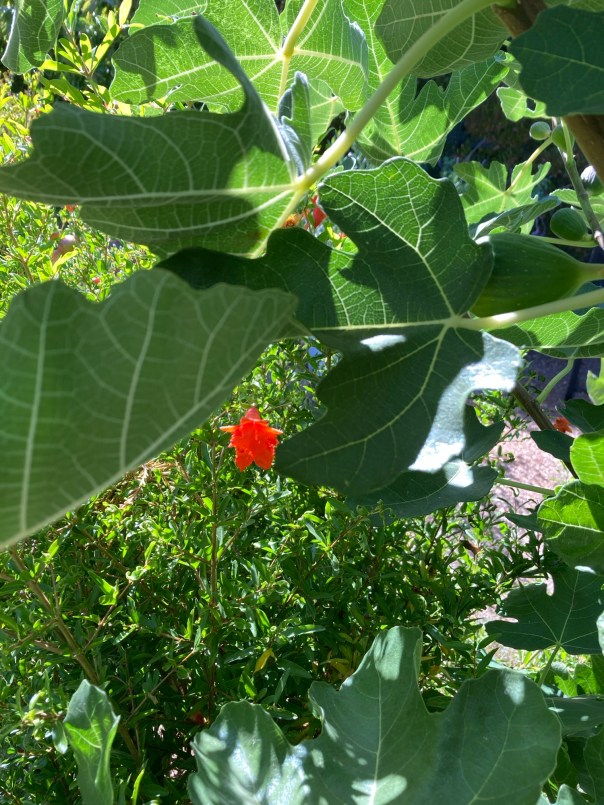
I finished my popsicle and my rest, and as I was headed back to the house, something glowing red in the sunlight caught my eye, among the leaves of the fig tree…. and when I looked in there, surprise ! it was a dead ripe fig (actually black) — I picked it and two more that were hiding in the shade inside. Now begins the bountiful fig season; I knew it would be a good year for them, because of our several heat waves, in contrast to last summer being a cool one and me getting zero figs. I better get my dehydrator ready.


 I took my root beer popsicle outside — the way we often require children to do — and wandered around the garden. On the earth and becoming part of it I spied three plums that must have fallen sometime since the day I thought I had picked the last of them. That makes — ta da!! — a total of 52 plums this summer, way, way more than ever before. It may have something to do with the copper dormant spray I applied last winter. The foliage has been looking healthy ever since it leafed out.

 Gladsome Lights