Category Archives: technology

A brief pause for this…

You know how it is when the power goes out, and you can’t do anything that requires the computer or TV? You might read a book by candlelight, or play cards with people, or pray… and the temporary result is often more calm, and more quietness of heart. The benefits of deprivation are real.

Orthodox Lent begins Monday, and the Great Fast is a chance to acquire what our hearts need. This year, in addition to our traditional food fast, I plan to “fast” from blog writing and reading. I will still be using email, and if any of you would like to chat about anything or just say hello, I would love to hear from you. You can find my address on my About Page; it is one of the tabs above.

And I have drafted quite a few posts in advance, mostly gleanings from others, scheduled to automatically publish on certain dates. They are articles or re-posts that seem particularly Lenten; I will put them out there without a comment option. Again, comments are possible through direct email.

Until I see you again here, may God bring us all, in every way possible, deeper into His love.

Ho! Everyone who thirsts, Come to the waters;
And you who have no money, Come, buy and eat.
Yes, come, buy wine and milk
Without money and without price.
Why do you spend money for what is not bread,
And your wages for what does not satisfy?
Listen carefully to Me, and eat what is good,
And let your soul delight itself in fatness.

-Isaiah 55:1-2

Hope is not a program for reform.

What is the difference between optimism and hope? One difference is that the word “optimism” is not in the Bible, and the word “hope” is. They are two distinct words and at least one of them is worth contemplating. I like to quote Fr. Alexander Schmemann on this topic:

“If there are two heretical words in the Christian vocabulary, they would be ‘optimism’ and ‘pessimism.’ These two things are utterly anti-biblical and anti-Christian…. Our faith is not based on anything except on these two fundamental revelations: God so loved the world, and: The fallen world has been secretly, mysteriously redeemed.”

Hope is one of the three foundational virtues of the Christian life, as this article, “Hope,” explains. Its description of the absence of hope tells us:

“The opposite of hope is despondency and despair. According to the spiritual tradition of the Church, the state of despondency and despair is the most grievous and horrible condition that a person can be in. It is the worst and most harmful of the sinful states possible for the soul.”

That’s why the title of an article in the current issue of The New Atlantis got my attention: “How Tech Despair Can Set You Free” by Samuel Matlack.

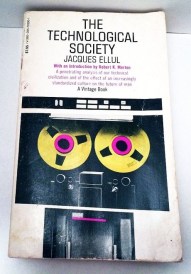
The author of this article discusses the philosophy of Jacques Ellul, and quotes him as saying, in Hope in Time of Abandonment, “You cannot talk about hope. The question is how to live it.”

Jacques Ellul, 1912-1994

Matlack comments, “The reason you cannot talk about hope — or rather, cannot describe the action it takes — is this: Hope is not a program for reform, a solution to implement, or a prescription to follow. To borrow from the farmer and writer Wendell Berry, hope means ‘work for the present,’ whereas optimism means ‘making up a version of the future.'”

“What we do know is that Ellul’s own life bears ample testimony to hope. Here is one episode of many. Having lost his university position during the Nazi occupation of France, Ellul and his wife Yvette settled on a farm in a small village near the demarcation line, opening their door to Resistance fighters and Russians escaping German prison camps. With the help of neighbors — since Ellul knew nothing about farming — he grew potatoes and corn, with his wife raising chickens. As he once told the story, “I spent most of my time helping people get across into the free French zone. I was in cahoots with an organization that dealt in forged papers. So I was able to provide a whole series of people with forged identity cards.’”

About their own aims the editors of the journal from which I quote write: “Dystopian dread is the shadow of utopian dreams. The hope of The New Atlantis is to help steer away from both — and instead toward a culture in which science and technology work for, not on, human beings.”

In another article on this general subject, of how to live in a technological age, Alan Jacobs wrote in last winter’s issue; he also mentions Jacques Ellul as one of the early critics of the technological society in “From Tech Critique to Ways of Living.” It is accessible to read right now. And Samuel Matlack has written previously about Ellul, in 2014: “Confronting the Technological Society.”

There he writes, after Ellul: “What is needed is a true revolution, which Christianity by its essence is uniquely equipped to effect — being in the world but not of it, living the hope of a kingdom already here but not yet.”

True revolution is not a change in the political order, but has to be something far beyond that realm, and deeper; may the Lord show us the basis for our true Hope, and teach us how to live it.

Our soul waits for the Lord; He is our help and shield.
Yea, our hearts are glad in Him, because we trust in His holy name.
Let Thy steadfast love, O Lord, be upon us, even as we hope in Thee.

-Psalm 33

Nagging that cuts the soul in pieces.

From the book New Media Epidemic:

Jean-Claude Larchet

Spiritual life…requires what is traditionally called recollection, the capacity to turn all one’s faculties inward, away from the world, there in one’s heart to unite and consecrate them to God in meditation and prayer. Recollection is the stage of preparation for prayer that precedes concentration. 

But as we have seen, the new media [cell phones, tablets, internet, etc] push man’s faculties in the opposite sense, always outwards toward the world. They are dispersed by a stream of discordant nagging that cuts the soul in pieces, and destroys the unity and identity of the inner man.

The new media encourage strongly two elements of ancestral sin:

(1) the loss of the inner unity of the faculties, which once were united in knowledge of God and doing His Will, dispersing them among physical objects and their representations (thoughts, memories, and images), or the desires and passions that they arouse;

(2) the resulting division, chopping up, and inner dispersion, which, according to St Maximus the Confessor, “breaks human nature into a thousand fragments.”

As other holy ascetics have said, the intelligence [attention/nous] is then constantly distracted, floating, erring, and wandering here and there in a state of permanent agitation, quite the opposite of the deep peace it experienced in its former contemplation. The thoughts that once were united and concentrated become manifold and multifarious, spreading out in a ceaseless flow. They divide and disperse, leaking out in every direction, dragging and dividing the whole being of man in their wake.

This leads St Maximus the Confessor to speak of: “the scattering of the soul amongst outer forms according to the appearance of sensory things,” for the soul becomes multiple in the image of this sensory multiplicity…which is simply an illusion… Stirred up and excited by a multitude of passions, they pull in many directions, often opposed, at once, and make of man a being divided at every level. This process of the fall of man, described by the Church Fathers of Late Antiquity, continues today faster than ever, driven on by the new media. They offer such a rich and speedy flow of temptations that they multiply the sensory objects that attract the senses…

—Jean-Claude Larchet

(from a church bulletin)

A dog without a tail.

gl-robot-at-computerI still get a few spam comments on my blog, but they are usually pretty boring these days. In the past I began a collection of the interesting ones, including the purely delightful combinations of words that always made me wonder if chaos theory applies here, or was it just very poetic and sweet non-native robot speakers of English ? with their charming and childlike misspellings…

First, I enjoy the often-thankful comments from those who are philosophical like me:

**Thanks for this post. I undoubtedly agree with what you might be saying. I have been talking about this topic a good deal lately with my mother so hopefully this will get him to see my point of view. Fingers crossed!

**My wife and I have been very blessed in our lives. We have also lived troguhh very tight times ( I. E., blood donations.)

**Appreciate your mistakes for what they are: prceoius life lessons that can only be learned the hard way. Unless it’s a fatal mistake, which, at least, others can learn from.

And there are the practical and encouraging tips and admonitions:

**When you have replied after 7 years, how do you except the reply immediately. Be Patient. Just wait for 7 more years to receive the reply. I use it every day.

**Paragraph writing is also a fun, if you be acquainted with after that you can write if not it is complicated to write.

**Open cupboard doors if your drain pipe is frozen or slice into
your surfaces or ceilings allowing the heat from your home to get to the pipes.

**so-called light cooked dress is not necessarily going to formal, just a feeling, albeit obscure, unlikely uncertain. Do not follow the rules but the atmosphere of printing , is hit the color of a new pattern of it, A glyph When did you start to become so confident? Perhaps it is because of your confidence.gl-spot-looking-in

**If you are the kind of person who feels it’s important how a body of a loved one is disposed of, then I would recommend cemiatron most because it’s difficult to bury a body deep enough to protect it from scavengers. And if you had your cat euthanized, the scavengers could get sick from leftover euthanasia solution.

**I needed to csmoope you one very small remark

Lastly — and I need to get these out of the way so they don’t drag me down (actually I think the fathers say that down is up…?) with pride during Lent — are the compliments, which may be just flattery, I know 😦 A couple of these I’m not entirely certain which category they go in, but since this kind of feedback is rare anymore, I’ll count them as pats on the back:

**Ab fab my gooldy man.

**You have touched some fastidious points here.

**I am writing to let you be aware of what a beicfneial encounter my friend’s child encountered using your webblog. She even learned too many things

**Your individual stuffs outstanding. At all times care for it up!

**Right away I am ready togl-breakfast-at-computer-mine do my breakfast, later than having my breakfast coming over again to read more news.

**nice paragraph and pleasant urging

**You do such a good job for a dog without a tail.

🙂